What has become of the sea in Hong Kong? With a coastline of 1,189 km, it ought to be everywhere, yet it seems to be hiding.
At the Maritime Museum, it serves as the backdrop to the entire history of the territory. In historical paintings, we see it carrying warships, pirates, then merchant vessels. Usually, it appears as a means, a resource; rarely as a subject in its own right.
Modern artists scarcely represented it – or, when they did, it was mere scenery. In Ap Lei Chau (1961) by Lui Shou-kwan, for instance, the island and the boats moored in the bay are rendered in ink, while the sea itself is utterly transparent, homogeneous and white – a void into which the boats might fall; a negative space.
We find it again, subdued, in Wu Guanzhong’s Victoria Harbour (2002), barely sketched with a few fine lines and bluish strokes. In contrast, over the past decade, artists have been increasingly representing the sea, exploring its ambivalent and complex features. How do these artworks participate in our collective understanding of the sea, and which image of the Hong Kong marine environment do they return to us?
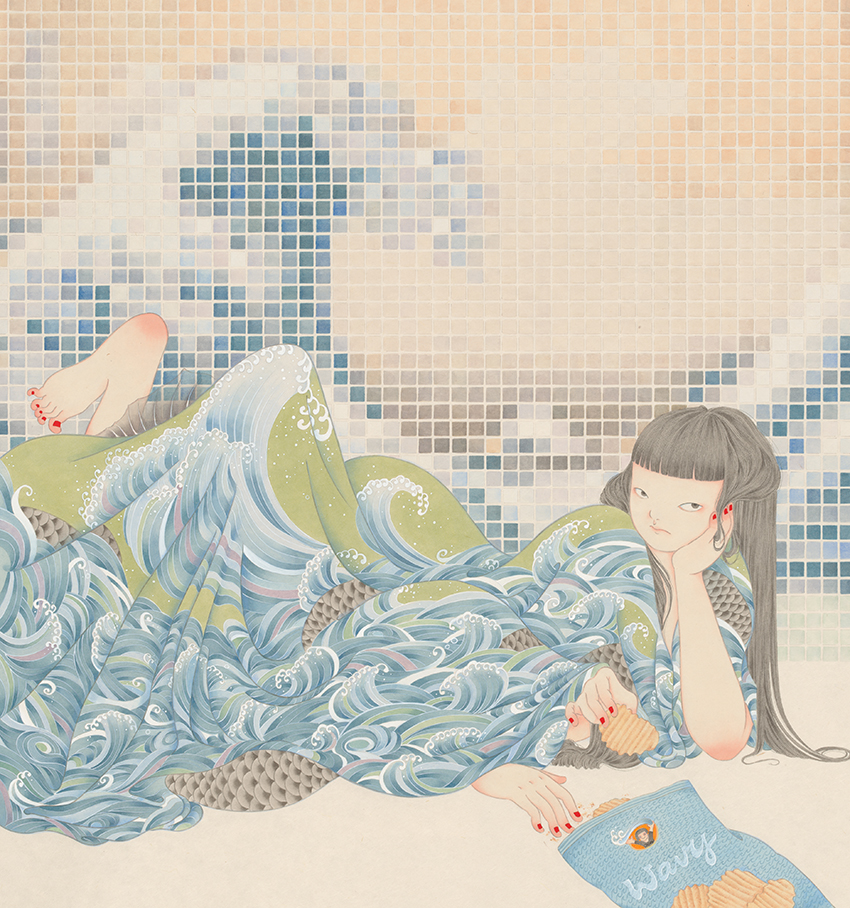
Since the city was colonised, the sea has ceaselessly receded. Aside from a few cases during the Han dynasty (206 BC-220 AD), the first land-reclamation works date from the middle of the 19th century and they have never stopped. Victoria Harbour, in particular, has continuously been altered, to the point that people have wondered whether, one day, people might cross on foot between Hong Kong Island and Kowloon. In Victoria (2022), Joey Leung imagines the sea as a young girl on a diet, whose body is wedged in by the buildings around her. Despite the girdle that constricts her on all sides, her flesh bulges out and her chubby little fingers protrude. With a lollipop in her mouth, she seems to defy the viewer. Yet, for all her pouting, the belt only tightens further.
In Hong Kong, the sea is everywhere yet it is concealed. Ferries close their open decks, the MTR and tunnels replace crossings, and bridges span the islands, connecting territories. For a long time now, porters haven’t been seen moving goods on large boats in the harbour, replaced by huge container ships and cranes that can be seen from afar. The coastlines have been reclaimed, encased in concrete, made artificial, flanked by highways and guardrails. Only occasionally does a sliver of blue appear between buildings.

Courtesy of the artist.
In Shum Kwan-yi’s works, the sea is literally boxed in. Her series The Cabinet of Landscape (2025) depicts it as fragmented, cut up and stored on shelves. Nothing overflows. Everything is compartmentalised, enclosed. Fishing boats on one side, containers on the other; rocks, mountains. All is clean and orderly.
With land reclamation, the entire shoreline has been radically transformed. In the 1980s, for example, the new town of Tseung Kwan O emerged in the east, built entirely on reclaimed land. For The Last Coast (2017), Yuk Mui Law had the coastline engraved into metal. The accompanying video shows the metalworker doing this, shards flying, the violence of the incision and the ridges that appear. The resulting sculpture stands upright, traversed by a long, thin scar running vertically along the metal – a mark of the last stretch of natural coastline that escaped the straight lines of property developers’ blueprints.
Everywhere, concrete replaces rocks or natural beaches. In their place, the grey wave-breakers known as dolosses accumulate. According to marine biologist PJB Scott, the name “dolos” refers to bones used by African sorcerers.
Whether or not this is magic, these tripods loom gigantic in Stephen Wong Chun Hei’s The Lonely Man at Po Pin Chau (2022), where they dominate the foreground, blocking the marine landscape. They stand as tall as the volcanic rocks that often compose Hong Kong’s islands, visible in the background. A lone man sits on one of the dolosses, dwarfed by these artificial constructions. Was he going there to see the sea? The sea is far away, seemingly inaccessible. It contents itself with forming a small patch of white foam at the base of the geological formations. Often, in Wong’s work, the sea is smooth and serene. It spreads in brilliant, luminous blues and shimmers day and night. It is a sea that invites meditation, self-reflection.
Wong, like many artists, does not seek to represent reality. After his hikes, he returns to his studio with sketches, but the sea he depicts is an imaginary space. It is often flat. The rare times it stirs, it borrows its motifs from others. The waves in Drive to the Cliff (2020), for example, are those found in Japanese prints – juxtapositions of hair curls dotted with foam.
Shum Kwan-yi and Chan Kwan Lok also draw inspiration from these in their compositions, and MAP Office explored this repertoire in their video Book of Waves (2018), based on Kyoto artist Mori Yuzan’s inventory. As in Hokusai’s famous works, these well-coiffed lines sometimes explode at their ends, giving rise to strange, somewhat menacing white patterns that symbolise waves.
Thus, it is not the sea that one sees; it is an idea of the sea. It is not a living sea; it is not water in which one swims. Learning to swim is not compulsory in schools and many Hongkongers still cannot do so.

Before municipal swimming pools opened across the territory, the government set up bamboo structures along the coasts so that people could bathe. Yet, as Ng Tsz-kwan notes, few used them for swimming; they were more often places for conversation or mahjong. The artist researched these structures to reconstruct one in North Point, as the temporary installation Re-Imagining Collective Swimming (2021). However, and much to his regret, climbing onto the work to swim was forbidden. Once again, the sea was kept at a distance, reduced to representation.
When invited by the Museum of Modern Art to reimagine Victoria Harbour as part of the Harbour Wonder project, Chan Wai Lap installed a vast empty pool on the promenade. Some of Us Are Looking at the Stars (2023) opened on one side like a box, allowing visitors to walk to the bottom and recline safely on a deckchair. With its familiar motifs, the work evoked a perfect image of water under control – the pool as a shelter, just like one of the compartments in Shum’s compositions.
One must protect oneself from the sea. Shum’s Cave (2023-2025) series places us safely inside grottoes, where we find the comfort of order. Inside, lines of trees, rocks or boats. Outside, the storm rages: through the opening, we see waves crashing, foam frothing in vast, implausible movements. The sea as a fury: no question of venturing into it.
Wong’s The Night We (Can’t) Talk (2020) suggests that while one may control the sea, one cannot contain emotions. The painting depicts a couple on a bridge parapet. Below them, water rushes forcefully through pipes, as in many reservoirs the British built across the territory. The noise must be deafening, making conversation impossible. Are they overwhelmed by their emotions with the same violence as that which drives the channelling of masses of water? In the struggle between sea and humans, who will prevail?

Series of five photographs. Courtesy of the artist.
This is one of the questions Joseph Leung raises in Who Shut Up the Sea Behind Doors When It Burst Forth from the Womb (2015), a series of five photographs taken from the rear of the Cheung Chau ferry. Tightly framed, the images capture the sea as it erupts to the surface. Each image offers itself as a new frame, an attempt to enclose it. As in Shum’s work, the force of the sea seems broken by this fragmentation. In the title, Leung refers to a passage from the Bible, Job 38:8, which also recalls the great works of Yu the Great, famed for having mastered the flood in ancient China by draining waters towards the sea. Are only gods and heroes capable of harnessing the sea’s power?
Despite repeated human efforts, the sea refuses to be contained. It overflows, submerges, infiltrates. In Chan Kwan Lok’s Oasis in the Wasteland (2025), a wave surges over a pool wall at night, erupting above the basin. Here, the water’s lines rear up like serpents or long arms, reaching further inland. At the pool’s bottom, seawater accumulates, rocks emerge and it seems as though nature is reclaiming this artificial space. Only a life buoy remains, like a reminder of human attempts at domestication.
Flooding is inherent to the Hong Kong landscape, as a large part of its territory is covered by the sea. The shape of some coastal areas such as Tolo Harbour and Sai Kung is the result of the flooding of former river valleys. With much of its land low-lying, Hong Kong has suffered significant damage and numerous fatalities due to flooding throughout its history.

42.5 cm (dia.), 2022. Courtesy the artisti. Photo: South Ho.
In Bouie Choi’s work, the sea seeps everywhere: the watercolour blue spreads, erodes, carries all before it. Water is always a dynamic component of her compositions, carrying its own language and mixing materials, emotions, space and time. For Choi, who studied geography, the sea is the salty element that erodes everything, slowly. In Crossing the nights (2022), for example, the entire territory takes on water and the land seems on the verge of being submerged. In The surf watcher (2020), octopus tentacles join with waves to claim the space. Is the sea rising or are the mountains collapsing? In My Sedimentary Rock (2022), geological formations and buildings clinging to the rock face tilt precariously, as if Hong Kong were sinking into the sea. The water appears calm but its deep blue is deceptive. Beneath the surface, rocks loom – perhaps having already been submerged. A disproportionately large boat escapes. Above, clouds swirl.

Courtesy of the artist.
The sea remains a mystery. In There is Something in the Sea (2023) by Tsang Chui Mei, it’s unclear what that something is. Almost abstract, it presents an expanse of dark water, seemingly inhabited by luminous forms – perhaps bioluminescent creatures, perhaps something else. The canvas is built from layer upon layer of pigment, which the artist then scrapes with sandpaper, creating fissures that evoke scars or the traces of unseen organisms.
For Tsang, the sea is always a metaphor, a mirror of the soul. It represents a descent into the abyss, into the unknown, towards an alternate temporality. Like Wong, she does not depict nature but an inner landscape. Her rendering of rock forms, for instance, draws not from actual geology but from the artificial props used in aquarium tanks. Might this be a means of reappropriating an oceanic environment that remains fundamentally elusive?
Some artists, such as Ma Chi Hang, explore the vanishing traditions of the sea people but very few dare to venture into Hong Kong’s often murky and polluted waters. Yuk Mui Law, who grew up on reclaimed land in Tseung Kwan O, sought to investigate what lies beneath. In her video Victoria East (2017), she asks what remains of the sea that once was, where the new town now stands. From a boat, she lowered a camera a few metres below the surface and filmed. As viewers, we follow the camera’s descent, quickly caught in the sway of the waves, moved by the swell. Sound becomes muffled, as if penetrating a living organism. Yet, apart from the movement, there is little to see – an empty space? One senses clearly that it is not. Can the sea truly vanish? Can it be erased?
The sea does not disappear. As Saint Lucian poet Derek Walcott reminds us, “the sea is history”. Like an archive, it holds all the past, stories from here and elsewhere, continuously churned since ancient times. Water has a memory. This theory, advanced by French scientist Jacques Benveniste, inspired Leung Chi Wo’s installation Water Memory (2022), displayed within the MTR Exhibition Centre Station, itself built on reclaimed land. The artist juxtaposes 1,200 long, horizontal photographs of the sea, taken in front of the station. Together, they form a composite portrait of the sea in all its diversity – from calm waters bathed in morning light to greenish hues and grey waves at dusk. Here, the sea unfolds in all its complexity and richness. It is ironic that one must descend underground, into the MTR, to confront it. Though it’s fragmented – represented by a series of photographs placed end to end – the viewer perceives the infinite variations in its colour and texture. The sea embodies a collective, retrievable memory, offering not just an archive but a metaphysical connection to different lands and times.

Courtesy of the artist.
In Hong Kong, this liquid memory is heavy with significance. The experiences of migrants who swam to the territory remain vivid. Siu Wai Hang’s father was among them, crossing in the 1970s to Ha Pak Lai on the west coast of the New Territories, opposite Shekou in Shenzhen. For Inside Outland (2015), the artist returned to these crossing points and photographed the sea at night. Standing on the Hong Kong side, the perspective is reversed: the lights on the horizon are those of contemporary China. Back then, Shenzhen was still a dark expanse. Depending on the currents, the journey could take five hours – for those who survived. Many were captured or killed, some eaten by sharks. In the photographs, the sea is as dark as thick oil, and it’s unclear what it hides.
In the video East Island (2021), Tang Kwong San and Yuen Nga Chi revisited the issue of illegal migration, this time focusing on Tung Ping Chau. The film’s images are presented with inverted light and added colour, lending it an eerie, surreal quality. This editing underscores the tension between these tragic histories and the island’s present-day tourism. What washes ashore now is not bodies but rubbish. The sea, however, remains a negative space – a vast, dark, opaque body of water, utterly unfathomable.
香港的海都變成怎樣了?蜿蜒1,189公里的海岸線,海洋理應隨處可見,但卻如隱了身一樣。
來到香港海事博物館,大海襯托著香江史跡,戰艦、海盜和商船在古畫汪洋中航行。海洋是畫中的交通載體、運輸資源,但卻鮮有擔當作品主角。
現代藝術家極少以海洋為題,或者說,海通常僅以風景現身。呂壽琨的《鴨脷洲》(1961年)正是一例,他以水墨渲染出海灣上的小島和船隻,但海則完全透明、一律白色——是船隻可能掉進的空洞,是負空間。
吳冠中的《維港寫生》(2002年)再次展現海洋的低調身影,由幾條細線與淡藍筆觸帶過。相反,過去10年,不少藝術家更著重以海洋為主題,探索其矛盾而複雜的特性。這些作品如何營造海洋的集體了解,又怎樣呈現香港海洋環境的畫面?
自殖民時代開始,香港的海面面積便不斷縮小。除了漢代(公元前206至公元220年)的幾次事件,首次填海工程於19世紀展開後便從未停過。尤其,維多利亞港一直在變,人們甚至懷疑日後港島與九龍之間會否變成徒步可達。梁嘉賢在《維多利亞》系列(2022年)中,將海洋構想為正在節食的胖女孩,身體被四周大廈擠壓,肥肉因為穿著束衣而被擠出身軀,圓潤的手指也凸了出來,她口裡吃著波板糖,好像與觀者對抗。然而,她越是嘟咀,腰間帶子越是拉緊。
雖然香港四面環海,但海景卻往往被隱藏起來。渡海小輪把開蓬甲板封起;街渡被港鐵和海底隧道取代,大小島嶼和跨境通道也架起了大橋。港口運輸商已有很長一段時間,沒有再於海港中以大船運送貨物,取而代之的,是遙遙可見的巨型貨櫃船和起重機。海岸線處處填海而來,混凝土包圍下變得人工化,而且盡是高速公路和圍欄;偶爾才會在樓宇之間的狹縫看到一線藍海。
沈君怡《藏景櫃》(2025年)系列中的海洋就像命題一樣,被分割成小段後整整齊齊地放進櫃格,水藏於櫃格中自然不會外溢。櫃子的一邊是漁船、另一邊是貨櫃船;還有岩石和山巒,全部井然有序。
填海顛覆了海岸線的面貌。例如在1980年代,香港東面的將軍澳便是建於填海土地的新市鎮。羅玉梅在《最後的海岸》(2017年)中,把海岸線刻在鋼板上,同場播放著工匠製作作品的影片,裡面有飛揚的碎屑、䥴刻的暴力,還有其後出現的山脊,最終塑造出直立的雕塑,中間是一道細長的垂直疤痕,暗喻逃過物業發展商藍圖而倖存的最後一段天然海岸線。
海旁的天然岩石或海灘一一被混凝土取代,包括工字型消坡塊組成的防波堤。這種大型混凝土塊的英文名字是dolos,根據海洋生物學家 PJB Scott所述,該字所指的正是非洲巫師所使用的骨頭。
不論這些工字石有沒有魔法,在黃進曦2022年有關破邊洲的作品《The Lonely Man at Po Pin Chau》中,它們在前景擋住了海洋的面貌。消波塊的高度不亞於背景中構成本港島嶼的大型火山岩。孤獨的人坐在其中一件人工製造的消波塊上,顯得特別渺小。他是否為了看海而來?海遙遠得似乎無法前往,但它很滿足,在地質形成的底部吐出一小片白色泡沫。很多時候,黃氏筆下的海都是風平浪靜,在明亮的藍色中延伸,不論日夜都閃閃發光。這片海洋邀請觀眾冥想和反思。
黃氏與很多其他藝術家一樣,所追尋的並不是表達真實。他在行山後會把素描帶回工作室,但所描繪的海卻是虛構空間,一般以平靜為主,當要起浪時,海洋會向他人借用圖案。以2020年的《Drive to the Cliff》為例,就是日本板畫中可以看到的_——以點狀浪花點綴一排排的捲髮圖案。
沈君怡和陳鈞樂同樣在構圖中向海浪取材,而MAP Office則以京都藝術家森雄山的作品為基礎,在其影片《Book of Waves》(2018年)中探索了上述題材。正如北齋筆下的著名作品一樣,這些精心刻劃的線條有時會在收筆處爆開,營造出怪異但又略顯脅的白色波浪圖案。
因此,畫中呈現的海洋並非人們眼中所見,而是對海的意念。此非有生命力的海洋、不是可以讓人暢泳的水域。不是學校的強制課程,不少香港人至今仍不諳泳術。
香港開設公立游泳池之前,政府曾於在海岸線設置竹棚供民眾游泳。然而,正如吳子昆指出,很少有人會到竹棚游泳,反而更多人到這裡聊天或打麻將。吳子昆研究這些竹棚,並於北角重建出類似結構,創作了臨時裝置《再想像.北角泳棚》(2021年)。然而,公眾被禁止攀進作品中游泳,此舉令他感到遺憾。海洋又一次只可遠觀,僅餘象徵作用。
香港藝術館在策展「游・遊」時,邀請了陳惠立重新構想維多利亞港,他於是在海濱長廊設置了大型的空泳池。《路過蜻蜓》(2023年)的一側像盒子一樣打開,歡迎參觀者由此路進,安全地躺在池底的躺椅。作品以為人熟悉的主題完美營造出水在掌控之下的意象,泳池就像沈君怡作品中的櫃格一樣,比喻遮風擋雨。
人面對大海必須保護自己。沈君怡的《洞穴》系列(2023至2025年)把我們帶進安全的洞穴,感受秩序的慰藉。洞穴裡面一排排樹木、岩石或船泊。風暴在外面肆虐:參觀者可以從洞口遠眺海面翻湧、浪花不停在遠處移動,令人難以置信。進入狂怒大海完全是不應提出的想法。
黃進曦在《The Night We (Can’t) Talk》(2020年)中暗示,雖然人類或有能力掌控大海,卻無法壓抑情感。畫中可見一對情侶站在橋的護牆上,洪水在橋下管道奔流,情景常見於英國人在香港各處建造的水塘。要在這種震耳欲聾的噪音下對話應該不甚可能。二人當下的情緒,是否被水流的龐大力量吞沒?在海洋與人類的爭鬥中,誰勝誰負?
梁望琛在《海水洶湧如出母胎時,是誰用門將海關閉?》(2015年)中提出了同樣問題,系列中的五幀照片都是在長洲渡輪船尾拍攝,以緊湊的構圖捕捉海水噴出水面的景象。每幅影像儼如試圖以新的框架包圍海水。就像沈君怡的作品一樣,間格似乎削弱了海洋的力量。梁望琛在作品名稱引用了聖經約伯記三十八章第八節,也呼應著古代中國大禹治水的偉績。大海的力量,是否只有神祇和英雄才能駕馭?
儘管人類多番努力,海洋仍堅拒受控,繼續外溢、淹沒、滲透。陳鈞樂在《荒池》(2025年)中,畫出波浪在晚間猛烈湧過水池圍牆。畫中的水線像蛇或長臂般豎起,似是要延伸至更內陸之處。海水在池底積聚,岩石浮現,彷彿大自然正在重新奪回這片人工空間。作品中僅餘一個救生圈,比喻人類對馴化的嘗試。
香港四面環海,常見水浸。以吐露港和西貢等沿海地區的地形為例,就是昔日河谷淹水而成。由於香港大部分土地地勢低窪,歷史上有不少因水浸所致的重大損害和死亡事件。
在蔡鈺娟的作品中,海洋無處不在:藍色水彩延伸、侵蝕,裝載所有面前的事物。在蔡氏的作品中,水素來都是動態元素,擁有自家獨特語言,融合了素材、情感、空間與時間。蔡氏攻讀地理學,對她來說,海洋的鹽成份把一切慢慢侵蝕。例如在《彼月此日》(2022年)中,整個城市被水蓋過,土地瀕臨陸沉。在《無風雨,也無情》(2020年)中,八爪魚與海浪結合來佔據空間。是海平面在上升還是山脈在崩塌?在《My Sedimentary Rock》(2022年)中,地質形成與建築物各自傾斜以緊貼岩壁,彷彿香港正沉入大海。深藍的海水面看似平靜,但卻表裡不一。水面下岩石若隱若現——或許早已被淹沒。一艘不成比例的巨大船泊正在逃逸。雲朵在天上旋轉。
海洋仍然如謎。曾翠薇在《海中有物》(2023年)中,「物」所指為何並不明確,但卻抽象呈現出廣闊陰暗的水域,似乎住著發光的形體——或許是發光的生物,或許是其他不知名的東西。曾氏在畫布塗上層層顏料後再用砂紙刮除,形成一道道彷如疤痕的裂縫,也令人聯想到一些前所未見的生物所留下的痕跡。
對曾翠薇而言,大海永遠是隱喻,是靈魂的鏡子,代表著墜入深淵、未知,和走向另一個平行時空。她與黃進曦一樣,所描繪的不是大自然而是內心的風景。例如,她筆下的岩石形態並非取材於實際地質,而是水族箱的人工假山。這是否曾氏重新定位根本難以捉摸的海洋環境的手法?
部分藝術家如馬智恆,探索水上人逐漸消逝的傳統,但很少有人敢踏入香港混濁且污染的水域。在將軍澳填海區長大的羅玉梅希望探究地面下的真相。在她的影片《維多利亞之東》(2017年)中,質詢新市鎮如今所在位置下,曾經存在的海洋遺跡到底在何方。她從船上將攝影機放到水面下幾公尺處拍攝。我們以觀眾角度追蹤鏡頭下沉,迅間被波浪搖擺,隨著暗湧被帶動。聲音變得朦朧,彷彿穿透了生物。然而,除了晃動之外,幾乎什麼也看不見——一片空洞嗎?顯然不是。但大海真的會消失嗎?它能被完全抹去嗎?
大海不會消失。正如聖盧西亞詩人德里克.沃爾科特提醒我們:「大海是歷史。」海洋宛如檔案館,不斷完整地保存著自古以來,在不同地方所出現的故事。法國科學家雅克.本維尼斯特提出水有記憶的理論,啟發了梁志和創作《水記憶》(2022年)。此裝置藝術於港鐵會展站展出,會展站本身亦建於填海土地上。梁志和將1,200張橫向的海洋照片並排,這些照片都在車站前拍攝,刻劃出海洋的各種面貌——從晨光下的平靜水面,到黃昏時一抹灰綠的波浪,呈現出海洋複雜而豐富的景色。諷刺的是,人們必須進入港鐵前往地下才能看到。雖然系列以首尾相接的照片呈現而略顯支離破碎,但觀者能感受箇中色彩與材質的無限變化。大海象徵著可以喚起的集體記憶,不僅擔任檔案館,更把不同土地與時代進行形而上的連結。
液態記憶對香港而言意義重大。以往新移民以游水方式來到香港的經歷至今依然歷歷在目。蕭偉恒的父親也是其中一位,他於1970年代來到新界西岸下白泥,對面是深圳石口。在《境內景外》(2015年)中,蕭偉恒特意前往上述渡口拍攝晚上的海洋。香港一方的視點已被逆轉:地平線上的燈光是來自當代中國的光芒。蕭父來港時,深圳漆黑一片。視乎水流情況,有幸經海面游水來港和生還的話,泳程可能需要五小時。許多人在途中被捕獲或喪命,有些被鯊魚吞噬。照片中的海面如汽油一樣深沉漆黑,難以看清底下隱藏著什麼。
鄧廣燊及袁雅芝在錄像《東途島》(2021)中重新探討非法移民議題,這次聚焦於東平洲。影片畫面以倒置光線和補色呈現,令其洋溢詭異和超現實的質感;這種剪輯凸顯了悲劇歷史與目前島嶼旅遊業之間的張力。現在沖上岸的不是遺體而是垃圾。然而,海洋繼續是負空間——一片廣闊黑暗的不透明水域,完全難以想像。