Kurt Chan received formal training in traditional Chinese art in the late 1970s and later studied contemporary art in the US in the mid-80s. For almost 25 years, he focused on mixed media sculpture, aiming to bridge the influences of both traditions. Recently, though, he decided to go back to ink painting and calligraphy, questioning the very essence of painting and landscapes as representations of reality and nature. His new experiments reflect his desire to continue challenging the artistic means of expression and, at the same time, respond to the current global political and ecological crisis.

Courtesy the artist and Galerie du Monde.
Caroline Ha Thuc: It has been five years now since you retired from The Chinese University of Hong Kong to focus exclusively on your art practice. What are your takeaways from your long teaching experience? Kurt Chan: I taught at The Chinese University for 27 years, focusing on mixed media, art history and theory. I have witnessed a significant change in how art is taught. In the 1980s, there were only a few art students at The Chinese University, and they were still learning modernism. However, now there are plenty of art students who are more interested in knowledge-based, socially engaged art and less interested in the formal, skill-based, practical aspects. They do not wish to engage in studio modes of learning and prefer to practise alone. I also feel that teaching has become complicated due to students searching and checking everything on the internet. Overall, I was glad to quit, although I enjoyed teaching very much.
CHT: What was your experience as a student in terms of creating and learning art? KC: When I was a student, I used to paint in the studio with the teacher watching. The idea of that time was already the question of finding a way to blend Chinese and western techniques. One of my teachers, Kwong Yiu Ting, taught oil painting, but his work had distinct Chinese features. Taiwanese ink master Liu Kuo-sung exerted a strong influence on my generation as well.

Courtesy the artist.
We were just a bunch of students, around 15 in one cohort, discussing art and being a bit rebellious in our way. Everything was so primitive. I wanted to know and learn everything, but we felt relatively isolated, as The Chinese University was the only place that offered a fine arts programme in Hong Kong. The only magazine I could find was Art in America, but I learnt a lot just by reading it. I used to attend discussions and exhibitions to gain more art insights, in particular at the Fringe Club. I remember very well that a senior alumnus told me that, as a Hong Kong artist, I would have no chance to make a name for myself, because no one would pay attention to a Hong Kong artist.
CHT: Were there any individuals who contributed to bringing more attention to the Hong Kong art scene? KC: Yes, artists like Antonio Mak, after he returned from the UK, and Oscar Ho. When Oscar Ho became the director of the Arts Centre, he contributed strongly to building international connections.
CHT: One of your earliest concepts regarding Hong Kong was that of “domestic aesthetics”. Do you think Hong Kong practices are still specific in their relationship with a general lack of space? KC: Domestic aesthetics was more a concept I forged for myself: it is about my way of making mixed media sculpture using domestic objects. While it does involve a lack of space and technical support, it doesn’t reflect other artists’ preferences.
That being said, in a certain way, yes, I think Hong Kong artists still face specific challenges such as a relative low mobility and a lack of space and technical support. Furthermore, it is hard to embrace novelty or experimental practices, with a dearth of collectors who do not appreciate artworks beyond paintings. The dominance of paintings in the art market persists, and even Art Basel is becoming more conservative in that regard.
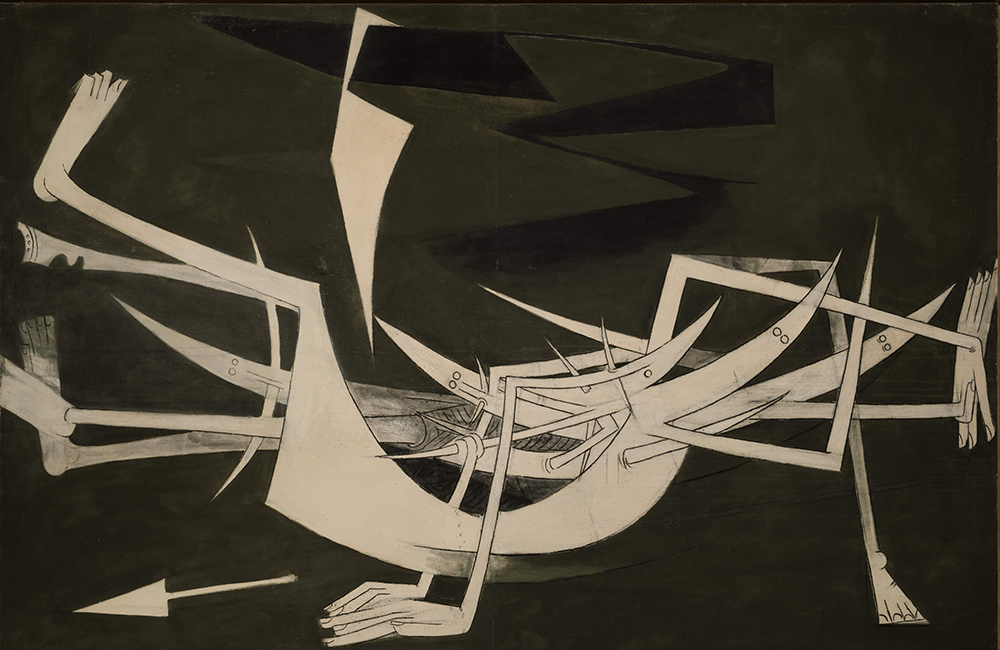
CHT: You moved away from painting very early in your career, embracing mixed media instead. KC: When I went to the United States to study, I learned that painting was considered “dead”. Accordingly, I shifted my artistic practice towards mixed media, working with ready-made objects, collage and creating installations. However, retrospectively, I do not think that my practice took a radical turn. You know, I learned the art of calligraphy at the age of 12, and this practice has always deeply influenced me. If you look back at my installations, you will find the influence of calligraphy. Each Chinese character within the installations stands as a piece of architecture. The dots, lines and curves present suggest a calligraphic vocabulary, such as in the piece Private Matter II (1995) or in the installation QK – A Daily Specimen (2003), a large wooden board conceived as a map.
CHT: After retiring from teaching, you seem to be going back to these early sources of inspiration. KC: Yes, I decided to return to painting and calligraphy, although they each require different attitudes. I began by creating landscape paintings using ink and, more recently, turned towards acrylic. Calligraphy requires a state of relaxation and focus, relying solely on what is within oneself and awakening that inner expression. It implies a continuous dialogue between me and the medium. It keeps a measure of intimacy and allows for accidents to happen, even if the result may be considered “undesirable”. Unlike acrylic, where adjustments and changes can be made, ink does not allow for hesitation.
Success or failure becomes apparent immediately and there is no space for repentance. Lately, I have been experimenting with transforming Chinese characters into paintings, in order to allow more time for deliberation in the process of “writing”.

Courtesy the artist.
CHT: I can see traces of brushstrokes in your acrylic paintings, and the flow of energy they suggest. Still, colours seem to dominate the compositions, standing out for themselves. KC: I find media themselves to be very interesting to explore. Painting with ink, for example, involves absorption by the paper, while acrylic remains on the surface of the canvas. The way I paint and use colours is completely different between the two. I am intrigued by how to bring the intimacy I have with ink to a canvas. The process and the effect produced are equally important to me.
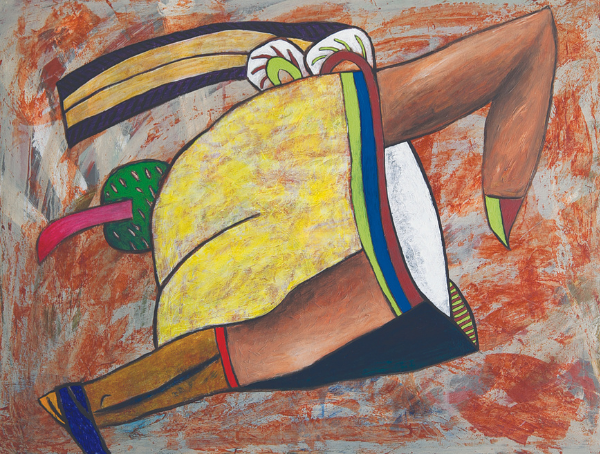
It all started with my exhibition at Angela Li’s gallery [Contemporary by Angela Li], Sky Rains Grain, in 2022. At that time, Angela Li visited my studio and preferred my painting with colour over my ink work, which later opened up a new path for me. Die-hard traditional calligraphers might not choose this direction, but I see it as an opportunity. However, now, I feel a desire to return to black and white or at least use a less vibrant palette.
CHT: Some of the paintings of that time, for instance Light (2022), are very architectural. Each layer of colour brings forth different types of forms and volumes, as if juxtaposed. KC: What you see might relate to another important concept that has been also at the core of my practice, which is collage. This concept remains fundamental to me. It serves as the most frequently used technique of postmodernism, representing the fragmented nature of reality, compressed time and the juxtaposition of unrelated elements coexisting simultaneously. I also feel a strong alignment with surrealism due to its connection to the unconscious and non-rational aspects of our minds.
CHT: In your most recent exhibition at Galerie du Monde in 2023, you projected moving images on your canvas. Was this also a way to reflect on the multilayered nature of reality? KC: Exactly. It was a way for me to bring different elements together and explore their interconnectedness. The moving images are elements which help to strengthen the idea of the powerful, untamed nature that may not adequately manifest itself in my paintings, also acting to connect different ideas regarding my thoughts about landscape.
You might feel that all these experiments lead to a form confusion when it comes to defining my style. As a teacher, I had to teach things that I both liked and disliked. Over time, all these elements became a part of myself. Perhaps that is why I do not believe in a distinct style, as artists nowadays are living in a world flooded with information.
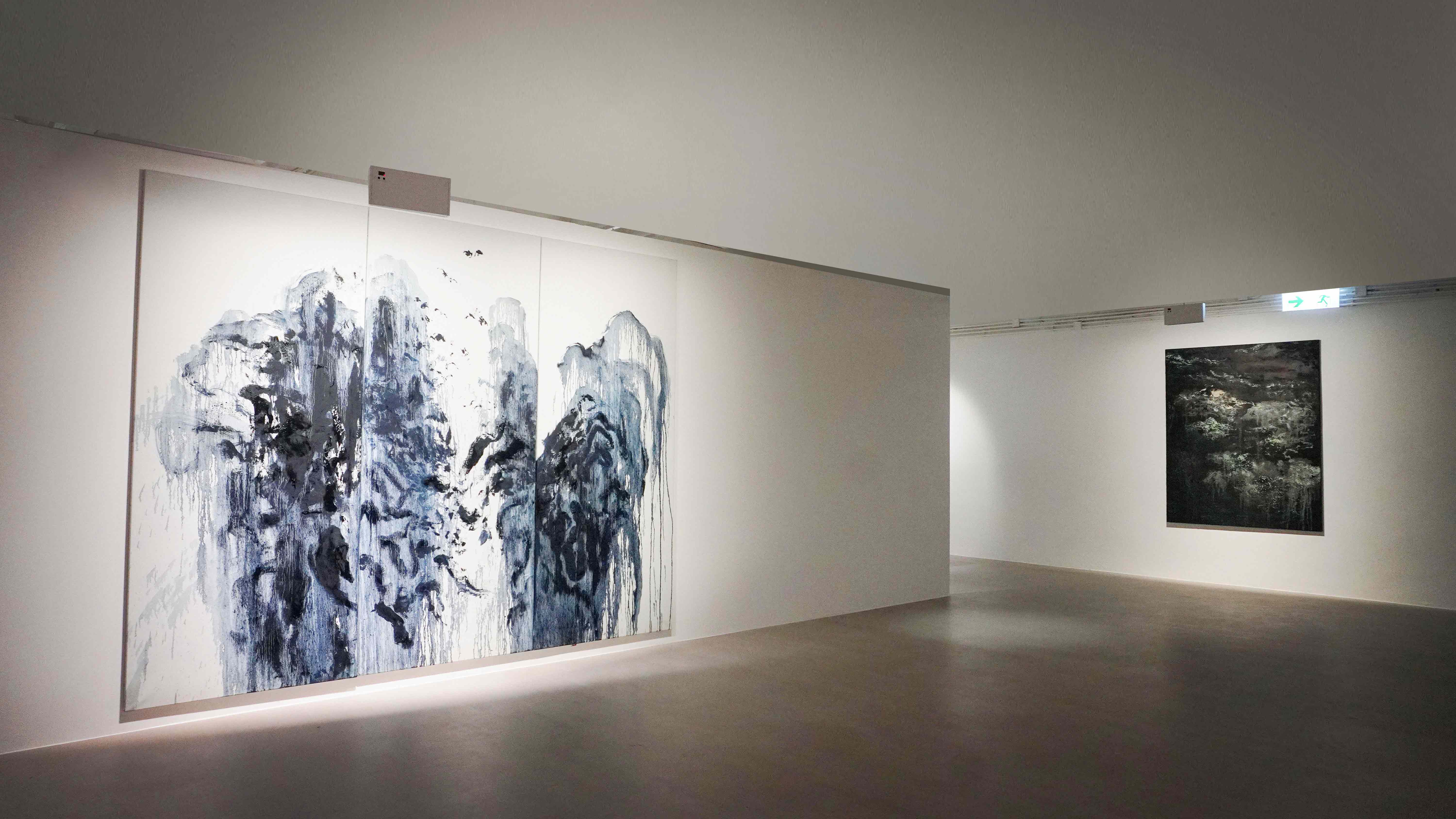
CHT: At the entrance of the exhibition, you displayed some ink on paper, followed by what could be conceived as an installation, comprising different sizes of paintings and sculptures. What guided your choices? KC: With this exhibition, my intention was to summarise what I have done so far and explore future directions. I wanted to investigate how to blend Chinese and western art, and whether there is a way to find a middle ground between the two. It was also an opportunity to delve into the exploration of different media and their unique characteristics. I guess I am returning to a more traditional practice and searching for the core of what I believe in. I ask myself the fundamental question: what shall I do as a painter? This choice may seem limited and perhaps old-fashioned compared to new technologies and knowledge-based practices, but I still hold on to that artistic myth that has been with us for thousands of years.
CHT: The title, Old Landscape: Lightning, Water and Rocks, refers to traditional Chinese landscape, yet I do not think your work follows that “old-fashioned” direction. KC: Indeed. I am not deeply connected to nature in the traditional sense, and I think I should find a new perspective to understand landscape, while I am still very much attached to the traditional ink painting tradition. My exposure to nature comes mostly through the internet and Netflix documentaries. I wanted to approach nature from a more scientific perspective, exploring how life is germinated on Earth. The famous Miller-Urey experiment [a 1952 experiment which showed that organic compounds could be synthesised from inorganic materials] shed light on the idea that the basic elements of rocks, trees and water in Chinese painting are comparable to elements they used in the laboratory to create amino acids. When I see the tree element as energy carrier, and when I translate it to lightning, everything in nature can be seen from a new perspective and even the old paintings by other painters make new sense to me.
CHT: Chinese painters influenced by Taoism have striven to approach the essence of nature, sometimes by reducing landscapes to very elusive brushstrokes. On the contrary, your work is an explosion of forms and lines. KC: I am interested in the essence of nature, but not from this oversimplified perspective. Of course, I believe in the interconnectedness of all things and in a form of unity. However, I have always felt frustrated with the abstract and conclusive nature of this philosophy. I wanted to explore the invisible aspects of nature and of the cosmos, going beyond our imagination and grasping the complexity of all things, even those that we can only guess at.
Similarly, I am highly interested in abstract art, but I feel that abstraction can sometimes become too self-referential. Abstract painters often seem to produce variations of the same work. Personally, I prefer the exploration of variety, complexity and details in my artistic practice.
I find Taoism shares a lot of common ground with new scientific findings that there is a cosmic force unifying the formation of both the universe and human cells, but in the still ongoing scientific research, there are far much more variations and details in this proposition.
CHT: There are some recurring patterns in your work, such as black suns, bright moons and straight lines. Do they have specific meanings? KC: The suns and moons are the only objects we see from the Earth that connect us with outer space; they signify time and seasons, things which change with time but always repeat. On the contrary, we humans always face uncertainties when we look at the sky, suns and moons: either we look at them differently when in a good or bad mood, or they remind us nothing has changed when compared our short life.
The recurring lines in my paintings symbolise the flow of energy. It can represent a river, the wind, lightning or any other kind of flux. These patterns can be found everywhere because I don’t want to be confined by the laws of gravity. I enjoy creating movement and the idea that water can exist in various forms and places, even underground.
CHT: Why are human beings absent from your work? KC: I contemplate the early days of the Earth and also ponder the potential extinction of humankind. I reflect on how human beings manage to survive through reproduction and the accumulation of food. However, this tendency to accumulate often leads to conflict and war. I would not be surprised if humanity were to vanish, and I do not feel pity for it.
I try to look at landscapes as they are, without the need to praise their beauty. I aim simply to embrace them. As an artist, I feel a part of the flow of energy and it resonates with me. Perhaps this is the core essence of art. I experience it in my body when I work, and I believe in our ability to be receptive to it. This is where the limit of artificial intelligence lies, as it cannot fully embody this resonance and connection.

Courtesy the artist.
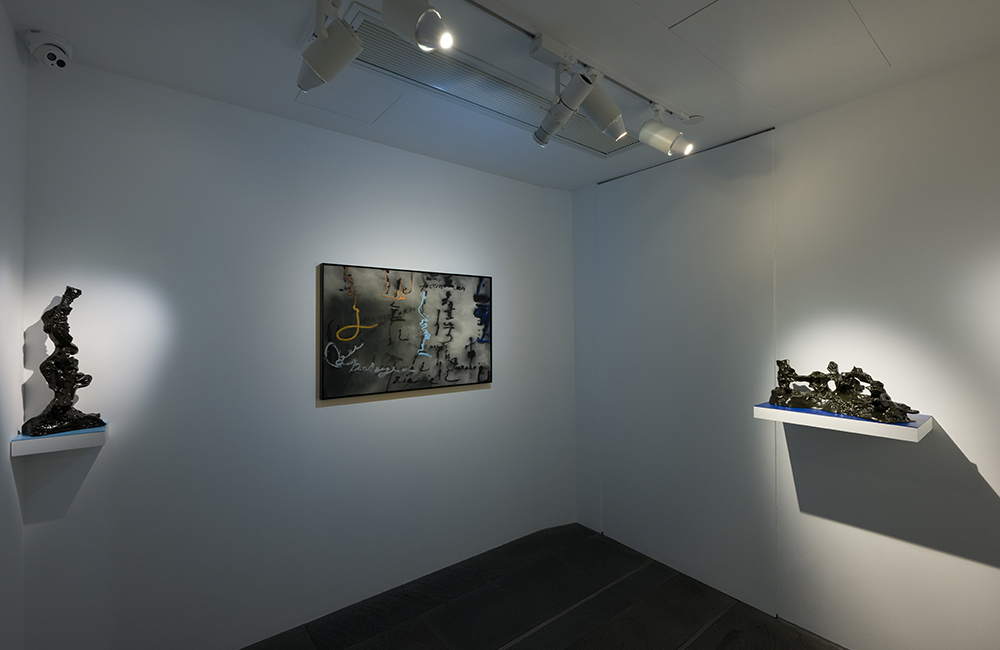
CHT: Text or characters have almost disappeared from your work, except perhaps in Reincarnations (2023). How do you conceive the relationship between writing and painting? KC: As a calligrapher, I have already moved away from the strict confines of meaning. For me and many calligraphers, the meaning of words and writing styles don’t necessarily align. I tend to subvert the conventional meanings of characters and prioritise personal forms of expression. In my paintings, I attempt to extend this writing process. Working with acrylic allows me to make changes, erase and add layers until I feel satisfied. Contrary to common belief, the best pieces are not necessarily the ones that took me the most time. Sometimes, the less I work on them, the more successful they become.
In a way, it’s like mimicking the process of calligraphy but with more possibilities. I also explore different tools, such as knives, to explore and exemplify various stylistic variations in the history of Chinese calligraphy.
CHT: In your studio, I also saw new works for which you used a ballpoint pen to write over earlier ink paintings. KC: In the past few months, I have been experimenting with using acrylic on ink paintings. I have started recycling old works and adding silver paint to them, either with a fine pen or through a spray application. However, these tools and experiences bring along doubts that I am currently trying to resolve.
For me, establishing a friendship with the materials I work with is fundamental. In my studio, I cultivate a relationship with tools, regardless of their intended usage. Only through this connection can a dialogue begin. I find this attitude to be extremely important, even though contemporary art tends to neglect the personal, bodily touch. Even when working with acrylic paint, I strive to maintain the grammar of calligraphy evident in my lines and brushstrokes.
CHT: Would you position yourself as an heir of the Hong Kong ink movement? Besides its historical importance, what is the legacy of this movement today? KC: I believe the modern ink movement in Hong Kong has opened up new horizons by incorporating design and abstraction into traditional ink practices. Figures like Lui Shou-kwan introduced abstract expressionism, Wucius Wong emphasised design principles, and Liu Kuo-sung advocated alternative methods such as rubbing and marbling to replace brushwork. These three individuals have, in a way, challenged the core belief that mastery of brushwork is essential in ink art.
With brushwork, which typically takes decades to master, no longer being the sole foundation of ink art, the younger generation can approach and practise ink art through various alternative paths. I see the legacies of these three masters as more than just inventing and inheriting styles; they are revolutionaries who have dismantled the traditional threshold of “good ink practices”, allowing for boundless imagination to redefine the genre.
I believe Chinese art and culture have always been ingrained in me since I was young. Although my artistic practice has mostly focused on mixed media sculpture for almost 25 years, I now see myself as a bridge connecting Chinese art traditions and contemporary art. At my current age, I may not be able to introduce entirely new and impactful ideas in ink practice, but I continue to draw from my past experiences and hope to bring insights to the younger generations.
CHT: What are your future artistic plans? KC: In the future, I would like to focus more on using electricity as a visual and conceptual element in my paintings. I am intrigued by the idea of continuing to explore the use of mineral colours as an additional tool in my work. I see painting as an alchemical process. There is also an urge for me to return to a mixed media approach, reminiscent of my early years.
Additionally, I have started attending a class about Buddhism, which I try to connect to Darwinism. I seek to resolve my own reflections in life and art amid the troublesome political turmoil worldwide. By watching nature documentaries, my imagination is fuelled with thoughts about the landscapes of early Earth. It also inspires me to contemplate the cruelty of natural species selection and how living things become extinct due to competition.
Competition still exists today and will continue to exist. Wars among countries are another form of selection triggered by the manmade environment, and only humanity can save us. If we believe that everything is connected and that the environment is composed of many ever-changing ingredients, the question of what enables something to survive, grow and lead becomes intriguing.
For me, landscape painting serves as an outlet to see a bigger and older world. The cruel reality of evolution cannot be judged as good or bad; it is merely a phenomenon. Extinction serves as a reboot of life when things become truly ugly.
Featured image: Installation view at Galerie Du Monde, 2023. Courtesy the artist and Galerie du Monde.
陳育強在1970年代後期曾接受傳統中國藝術的正式訓練,之後在1980年代中又到美國修讀當代藝術。他在25年間致力鑽研混合媒介裝置,欲連結起兩種傳統。不過,他最近決定回歸水墨畫和書法,質疑運用繪畫和風景展示現實與自然的本質。他的新實驗反映他既渴望繼續挑戰藝術的表達方式,同時又回應了現在的全球政治及生態危機。
Caroline Ha Thuc: 自從五年前從香港中文大學退休後,你一直專心於藝術創作。在你多年的教學生涯中,你有怎樣的得著?陳育強: 我在香港中文大學任教了27年,主要教授混合媒介、藝術史和藝術理論。這期間,我親身經歷了藝術教學的重大變化。在1980年代,香港中文大學只有寥寥數名藝術學生,而且他們當時都是在學習現代主義藝術。不過現在修讀藝術的學生多了很多,比起正規及技巧性的務實藝術風格,當中不少人對知識性的社會參與藝術更感興趣。他們不喜歡困在畫室裡的學習模式,更傾向於單獨練習。另外,我認為教學的難度也提升了,因為現在的學生都會自己在網絡上搜尋資料。總而言之,雖然我很喜歡教學,但我還是很高興我辭職了。
CHT: 在學生時代,你在創作和學習藝術方面有甚麼經驗?陳育強: 學生時期,我通常都是在畫室裡在老師的觀察下畫畫。那時候的課題便已經是嘗試融合中式和西式的技巧。我的其中一位老師鄺耀鼎是教授油畫的,但是他的作品都有獨特的中式元素。台灣水墨畫大師劉國松也對我這一代有重要的影響。
以前的我們只是學生,一個班級大概有15人,我們一起討論藝術,以自己的方式反叛一下。一切都很原始。我想了解和學習一切,但我們卻覺得自己被孤立了,因為香港中文大學是當時香港唯一一所提供藝術課程的學校。我唯一可以找到的雜誌就是《Art in America》,我光是閱讀已經可以從中學到許多。我也會參加討論會和展覽深入探索更多藝術觀點,尤其是在藝穗會。我清楚記得有一位學校前輩曾告訴我在香港當藝術家不可能出名,因為沒有人會關注香港藝術家。
CHT: 在提高對香港藝術的關注方面,有沒有哪些人有重要的貢獻?陳育強: 有,例如何慶基和從英國回流的藝術家麥顯揚。當何慶基成為香港藝術中心的總監時,對建立國際聯繫功不可抹。
CHT: 你其中一個關於香港的早期概念是「本土美學」。即使空間有限,你認為香港的藝術是否仍然獨特?陳育強: 本土美學是我為自己創造的概念:是關於我運用本地物件製作混合媒介裝置。雖然它的確與缺乏空間和技術支援有關,但是它不代表其他藝術家的傾向。
話雖如此,在某程度上,是的,我認為香港藝術家仍然要面對一些特定挑戰,例於相對低的流動性及空間與技術支援的缺乏。而且,由於不少收藏家都不喜歡繪畫以外的作品,所以新式或實驗式的創作很難發展。繪畫在藝術市場上一直保持著主導的角色,甚至連巴塞爾藝術展在這方面都越趨保守。
CHT: 你在事業的很早期便已經放棄繪畫,轉而創作混合媒介。陳育強: 當我在美國學習時,我明白到繪畫「已死」。因此,我把自己的藝術重心轉到混合媒介,利用現成物去拼貼和創作裝置。然而,現在回頭看,我並不認為我的創作有大幅轉變。如你所知,我從12歲起學習書法,所以我的作品中都有書法的影子。如果你回看我的裝置,你就會找到書法的痕跡。裝置中的每一個中文字都是一件建築。每一點,一劃都有書法的特質,例如在畫作《Private Matter II》(1995年)和用大木板構造成地圖的裝置《QK – A Daily Specimen》(2003年) 。
CHT: 從學校退休後,你似乎回歸了這些早期的創作風格。陳育強: 是的,我決定回歸畫畫和書法,雖然它們需要不同的心態。我一開始是用水墨畫風景,最近轉用塑膠彩。寫書法需要在放鬆的同時集中精神,完全依賴一個人的內在和對內在感受的了悟。寫書法需要我和媒介持續對話。它需要一定程度的親密和容許意外發生的空間,即使結果可能並不理想。與可以調整和修改的塑膠彩不同,畫水墨畫不可以猶豫。成功還是失敗即時可見,沒有後悔的空間。最近,我在嘗試把中文字轉化成畫,讓書寫時可以有更多思考的時間。
CHT: 在你的塑膠彩畫中我可以看到筆觸和痕跡和其能量的流動。不過,色彩似乎仍然是畫中的主角,很突出。陳育強: 我發現探索媒介本身很有趣。例如畫水墨畫時畫紙會吸收顏料,而畫塑膠彩畫時顏料則會停留在畫布的表面。繪畫這兩種畫時我的畫畫手法和對顏料的運用迥然不同。我對怎樣把畫水墨時的私密感帶到畫布上很感興趣。其中的過程和效果對我同等重要。
我是從2022年在李安姿的畫廊Contemporary by Angela Li舉辦個展「天雨粟」時開始有這些想法。當時,李安姿到訪我的工作室。比起我的水墨畫她更喜歡我彩色的畫,而這件事為我打開了一個新的可能性。固執傳統的書法家也許不會選擇這種做法,但是我從中看到了機會。不過現在,我期望回到黑白或者至少是不太鮮艷的創作。
CHT: 你當時的一些畫是有多層次的,例如《Light》(2022年)。每一層的顏色都有不同的形式和大小,相互比對。陳育強: 你看到的可能與我的另一個重點創作理念有關,那就是拼貼。如今它仍是我的基本創作理念。它是後現代主義中最常見的手法,代表著現實破碎的本質、壓縮的時間和不相關事物的同時存在。除此之外,因為這種拼貼手法與潛意識及我們腦海中非理性部分有關,我亦感覺到它與超現實主義之間的強烈連繫。
CHT: 你最近在2023年於Galerie du Monde舉辦的展覽中,在畫布上投影動圖。這是否也是反映現實的多重性質的方法?陳育強: 正確。這方法讓我可以把不同的元素帶到一起,探索它們之間的關聯性。那些動圖強調了大自然的強大和原始性,而這些元素在我的畫中未必有呈現出來,它們也把我對景觀的各式想法連結起來。
可能這些實驗性創作會令你對我的風格感到混淆。作為老師,我要教授自己喜歡和不喜歡的事物。隨著時間發展,這些種種都成為了我的一部份。也許這就是為什麼我不相信獨特的風格,因為現今的藝術家生活在一個充斥資訊的世界。
CHT: 在展覽的入口,你展示了一些水墨畫,以及像是裝置的作品。裝置由不同大小的畫和雕塑組成。你的靈感來自於哪裡?陳育強: 藉今次展覽,我想總結自己至今的所做的事和尋找未來的方向。我曾想研究怎樣融合中西藝術,以及兩者之間是否有中間點。那亦是一個機會讓我深入鑽研各式媒介和它們的特徵。我想我之後會重回比較傳統的風格及找尋自己的信念核心。我問自己一個基本問題:作為一個畫家我應該做什麼?選擇看似不多,而且比起新的科技和知識性藝術也許老土,但是我仍然相信有千年歷史的藝術傳說。
CHT: 展覽的名稱「舊風景 — 電、光、水、石」是取自傳統中國風景,但是我不認為你的作品追隨「舊式」的風格。陳育強: 的確。我與大自然並沒有深刻的傳統連繫,而且我覺得自己應該用一個新的角度去理解景觀,但同時我仍然喜歡傳統水墨畫。我最常看到大自然的地方就是網絡上和Netflix上的紀錄片。我想從一個比較科學的角度探討大自然,研究生命在地球上的起源。著名的Miller-Urey實驗[1952年的一個實驗,證明了無機物可能會合成為有機化合物]帶來了一個可能性是中國畫中的石、樹和水的基礎元素也許與實驗室用來製造胺基酸的元素沒有大分別。當我將樹視作能量載體,我把它轉化成閃電時,大自然中的一切都可以從一個新的角度去理解,甚至其他畫家的舊畫也對我有了新的意義。
CHT: 中國畫家受道教影響,致力探討大自然的本質,有時會把風景簡化為抽象的線條。相對地,你的作品卻有大量形態和線條。陳育強: 我對大自然的本質感興趣,但不是用這種過分簡化的方法。當然,我相信萬物之間的相互關聯性和統一性。可是,我亦常常對這種學說的抽象和確定性感到困擾。我想研究大自然與宇宙中看不到的方面,超越我們的想像和掌握萬物的複雜,包括那些我們只能猜測的事物。同樣地,我對抽象藝術亦非常有興趣,但是我覺得抽象藝術有時候太過於自我指認。抽象藝術家偶爾會用同一件作品創作出不同的版本。就我個人而言,我傾向在創作中嘗試不同的種類、複雜性和細節。
我發現道教與新科學研究有不少類近的地方,它們都認為有宇宙力量統一了宇宙和人體細胞的形成,不過仍然持續進行的科學研究在這方面有更多的變化和詳情。
CHT: 你的作品中有些重複的圖案,像是黑色太陽、耀眼的月亮和直線。它們是否有特別的意義?陳育強: 太陽和月亮是我們在地球上唯二可以看到又連繫起我們和外太空的東西;它們意味著時間和季節,隨時間轉變,但又不斷重複。相反,我們人類在看天空、太陽和月亮時常要面對不確定性:我們心情好與壞時以不同眼光觀察,或是提醒我們,對比起我們短暫的生命什麼都沒有變。
我畫中重複出現的直線象徵著能量的流動。它可以代表河流、風、閃電或任何其他能量變化。任何地方都可以看到這些圖案,因為我不想被萬有引力定律限制。我喜歡創作動態和水可以有多種形態和出現在不同地方的想法,包括在地底。
CHT: 為什麼你的作品中沒有人類?陳育強: 我在想地球早期的生活和人類滅絕的潛在可能。我反思著人類如何透過繁衍和累積食物生存。可是,這種累積的習性有時會帶來衝突和戰爭 。如果人類消失於世界上,我不會覺得訝異,亦不會同情。
我嘗試從務實的角度看風景,不去讚頌其美態。我只是想簡簡單單地擁抱風景。作為藝術家,我感覺到一部份能量的流動,而這種流動讓我產生共鳴。也許這就是藝術的核心本質。工作時我可以從自己的身體感覺到,我相信我們的接受能力。這就是人工智慧的限制,因為它不能完整地感受這種共鳴和連繫。
CHT: 除了在《Reincarnations》(2023年),文字幾乎從你的作品中消失了。你對寫作和畫畫的關係有什麼看法?陳育強:作為一個書法家,我已經不再受古板定義所限。對我和很多書法家而言,文字的意思和寫作風格不一定要相應。我傾向推翻文字的傳統意思,並以個人看法重新定義。在我的畫中,我嘗試應用這種寫作方式。用塑膠彩畫畫讓我可以作出修改、擦除和增加層次,直到我滿意為止。與普遍理解不同,我花最長時間的不一定是最好的作品。有時候,我投入少點時間反而作品會更好。
某程度上,這就像是模仿書法的過程,只不過有更多可能性。我也會試用不同的工具去探索和實驗中國書法歷史上各式各樣的文體風格,例如用刀。
CHT: 我在你的畫室看到你用原子筆在舊的水墨畫上塗寫的新作品。陳育強: 在過去數月,我一直嘗試在水墨畫上畫塑膠彩。我把舊作品循環再用,並用鋼筆或噴漆塗上銀色的顏料。可是,這些工具和經驗帶來了我現在想要解決的疑問。
對我來說,與自己用的物料建立友誼是基本。在我的畫室裡,不論工具的用途是什麼,我都與它們培養出了一段感情。只有建立起這樣的關係才能對話。雖然當代藝術傾向忽視個人和身體接觸,我發現這種態度仍是非常重要。畫塑膠彩畫是時,我也會在線條和筆觸上努力維持書法的語法。
CHT: 你是否認為自己是香港水墨畫運動的繼承人?除了歷史意義,這次運動還留下了什麼?陳育強: 我相信香港的現代水墨畫運動透過將設計和抽象元素融入傳統水墨畫,開啟了新的角度。著名人物如呂壽琨帶來了抽象表現主義,王無邪強調設計原則,而劉國松則推崇其他方式如用磨擦和浮水畫取代畫筆。上述三位都是在用不同方式挑戰筆法在水墨畫至關重要這一核心信念。
筆法通常要幾十年時間才能精通。如果筆法不再是水墨畫的唯一基礎指標,年輕一代就能從其他途徑接觸和學習水墨畫。我認為這三位大師帶來的不只是創造和傳承風格;他們是推翻傳統「優秀水墨畫」標準的革新者,讓人可以無限制地想像以重新定義水墨畫。
我相信中國藝術和文化從小就一直紮根於我的內心。雖然我的藝術重心在近25年來主要集中於混合媒介雕塑,但是我現在把自己視為連繫中國傳統藝術和當代藝術的橋樑。在我這個年紀,我也許不能帶來全新和有深遠影響的水墨畫手法,但是我會繼續吸收過去的經驗去創作,希望新一代可以從中獲得一些見解。
CHT: 你未來有什麼藝術計畫?陳育強: 未來,我希望專注於在畫中用電作為視覺和概念的元素。我很有興趣繼續研究如何將礦物顏料這種額外的工具應用在作品中。我認為畫畫是一個煉金術過程。我也有一股衝動想回歸我早期的混合媒介創作。
此外,我開始參與佛教課程,我嘗試將之與達爾文主義連繫起來。在世界各地都有令人憂慮的政治動盪時,我在反思自己的生活和藝術。看了大自然的紀錄片後,我的腦海充斥著早期的地球景觀。這亦啟發了我去思考物競天擇的殘忍及競爭如何導致生物滅絕。
現今競爭仍然存在,而且會一直存在。國與國之間發生戰爭是物競天擇的另一方式,由人工環境造成,而只有人類能拯救自己。如果我們相信世間萬物都是相關的,以及環境是由很多持續變化的事物組成,那麼探討是什麼使一樣事物生存、成長和領導就是一個很有趣的課題。
我覺得風景畫是看到更大更原始的世界的渠道。進化的殘忍不能以好壞評斷;它只是一個現象。當事物變得太過醜惡時,滅絕就是重啟生命的方法。