Rossi & Rossi /
Wong Chuk Hang, Hong Kong /
Sep 28 – Nov 14, 2024 /
The adjective that you will most often see associated with Nepali artist, preservationist, novelist and scholar Lain Singh Bangdel (1919–2002) is “iconic”. He is the man who single-handedly brought contemporary art into the Himalayan country, while at the same time being the most dedicated scholar of Nepal’s artistic past, painstakingly and doggedly compiling catalogues of looted or lost art, and making a remarkable contribution to our understanding of Nepal’s history and artistic heritage. A pioneer and the first truly international Nepali artist, Bangdel kept his deep interest in his country’s ancient art rather separate from his own artistic practice, which mainly consists of very modernist oil paintings, with clear influences from his contemporaries from all around the world.
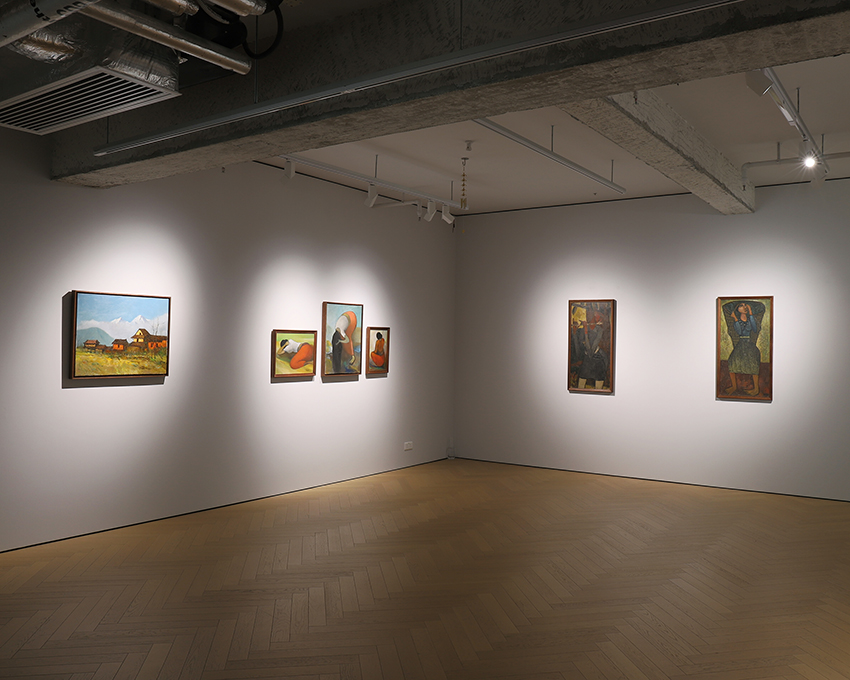
A recent show at Rossi & Rossi Wong Chuk Hang’s gallery was a very rare chance for people in Hong Kong to get a glimpse of the work of this household name in Nepal – a small but still quite comprehensive overview of the different styles and approaches Bangdel adopted throughout his career as a painter.
Bangdel was born near a tea estate in Darjeeling, India to a Rai family – an ethnic group indigenous to the Khotang valley in eastern Nepal. Before settling in Nepal in the second half of his life, he travelled extensively in India and Europe, absorbing new ideas and influences that he would then apply to his own work, switching styles and approaches but always painting about Nepal, its scenery, its people and its colours.
Bangdel graduated from the Government College of Art and Craft in Calcutta, now Kolkata, with a degree in Fine Arts in 1945, and spent his time in the city not only studying arts but also writing a number of novels about Nepal in Nepali. Initially, he adopted a rather classical, 19th-century style of writing, until his novel The Cripple’s Friend (1951), which is regarded as the first Nepali work of fiction written in a realistic style. This literary shift foreshadowed his growing interest in contemporary ways of describing modern life, whether in visual art or writing, which is the art form for which he is most recognised today.

Courtesy Rossi & Rossi.
In 1952, he left for Europe, letting himself be inspired by Picasso and other cubist artists, Gauguin, Cézanne and, more generally, modernism. In the early 50s, Bangdel was part of a group of Asian artists residing in Paris, including Zao Wou-Ki and Sanyu from China; Affandi from Indonesia; Zubeida Agha, one of the first Pakistani modern artists; and Paritosh Sen and Akbar Padamsee from India. Like them, Bangdel studied at the École des Beaux-Arts, which is when he became exposed to and absorbed the techniques and aesthetics of the modernist movements that were being developed in Europe at the time.
Unlike some of his Asian contemporaries in Paris, though, he never explored western scenery or themes, transposing onto his paintings only the techniques but not the subject matter; whether they are landscapes, depictions of social vignettes or portraits, his paintings are always unmistakably about Nepal. The Rossi & Rossi show features examples of the different styles he used to paint Nepali themes. In his realistic phase, Bangdel painted portraits and self portraits in a nearly academic style, infusing just a slight touch of irony or tenderness, depending on the person portrayed – keeping the irony mostly for his self portraits. When he moved onto abstraction, he depicted Himalayan villages as geometrical clusters of colour set in the middle of a grey-to-white scale of snow and mountain peaks, or azure rain, in works such as Rainy Season (1974) and Winter in the Valley (1984). In spite of their abstraction, with only patches of colour depicted amid a snowy landscape, a close look reveals recognisable Nepali village architecture, with its characteristic tiles, thatched roofs and multiple front windows. In A Village near Kathmandu (1963), on the other hand, he sticks to more representational depictions of the Himalayan countryside, with rural houses in red and yellow, thatched roofs faithfully reproduced, contrasting against the sharp white of the snow-covered peaks behind them.
All of these works were produced after Bangdel had returned to Nepal and decided to settle down there – initially, at the invitation of King Mahendra, who had asked him in 1961 to live in the country to help modernise the art scene there.
In the 60s and again in the 90s, Bangdel showed how deeply he had been influenced by Picasso, especially with paintings such as Mother and Child (1965), where this eternal theme is explored through precise contours and blurry details, against a very colourful background; and even more so in Mother Nepal II (1990) which, in its nearly monochrome blue and pale blue palette, recalls the Spanish artist’s Blue Period. Not that Bangdel’s work is derivative, even when the influences he has absorbed are so recognisable: in works such as Misty Mt. Everest (1978) he mixes abstraction, in how he depicts the mist and the clouds, and very careful realism, in the portions of the painting that show the mountain’s granite in all its details. In order to pay homage to his deep knowledge of traditional Nepali sculpture and his work as a conservationist, the show, co-curated by Rossi & Rossi and Kathmandu-based Swosti Rajbhandari Kayastha, is also dotted with classical Buddhist statues and sculptures, in bronze and hard stone, which are what we more commonly associate with Nepali art. In this, too, Bangdel caused a revolution of sorts, pushing both private and public institutions to become more engaged with protecting the country’s cultural heritage.
From his own personal observations in his copious writings, we can see how he positioned himself as a “Nepali that is new to Nepal”, balancing the desire to be fully acknowledged as a Nepali artist, in spite of the decades he had spent out of the country, and to be someone who challenges the traditional notions of figurative art, in line with the task that had been given him by the king. The lasting influence and prestige of his work show that he was more than successful in his endeavour.
最常用於形容尼泊爾藝術家、保育者、小說家和學者Lain Singh Bangdel ﹙1919-2002的詞語是「標誌性」。他獨力將當代藝術引入這個喜馬拉雅山國家,同時他也是最專注於尼泊爾藝術史的學者。他煞費苦心、堅持不懈地編撰被盜或已丟失的藝術作品,在讓我們了解尼泊爾的歷史和藝術遺產方面作出了傑出貢獻。Bangdel作為先驅和首位真正蜚聲國際的尼泊爾藝術家,他把對自己國家古代藝術的強烈興趣與他的個人藝術分開。其個人藝術作品主要是非常現代主義的油畫,明顯受到世界各地同代藝術家的影響。
最近在位於黃竹坑的 Rossi & Rossi畫廊舉辦的展覽,予香港人一個難得的機會一睹這位尼泊爾家喻戶曉的畫家的作品——展覽的規模雖然不大,但是仍然全面地概述了 Bangdel 在其畫家職業生涯中所用不同的繪畫風格和方法。
Bangdel出生在印度大吉嶺一個茶園附近的拉伊族家族。拉伊族是尼泊爾東部Khotang山谷的原住民。在決定下半生定居在尼泊爾前,他曾在印度和歐洲很多不同地方遊歷,吸收新的思想和影響,並將之應用到自己的作品中。他不斷改變創作風格和方法,但其作品描繪的通常都是尼泊爾的風景、人民和色彩。
Bangdel於 1945 年從加爾各答的政府工藝美術學院畢業,取得美術學位。他在加爾各答不僅是學習藝術,還用尼泊爾語寫了多本關於尼泊爾的小說。在撰寫小說《The Cripple’s Friend》(1951 年)前,他一直採用了比較古典的 19 世紀寫作手法。《The Cripple’s Friend》是第一部以現實主義風格寫作的尼泊爾小說作品。這種文學風格的轉變預示了Bangdel無論在視覺藝術還是寫作方面,都對以當代藝術方式描述現代生活的興趣日漸濃厚,而寫作是他現在最廣為人知的藝術形式。
他在1952年前往歐洲,受到畢卡索和其他立體派藝術家、高更、塞尚以及泛義上現代主義的啟發。 在50年代初,Bangdel與一群亞洲藝術家在巴黎居住,其中包括來自中國的趙無極和常玉、印尼的 Affandi、巴基斯坦最早的現代藝術家之一Zubeida Agha,以及印度的 Paritosh Sen 和 Akbar Padamsee。Bangdel與他們一樣在法國美術學院學習。他在那裡接觸並吸收了當時正在歐洲發展形成的現代主義運動的技術和美學。
可是,有別於在巴黎的一些亞洲同代藝術家,Bangdel從未描繪過西方的風景或主題,他只在畫作中運用了所學的技巧,而非主題。無論是關於風景、生活片段還是人像,他的畫作總是毫無疑問地以尼泊爾為主題。Rossi & Rossi的展覽展示了他描繪尼泊爾的各種畫作風格。在他的寫實創作階段,Bangdel以類似學院派的風格繪畫人物肖像和自畫像,並根據描繪的對象加入些微的諷刺或感性元素(諷刺通常只會在他的自畫像中出現)。當他轉向抽象創作後,他在《Rainy Season》(1974 年)和《Winter in the Valley》(1984 年)等作品中將喜馬拉雅村莊描繪成位於灰白色的雪和山峰或天藍色雨水中的幾何色彩斑塊。雖然這些作品比較抽象,只在雪景中的描畫了幾塊色彩,但如果走近觀察就能辨認出其中的尼泊爾村莊建築,包括其特色瓦片、茅草屋頂和多個前窗。然而在《A Village near Kathmandu》(1963 年)中,他卻用更具體的方式描畫喜馬拉雅鄉村。他以紅色和黃色繪畫農村的房屋,寫實呈現茅草屋頂,與背景中亮白色的山峰形成鮮明對比。
所有這些作品都是在Bangdel回到尼泊爾並決定在那裡定居之後創作的——起初,他是應國王馬亨德拉的邀請回尼泊爾。國王於 1961 年邀請他回尼泊爾居住,幫助國家藝術發展現代化。
在 60 年代和 90 年代,Bangdel展現了他深受畢卡索影響的風格,尤其是在如《Mother and Child》(1965 年)的作品中,他在色彩繽紛的背景上透過精準的線條和模糊的細節探索這個永恆的主題;而在《Mother Nepal II》(1990 年)中,他用近乎單色的藍和淡藍色調讓人回想起了畢卡索這位西班牙藝術家的藍色時期。即使Bangdel的風格受到非常明顯的影響,但他的作品並非是模仿:在《Misty Mt. Everest》(1978 年)等作品中,他用抽象手法描繪雲和霧,同時又用寫實的手法畫出山上花崗岩的細節。為了展示Bangdel對於傳統尼泊爾雕塑的深厚知識和向他的保育貢獻致敬,這個由Rossi & Rossi 和加德滿都的 Swosti Rajbhandari Kayastha 聯合策劃的展覽還展出了以銅和石頭雕刻而成的古典佛教雕像和雕塑,這類型雕塑常與尼泊爾藝術聯繫在一起。在這一方面,Bangdel也帶來了變革,他推動了私人和公共機構更加積極地保護尼泊爾的文化遺產。
從他豐富的著作中可以看到他如何將自己定位為「新來尼泊爾的尼泊爾人」。即使他曾在國外生活了幾十年,但他亦希望能作為一名尼泊爾藝術家得到認可,同時又希望能達成國王的期望,成為一名挑戰尼泊爾傳統具象藝術觀念的人。他的作品的長久影響力和美譽證明他的努力取得了巨大的成功。