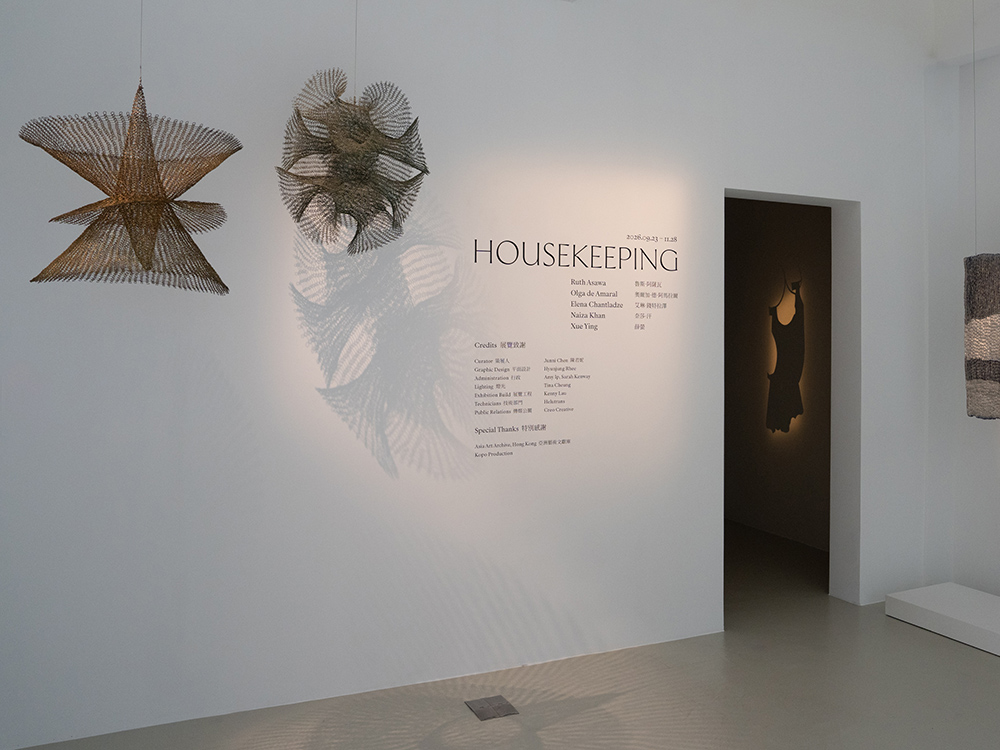
Housekeeping /
Cheng-Lan’s Corner /
Hong Kong /
Sep 23 – Nov 28, 2026 /
Remove dust from every surface. Scrub the sink. Do the laundry. Stock the fridge. Cook, cook, cook. Housekeeping is a litany of unending tasks that can wear a person down if they can’t find their own joy in it: an obligation to make everyone under the same roof feel comfortable. When done well, the outcome is a home that always looks welcoming, with the effort to reach that state removed from view.

Courtesy the artist and Cheng-Lan’s Corner.
Xue Ying’s work in Housekeeping – the third exhibition held at Cheng-Lan’s Corner, the Cheng-Lan Foundation’s space in Mid-Levels – takes that concealment literally. Her installation the room is empty, but pregnant (2026) involves a wooden floor constructed above waist level, dividing the room into a world above and another below. On top, objects are arranged with care: a shell cradled in a spoon, a cast hand seemingly clutching a feather. The split scene links up with the notion of how a home’s inhabitants might want it to be seen. Standing by the installation, visitors see this polite side: a clean floor demands no scrutiny.
That sense of order is absent below. Eggs lie strewn about; patches of soil mark the ground. Xue uses this fission to narrate the way how families, including her own, perform labour to keep certain matters and feelings from rising to the surface. Everything messy stays below, out of sight but always ready to be accessed.
Other types of split run through the show. Ruth Asawa made her looped wire sculptures while undertaking the daily care of her six children, who were all born in the 1950s. One daughter coiled wire using a dowel, and some of the artist’s sculptural forms would cradle a baby. Art historian and curator Jordan Troeller writes in her book Ruth Asawa and the Artist-Mother at Midcentury (2025), which was one of the volumes in the reading nook of Housekeeping, that modernists such as Asawa “made motherhood into a medium”. The line is generous and puts the spotlight on unseen work that lets an artist’s practice become visible. In Asawa’s case, when the household is also the studio, that labour is even harder to separate from her creative output.

Courtesy the artist and Cheng-Lan’s Corner.
The inclusion of Colombia’s Olga de Amaral in the show takes the split in yet a different direction. She learned to value fabric, texture and form from her mother; her weaving techniques draw on pre-Andean warping and wefting that make carpets and ponchos. The work on view, Aqua 14 (2016), is covered in Japanese paper and palladium leaf, so that it shimmers. This is the clearest instance in the show where domestic craft is elevated to the appearance of treasure, although it also hides the drawn-out, repetitive actions in the actual creative process. One could read this as honouring that labour or as disguising it.

Courtesy the artist and Cheng-Lan’s Corner.
At first glance, Elene Chantladze, a painter from Georgia, doesn’t quite fit into the framing of Housekeeping. A librarian by training, she began painting at the age of 50, after her husband and son-in-law died in close succession. She had to raise her grandson in the house that she once shared with her spouse. Chantladze’s practice began as a daily habit, paint brushed onto scrap cardboard, pieces of plastic and whatever else was around. The scenes are innocuous – families or friend groups out in public or moments captured within homes. These were emotive moments for the artist as she watched the people around her. In Chantladze’s case, the household is simultaneously the subject, studio and reason to move forwards in life. Painting itself was a form of upkeep and a way to hold herself together.
Naiza Khan’s work lent an extra edge to the show. The Pakistani-born artist is known for beginning with attire such as lingerie, corsets and chastity belts, then casting it as armour. These pieces were originally made in response to an Urdu text that prescribes “appropriate” morals and behaviours for young Muslim women. The steel sculptures pair aggression with seduction, strength and security with fragility. Their material equally protects and confines. Where Xue’s “pregnant room” demonstrates what a home can sweep out of sight, Khan’s Armour Lingerie IV (2006) shows what a home or society demands of bodies that live within. A set of four accompanying photographs depict artist and curator Samar Zia in various stages of a performance, putting on or taking off these steel garments, at a time when her own practice probed the representation of different identities.

Courtesy the artist and Cheng-Lan’s Corner.
Housekeeping describes a household as a place where someone is always performing some form of maintenance. The artists whose work is featured in the show are mothers, daughters and grandmothers who must maintain the space that is theirs, whether in physical terms or mental ones. That meaning changes when it is applied to Hong Kong’s context – or even merely the context of the neighbourhood where Cheng-Lan’s Corner is situated. For many households, the labour of housekeeping is outsourced to roughly 370,000 foreign domestic helpers across the city. They do the scrubbing, washing and cooking that makes a home look welcoming.
Perhaps, then, it is Xue’s segment of the exhibition that leaves the strongest impression. The initial view is prim and proper, just like in a Hong Kong flat. Underneath, someone else’s daily work is done so well that it is completely invisible.
Housekeeping
承蘭藝術文化機構
香港
2026年9月23日至11月28日
把塵埃從所有表面上掃走。刷洗鋅盤。洗衣服。為雪櫃補給。煮飯、煮飯、再煮飯。家務永無休止,做家務的人要是無法找到箇中樂趣,家務可以把人磨蝕。家務是一種責任,要讓同屋共住的成員都舒適地生活。妥帖的家務換來窗明几淨,但這種狀態背後所消耗的努力卻未被看到。
位於中半山的承蘭藝術文化機構最近舉行了第三場展覽,題為「Housekeeping」(家務)。展覽中,薛瑩的作品把被抹去的家務具象化。她的裝置《the room is empty, but pregnant》(2026年)以一道高於腰間的木地台把展廳分成上下兩個世界。地台上方的物件經悉心擺設:湯匙盛著貝殼;鑄造的手彷彿正捉住羽毛。分裂的場景,令人聯想到居住者理想家居觀感的想像。觀眾站在裝置旁,看到體面的一面:潔淨的地板毋庸置疑。
地台之下,這種秩序蕩然無存。雞蛋散落四周,地面滿是斑駁的泥跡。薛瑩以這道裂縫,訴說家庭(包括她自己的家庭)如何以勞力阻止某些事情與感受浮上表面。一切凌亂都留在下方,避開視線,卻隨時有待看見。
其他分裂亦貫穿了展覽。露絲·阿薩瓦在日常照料六名子女時創作了環圈鐵絲雕塑;她的孩子全都出生於 1950 年代。其中一名女兒會用木棒纏繞鐵線,阿薩瓦某些雕塑形態可用作搖籃。「Housekeeping」展覽的讀書閣裡放有《Ruth Asawa and the Artist-Mother at Midcentury》(2025年)一書,作者為藝術史家兼策展人 Jordan Troeller,她在書中寫道,阿薩瓦等現代主義者「把母職化為媒介」,評語大方地肯定了藝術家鮮為人見的工作,成就了她的藝術實踐。對阿薩瓦而言,家居也是工作室,家務勞動更難以與創作成果分割。
群展的另一位藝術家奧爾嘉.德.阿馬拉爾來自哥倫比亞,她將這種分裂帶去另一方向。她從母親身上學會珍視布料、材質與形態;其編織技法源於前安第斯時期製作地氈與披風的經緯工藝。展出作品《Aqua 14》(2016年)的表面閃爍生輝,因為以和紙及鈀金箔覆蓋。這是展覽中最鮮明的例子:儘管家居工藝在外表上提升至珍寶一樣,卻也同時隱藏了實際創作過程中漫長而重複的動作。觀者可以理解作品是為向勞動致敬,也可以視之為掩飾勞動。
乍看之下,格魯吉亞畫家埃琳·尚特拉澤似乎不完全切合「Housekeeping」的策展框架。她的研習背景是圖書館學,直至五十歲,在丈夫與女婿相繼離世後才開始繪畫。當時,她需要以一己之力,在昔日與丈夫共享的家中撫養外孫。尚特拉澤的創作始於日常習慣:把顏料掃在廢棄紙皮、塑膠片,以及身邊一切可用的物料上。場景平平無奇,包括在公共場所出現的家庭或友伴,或捕捉家居的片刻。她觀看身邊的人,所以作品上的瞬間承載著個人情感。對尚特拉澤而言,家既是題材與工作室,也是支撐她繼續生活的理由;繪畫本身成為一種維繫,令她不致身心破碎。
奈扎·汗的作品為展覽增添另一個層次。這位生於巴基斯坦的藝術家,常以內衣、束衣和貞操帶等服飾為切入點,再把它們鑄成盔甲。作品最初回應一篇烏爾都語文本;該文為年輕穆斯林女性臚列「合宜」的道德與行為。這些鋼製雕塑把挑釁、誘惑、力量、安全感和脆弱彼此並置;材質既保護身體,亦把身體禁錮。如果說薛瑩的「懷孕房間」揭示家可以把哪些事物藏於視線之外,汗的《Armour Lingerie IV》(2006年)則呈現家庭或社會對居於其中的身體有哪些要求。隨作品展出的四幀照片,記錄藝術家兼策展人 Samar Zia 在演出不同階段穿上或脫下這些鋼製衣物;其時,她本人的創作亦正探問不同身份的論述。
「Housekeeping」把家庭描繪成總有人負責維繫工作的地方。展覽中的藝術家身份計有母親、女兒和祖母;她們必須維持屬於自己的實體與心靈空間。當這層意義放進香港環境,甚至只放進承蘭所在的社區,便會出現變化。對不少家庭而言,家務勞動很多時都假手約37萬名外籍家庭傭工,由她們負起刷洗、清潔、煮飯的工作,使家更舒適親切。
因此,展覽中最令人久久不忘的,也許仍是薛瑩的部分。第一眼所見端整潔淨,如香港的住宅單位一樣;在它下方,他人的日常勞動妥帖得完全沒有人看得見。