Respirare / Empty Gallery / Hong Kong / Dec 8, 2024 – Mar 1, 2025 /
Everyone experienced the Covid pandemic on different terms. There were forced lockdowns for some and productive isolation for others, social pods and cautious public encounters, with a constant reminder of strained medical systems and an immense loss of life. For Tokyo-based painter Reina Sugihara, that era provided an opportunity to slow down and start a new hobby. Like many millennials around the world, she picked up bird watching.
That was one of the kernels for Respirare, an exhibition of paintings by Sugihara at Empty Gallery. After a bout of sickness that affected her breathing, the artist came across an article about a bar-tailed godwit that set a world record by flying nonstop for 11 days, covering 13,559 kilometres between Alaska and Tasmania. Sugihara began to consider how birds breathe. Unlike human lungs, which move air in and out through the same pathway, avian respiration enables a one-way air flow, making it an efficient system that enhances oxygen uptake. This is crucial for flight, an activity with high metabolic demands.
Sugihara specifically developed a fascination with the air sacs in birds that are essential to this process. Her set of paintings at Empty Gallery expressed facets of that interest in this mode of breathing.
Quiet Ending by Reina Sugihara, Oil and wax on canvas, unframed, 40.5 x 30.5 x 2 cm, 2024. Courtesy the artist and Empty Gallery.
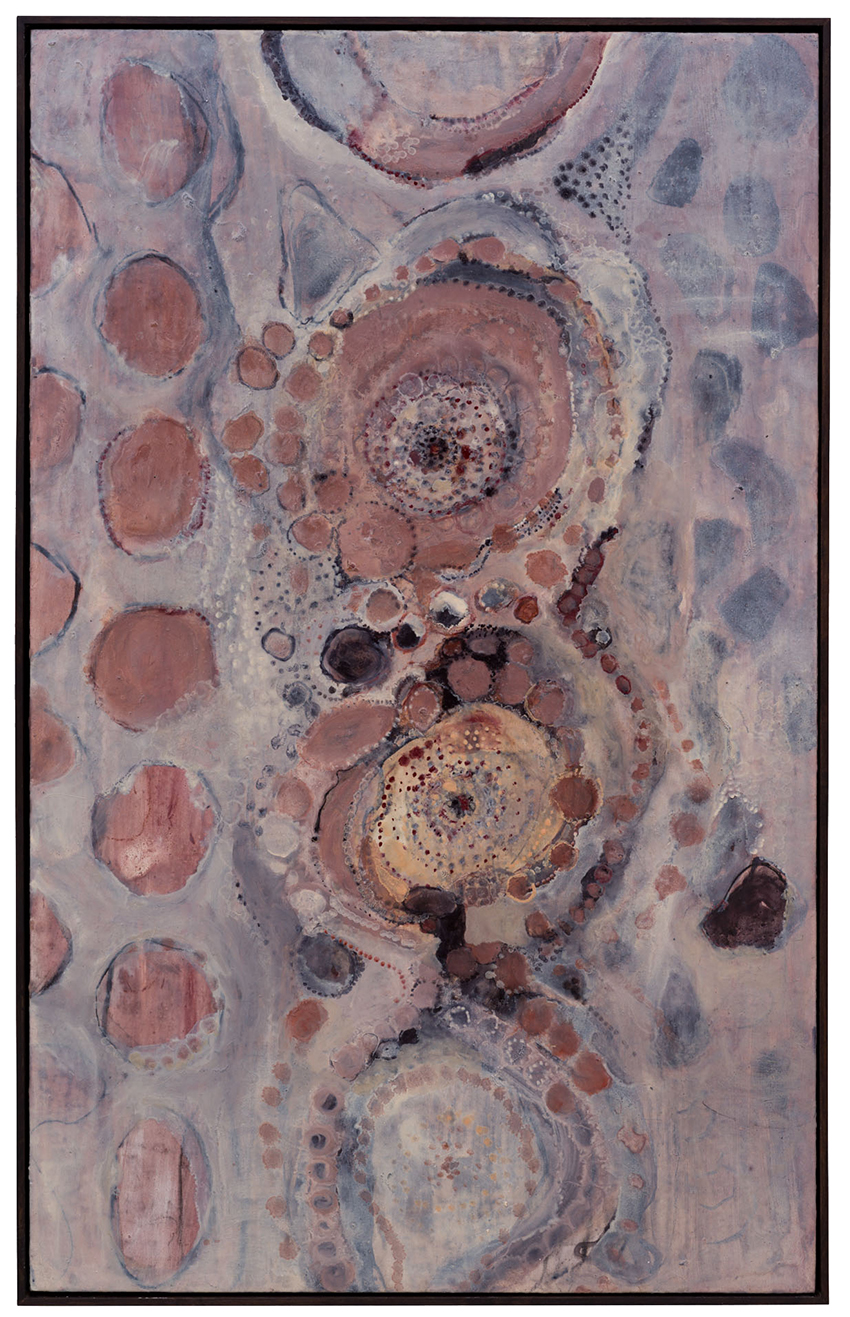
The experience of viewing Sugihara’s paintings in Respirare was akin to encountering enlarged images of organs or cells—difficult to make out at first, even though there’s a lingering feeling of familiarity, a sense that there’s a bit of ourselves in the visuals before us. Canvases like Molt and Brood (all works 2024) have a biological sensibility to them, as if we are examining the cross-sections of internal organs, yet they are abstract enough to avoid immediate associations with entrails and the strata of tissue within human and animal bodies.
Shades of brown, red and cream tinted the paintings throughout Respirare, as if they were organic matter visible only through gashes on the gallery’s black walls, magnified under spotlight. Fleshy and lush, there was warmth in the thick layers of gesso, oils, pigment and binder.
Sugihara began painting the small, dark Quiet Ending in 2016, when she was pursuing an MA at the Royal College of Art in London. Over time, the painter added fresh coats to the work, grafting new meaning onto the painting until its essence coagulated. The work was only completed eight years later, shortly before the show opened.
The imposing Digestion, meanwhile, has a more regular—and less organic—arrangement of dots that spiral inward. Meant to evoke the digestive tract, which could be understood as a lengthy path that is mostly folded into the compact space of the abdomen, this tight pattern was created by Sugihara by making moment-to-moment decisions at an instinctual level, maintaining a creative connection with the structures within our bodies.
The germinating theme of Respirare was a slight departure from Sugihara’s practice of mining the emotions and memories embedded in human viscera. A set of paintings shown in 2022 at Tokyo’s Misako & Rosen were based on human bones that the artist saw in anatomical drawings. Another batch of canvases created with a lighter palette and presented at London’s Arcadia Missa in early 2024 referenced a model of the human pancreas and a 17th-century drawing of digestive organs. Sugihara’s artworks at Empty Gallery were noticeably darker, even though the birds that inspired them are by any measure freer than most living beings.
It may feel gauche to mount an exhibition in 2024 that holds such a strong association with the Covid pandemic but Sugihara channelled her personal experience in a way that gave Respirare a singular bent. The artist has demonstrated a consistent practice of examining the stories and emotions held within organic bodies, and brought forth an emotive, thoughtful presentation that was accidentally timely: a new bat-transmitted coronavirus that could infect humans was discovered in early 2025. Memories of the pandemic and respiratory complications remain difficult to escape.
Featured image: Molt (winter) by Reina Sugihara, Oil on canvas, artist’s frame, 119.1 x 75.2 x 4.4 cm, 2024. Courtesy the artist and Empty Gallery.
Evaporates at Kiang Malingue’s Sik On Street space is organised by Yu Ji, and is the first chapter born out of the self-organised residency program in Phnom Penh, Cambodia. Featured in the exhibition are works by all artist friends who participated in PLAY KNOW ATTENTION: Casey Robbins (Vermont, New York), Ho King Man (New York, Guangzhou), Kojiro Kobayashi (Tokyo), and Boat Zhang (Tokyo, Shanghai). The artists reminisce about the space and time of the residency in Hong Kong, living together again at Kiang Malingue in the last month of 2024.
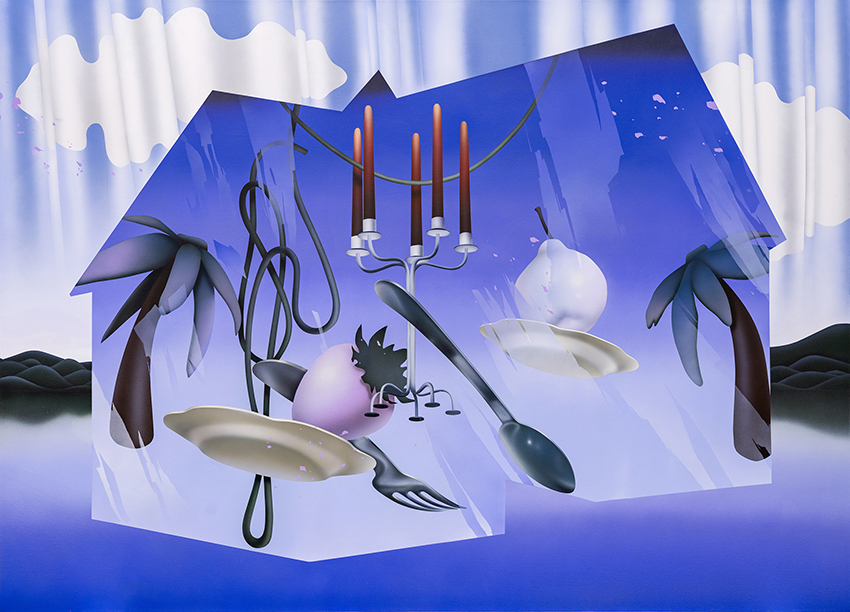
Here Today, Gone Tomorrow by Chongqing-based artistHou Jiananis now open at DE SARTHE Hong Kong. The exhibition features a new body of works on canvas that allude to the illusion of fulfillment that manifests in the cross-breeze of consumerist society and digital gratification.
Sweet and plump yet empty and fragile, Hou Jianan’s manipulation of imagery alludes to the way in which our perception of goods is enhanced by technology, resulting in the expanded desire to consume and indulge in materialism. As we are constantly distracted, or arguably numbed, by temptations and entertainment, we fall into a false sense of security as Hou suggests through his portrayal of home environments and domestic objects. With an emphasis on artificiality, the imagery speaks to the illusion of fulfillment constructed and exacerbated by instant digital gratifications.
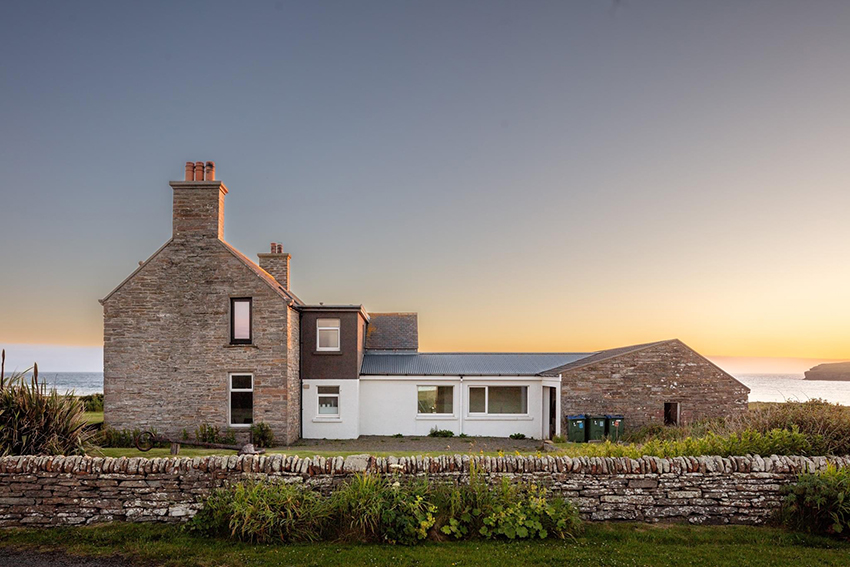
There is an ancient saying on the Orkney Islands: “If you scratch the surface in Orkney, it will bleed archaeology.” This group of about 70 small islands is slightly smaller than Hong Kong but home to only 20,000 people. Despite its small size, Orkney has long produced artists and attracted creatives from elsewhere to its shores. In 1979, a modest yet significant art gallery was established, the Pier Arts Centre, in Stromness, Orkney’s second-largest town.
Scotland’s northernmost art gallery, it’s a sea away from the Svalbard Museum in Norway, the world’s northernmost museum. The gallery was not created by wealthy elites or set up by the government but by Margaret Gardiner, an anti-fascist, anti-Vietnam War pacifist and writer, alongside her artist friends. Gardiner descended from a prominent family – her father was an Egyptologist involved in the discovery of Tutankhamun’s tomb. After graduating from Cambridge University, she briefly worked as a teacher and then, from the early 1930s onwards, devoted herself to social activism. She was also a major supporter of the artists who sought refuge in the southwestern English town of St Ives during World War II and continued to champion the development of emerging British artists after the war. Her first visit to Orkney in the 1950s left a lasting impression on her, leading to long-standing relationships with local artists. She purchased a two-storey house by the old pier in Stromness, transforming it into a space to store her collection of modern paintings and sculptures, and a studio for local artists.
Margaret Gardiner disliked being called a collector. Her close friend, British artist Barbara Hepworth, introduced her to many significant artists. Through friendship and as a means to support them, Gardiner began to acquire an important personal art collection. An archive of the development of British modernism, it later became the foundation of the Pier Arts Centre through her first donation, in 1979, of 67 pieces. Despite its small size, the Pier Arts Centre has one of the finest collections of 20th-century British art, with many pieces often loaned to international exhibitions. It has grown to include more than 180 works, featuring artists such as Hepworth, Sean Scully, Eva Rothschild and local talents such as Sylvia Wishart and Stanley Cursiter. The gallery on this remote island supports the development of young local artists, many of whom return to Orkney after studying elsewhere to hold exhibitions. We attended the solo exhibition of locally born-and-bred artist Leah Moodie, a recent painting graduate of Edinburgh College of Art, which was excellent.
During my visit to the Pier Arts Centre for the first time, I particularly admired the works of Wishart, who was born in 1936 in Stromness. Her paintings primarily depict Orkney’s landscapes – rolling farmlands, a dynamic sea and solitary lighthouses, churches, mills, docks, farms and castles in vast surroundings. She grew up in Stromness, working at the town’s post office while painting in her spare time to express her deep love for her birthplace. Encouraged by friends, she enrolled at Gray’s School of Art in Aberdeen in 1955, where she was a leading light. Her paintings, silkscreen prints and etchings documented Orkney’s changing seasons, agricultural and wildlife scenes, the dramatic views across straits, steep cliffs and the majestic Scottish landscapes. What impressed me the most was how she combined outdoor sketches with detailed observations of Orkney’s unpredictable weather and scenery seen from indoors, through windows as well as the reflections on the windows, while merging the two. She used paint and texture to construct layers and shapes or simply left areas of space blank to evoke the island’s crops and native landscapes.
While she taught for years away from her hometown, Wishart would always return to Orkney during holidays to work on her art. She transformed an old warehouse by Stromness harbour into her home and studio, later helping Gardiner to turn it into the Pier Arts Centre. Wishart taught at Gray’s School of Art from 1969 for nearly two decades, influencing many Scottish artists and students, including Pier Arts Centre’s current director Neil Firth and even Hong Kong artists such as Christopher Ku and Joe Fan. For the last 30 years of her life, she lived on the islands and kept creating drawings and prints inspired by Orkney’s ever-changing landscapes, where fields meet the sea.
I led our first workshop during the residency. Local residents were recruited to use The Orcadian, the island’s only newspaper, as material to make collages of poems, storybooks and zines. Surprisingly, even in such a sparsely populated area, the workshop was full. Participants from all walks of life came together to explore new ideas in their conscious and unconscious minds, creating beautiful works in just a few hours.
The Orcadian newspaper collage poetry workshop. Courtesy Wong Ka Ying.
An archaeologist said that history was repetitive. She had excavated a site while reading daily news on wars. She was of the belief that time would eventually bring peace. A retired teacher who came to Orkney every year for quiet reflection found herself pondering the meaning of farewell, prompted by obituaries in the newspaper and news of a friend’s terminal illness. A writer stuck in a creative rut returned to Orkney, his birthplace, to find inspiration. Reading the news about the ocean brought to his mind the connection between life and home, and the question of where to go next. A reporter from The Orcadian, who was also a poet, had been interested in the workshop from the start. He quickly gathered poetic sentences from the newspaper, piecing them together with speed due to his professional familiarity with the material. Three young art students, meanwhile, earnestly worked on their visual diaries documenting their summer on Orkney. Our artist Phoebe Man created a collage of island flowers related to her residency project on commemorative wreaths, while Sara Tse focused on collecting newspaper images of the Orkney wildlife – wild hares, puffins, sea lions, whales – that inspired her soft sculptures. Shirley Tse explored the theme of renewable energy, combining news about tides with emotional astrology readings to create a romantic zine about the moon and astronomy.
Workshops such as these are vital in a residency, allowing artists to engage meaningfully with local residents. We are grateful for the interest Orcadians showed in us. By creating art, we transcended the boundaries of language and cultural background to communicate our thoughts and feelings directly, and spent a delightful weekend together.
Although the population is small, Orkney has produced a remarkable number of artists, undoubtedly related to its stunning natural landscapes and ample living space. There are more sheep than people on the islands and no shortage of land. During our residency, we often encountered artists in various places. Due to a lack of workers, some people might teach in the morning, work at a museum at noon and still have time to go home to create art before sunset. Others, in their 60s, attend art or archaeology courses at the community college out of interest, and in their spare time might work as tour guides or farmers, or take on various odd jobs. The manager of the gallery hosting us is also a print artist, the radio host who interviewed us is also an English teacher at a local school and the museum receptionist is a mature university student. Setting aside healthcare, weather and geographic distance, such a lifestyle is quite enviable: a place with advanced urban infrastructure and community planning but without the stifling fast pace of city life. Many young families are moving to Orkney with their children, hoping to raise them in a natural, low-stress environment.
In the first few days after we arrived, Phoebe Man, who had come ahead of us, led us on a hike to familiarise ourselves with the surroundings. She had already told us that the local thrift shops were interesting, which was a pleasant surprise for our group of
artists, as many of us are fond of antiques and second-hand goods. For example, Pak Chai and Shirley enjoy historical stories and Sara collects vintage items. In my own art practice, I consciously divide materials into two categories. For commercial events or gallery works, I use new, mass-produced materials; but for community or nonprofit projects, I collect second-hand items that I come across by chance, which often have their own stories. The gift economy is reflected in the circulation of objects within the community, where things that no longer serve one person find their way to someone who needs them. Some objects carry personal or community stories, becoming tangible history through the passage of time and oral traditions. By transforming these objects in an artistic way, I give them a new life beyond their original purpose, adding layers of interpretation and appreciation, while increasing the potential for their stories to be passed down. Of course, there are some beautiful antiques that I am reluctant to alter, fearing I might destroy their inherent beauty due to my modest abilities. I prefer to collect the cheapest, most neglected and often broken second-hand items for my re-creations.
We visited the thrift shops in Orkney regularly, and each visit brought new surprises. I especially paid attention to items that were stuck on a shelf or objects that appeared in multiple shops in similar styles, as these reflect a kind of collective taste or lifestyle, which could be tied to local culture, customs or the after-effects of surplus production and marketing by large companies. One of my most vivid memories is stepping into a second-hand shop and hearing a popular old song playing on the radio. Before the song ended, we left the shop and walked into the next one, where the same radio station was playing the same song. At the third store, I finally heard the radio host’s voice – same street, same island, same local radio station and a shared rhythm of life. After observing and collecting for over a month, I became particularly fond of the pet-themed jigsaw puzzles and mirror hangings. Both are declarations of love meant to be displayed at home – uncool, direct, cute and somewhat useless, making them perfect for re-creation.
The house we stayed in had plenty of studio space, allowing each artist to fully focus on their work. Such a luxury is unimaginable in Hong Kong. Although our residency was not long, the work-life balance and the relaxed pace of life, with the town winding down by 4pm, greatly increased our productivity. While there are a few art supplies shops on Orkney, they are not the professional kind you might imagine, and some specialised supplies still need to be ordered by mail or brought in from elsewhere. But this didn’t dampen the creative spirit and drive of the artists. In addition to working on our own projects, we participated in a workshop at a local print studio, learning 18th-century techniques to create Pride Month posters.
Orkney street landscape collage by Pak Chai. Courtesy Wong Ka Ying.
Not long after our return to Hong Kong, we heard that the UK government was slashing its arts funding due to the weak economy. In response, Scottish artists organised petitions and gatherings, urging the government to reconsider. The historical print studio on the island, which has not been profitable for years, relies heavily on government support for education and conservation efforts. They quickly issued a statement, hoping the government would rethink its decision. In a community where both a free market and gift economy coexist, even a remote island like Orkney cannot escape the constraints and influence of larger systems.
There is not much information about Orkney available in Chinese, which is one of the reasons why this exchange programme holds so much value: island-to-island dialogue and resonance. Hongkongers might not have heard of Orkney but Orkney residents seem to know Hong Kong quite well. We met people who had visited relatives in Hong Kong, passed through Hong Kong on a layover, worked there or even lived in Hong Kong and started families as a result. They are well informed and concerned about the current events and news coming out of Hong Kong. A place it takes three flights to reach from Hong Kong might seem worlds apart in a physical sense, but in terms of spiritual significance, the distance between the two is shorter that one would imagine. We will continue to recount the people we met, the events we experienced and the art we created during our residency, in the hope that with a little more background knowledge, readers will see themselves in our stories.
在奧克尼群島(Orkney Islands)有句古諺語:「只要你輕刮地面,考古文物就會浮現。」由多達70個小島組成的群島,面積約香港一半大,人口只有二萬人,多年來卻盛產藝術家,又吸引不少外地藝術家移居小島,甚至在1970年代尾建設了麻雀雖小但意義重大的美術館,那就是位處奧克尼群島第二大城鎮斯特羅姆內斯.(Stromness).的.Pier Arts Centre。
Pier Arts Centre.成立於1979年,是蘇格蘭最北的美術館,一海之隔就是世界上最北的博物館,位於挪威的.Svalbard Museum。最令人神往的是美術館並不是由財閥巨擘或是政府主導設立,而是由反法西斯、反越戰的和平主義份子和作家.Margaret Gardiner.和藝術家朋友們一起建立的。當然.Margaret Gardiner.的家庭來頭也不小,她的父親是有份協助打開圖坦卡蒙墳墓的埃及學家,Margaret.在劍橋大學畢業曾短暫擔任教師,其後在1930年代早期開始全力投入社運,並成為二次大戰時小部份往聖艾夫斯(St. Ives)尋求庇護的藝術家們的主要支持者,且於戰後大力支援英國新生代藝術家發展。1950年代她初次到訪奧克尼後便深深喜歡上島嶼,與本地的藝術家建立了日久的聯繫,後來購入了斯特羅姆內斯舊碼頭邊的兩層房子,改造來收藏她的現代繪畫和雕塑作品,以及讓島上藝術家作為工作室。
Margaret Gardiner.討厭被稱為收藏家,她的摯友,英國藝術家.Barbara Hepworth.又介紹了其他重要藝術家讓她認識,因為友誼和幫助藝術家,Margaret Gardiner 得以收集了一批非常個人且重要的藝術收藏,這些作品密切記錄了英國現代主義的發展,其後於1979年捐出了67件藏品,Pier Arts Centre.由此成立。儘管規模不大,但.Pier Arts Centre.的館藏被認為是英國20世紀藝街最優秀的收藏之一,重要作品經常借展於世界各地展覽,收藏不斷增長,現已包含超過180件作品,包括.Barbara Hepworth, Sean Scully, Eva Rothschild, Olafur Eliasson.等人的藝術品,還有當地藝術家如.Sylvia Wishart.和.Stanley Cursiter.的作品。偏遠的小島上的美術館多年來一直支持本地年輕藝術家發展,這些以藝術為志業的年輕奧克尼人往外求學後,再回到出生地辦展覽意義非凡,我們是次參觀了出生和成長於奧克尼,剛畢業於.Edinburgh College of Art.主修繪畫的Leah Moodie.的個展,很不錯看!
首次到訪.Pier Arts Centre,我最喜歡的是1936年生於斯特羅姆內斯的Sylvia Wishart.的畫作。Sylvia Wishart.的畫多描畫奧克尼的自然景色:起伏的農田和多變的大海,和立於廣闊景色次中的燈塔、教堂、磨坊、碼頭、農莊和城堡。在小鎮長大的Sylvia Wishart本於鎮上的郵局工作,閒時才畫畫表達對出生地深刻的愛,後來在朋友鼓勵下1955年才到亞伯丁(Aberdeen)的.Gray’s School of Art.求學,大放異彩。Sylvia Wishart的繪畫、絲網印刷和蝕刻版畫記錄了奧克尼的季節變換、農業和野生動植物景觀、橫跨海峽的壯麗風景,遠處山丘的陡峭懸崖以及蘇格蘭的壯闊土地。我最印象深刻的是她在腦海中用幻想將在室外寫生,與在室內觀測到外面陰晴不定的天氣和景象細節在構圖上相結合,然後藉描畫窗戶及其反映出的室內家居倒影融為一體,並利用顏料和紋理來構建層次和形狀或是留些空白,以喚起觀者對農作物和本土景觀的聯想。
Sylvia Wishart.就算長年在外教學都會趁假期回到奧克尼創作,並將斯特羅姆內斯港口前的一個舊倉庫改造成為住所和工作室,後來協助她好朋友Margaret Gardiner.將這古屋變成.Pier Arts Centre。她1969年返回.Gray’s School of Art教學,教了差不多廿年,許多蘇格蘭的藝術家、Pier Arts Centre.的現任館長、以至香港藝術家谷敏超和.Joe Fan.都是她的學生。她人生最後的三十年都長居此地,持續創作出受永鹿變化、面靠汪洋的田野景觀啟發的繪畫和版畫。
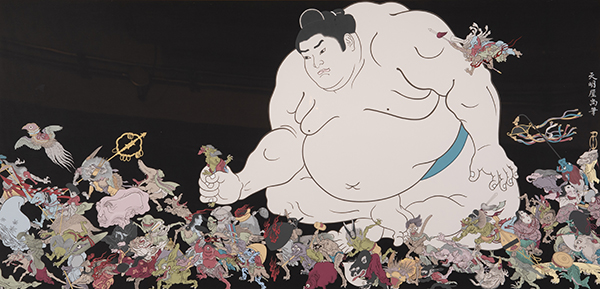
Whitestone Gallery is thrilled to announce the upcoming exhibition of renowned contemporary Japanese artist Tenmyouya Hisashi, opening on 23 November 2024. Born in Tokyo in 1966, Tenmyouya is celebrated for his innovative Neo-Nihonga style, which revives traditional Japanese painting for modern audiences. His vibrant works explore various aspects of Japanese culture, depicting classic icons such as raging gods and Yokai from folktales, Sumo wrestlers, Samurai, and modern Sentai heroes.
Titled Game of Thought, this exhibition invites viewers to engage deeply with the art while embracing a playful spirit. It aims to blend contemplation and creativity, showcasing pieces that encourage reflection and spark joy, transforming the viewing experience into an interactive journey that resonates on both intellectual and emotional levels.
Tenmyouya has participated in significant exhibitions, including The American Effect – Global Perspective on the United States, 1990-2003 at the Whitney Museum of American Art and the 17th Biennale of Sydney. His works are held in esteemed collections worldwide, including the Museum of Fine Arts Houston, Chazen Museum of Art, Art Gallery of South Australia, and Takamatsu City Museum of Art. These pieces reflect his meticulous attention to detail and his ability to bridge the past with the present, offering a unique lens through which to engage with traditional narratives.
The opening reception will feature a live Taiko drum performance, with Tenmyouya in attendance to share insights and engage with guests. This event offers a unique opportunity to experience the profound narratives and playful spirit inherent in Tenmyouya Hisashi’s art. It promises to be an evening of meaningful engagement and artistic exploration.
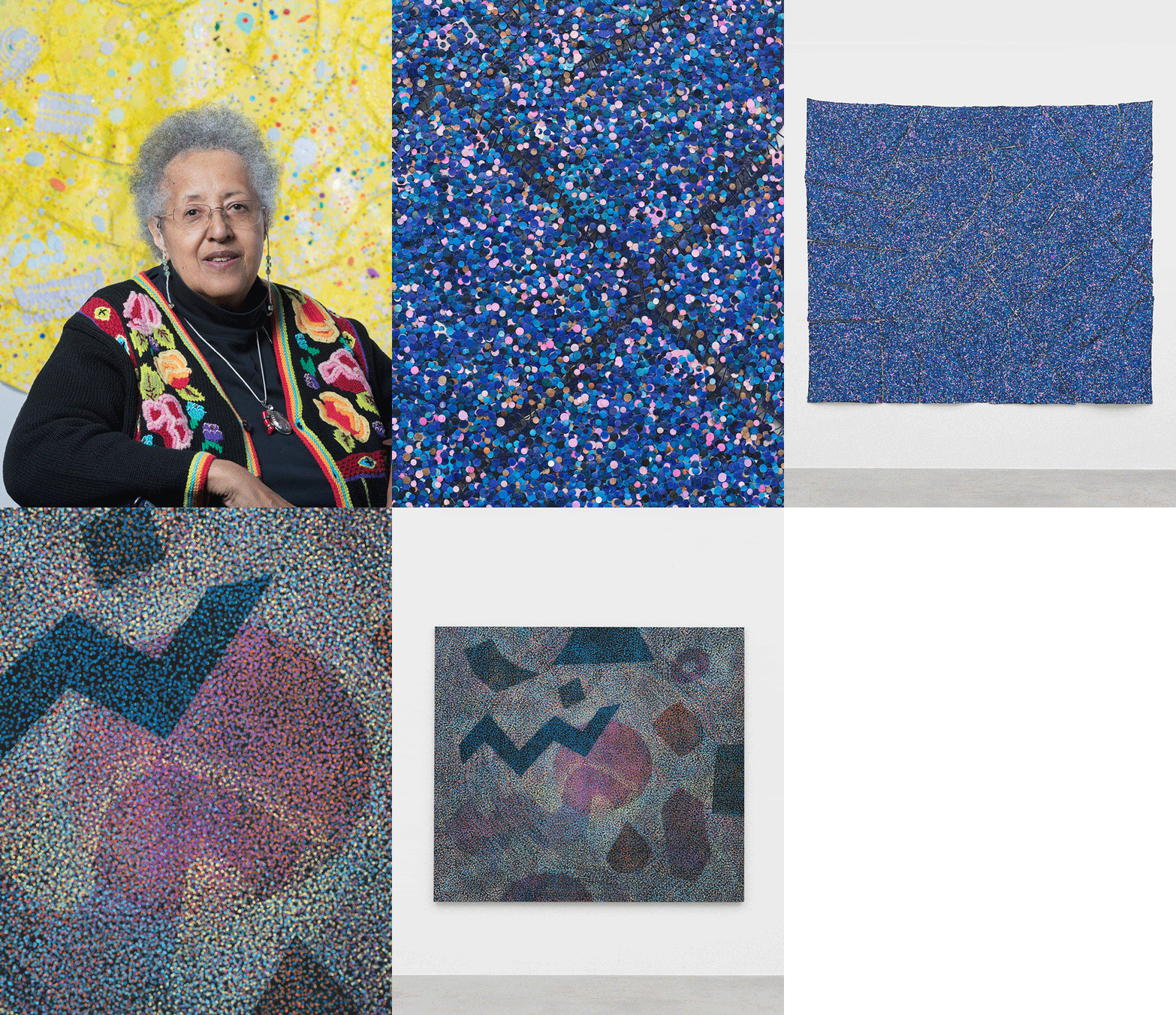
White Cube Hong Kong presents Howardena Pindell’s first solo exhibition in Asia, showcasing the multidisciplinary American artist’s recent paintings that draw inspiration from the visual splendours of the ocean and outer space, alongside the ongoing series ‘Tesseract’ which emerges out of her early work.
Multilayered, illusory and tactile, these works further Pindell’s fascination with the macro and the micro, from the tensions between surface and depth to the relationship between the cosmic and the cellular.
Howardena Pindell’s profoundly personal and politically charged work delivers a dynamic materiality to the canons of painting – serving as much as a diaristic account of her own biography as a means to interrogate broader issues of social justice. With a practice spanning over five decades and encompassing a diverse range of mediums – including painting, collage, drawing and film – Pindell lends visceral form to a rigorous intellectual inquiry of the given subject.
Title of Award: The Third Hengshan Calligraphy Research Award Advisor: Taoyuan City Government, Taoyuan City Council, Department of Cultural Affairs, Taoyuan City Organiser: Taoyuan Museum of Fine Arts | Hengshan Calligraphy Art Center Online Registration Period: From 10:00 AM (GMT+8), December 2, 2024, to 5:00 PM (GMT+8), April 30, 2025.
tmofa-hengshanawards.com.tw
The Hengshan Calligraphy Art Center (HCAC) in Taiwan launches the open call for the 3rd Hengshan Calligraphy Research Award for calligraphy art development in Asia. This year the Award accepts multilingual and published papers on calligraphy and will subsidize the awardees to attend the ceremony, fostering global engagement in calligraphy research.
The Award follows a dual-track system, incorporating both a nomination committee and an open call for submissions. The awardee of the Grand Prize will receive TWD 150,000 (HKD 36,000), while each Merit Awardee will receive TWD 30,000 (HKD 7,200). Through this initiative, the HCAC aims to attract high-quality research from around the world, encouraging participation and dialogue among calligraphy researchers.
In order to broaden the scope of research exchange, submissions are accepted in Chinese, English, and Japanese. Research papers written or published between January 1, 2021, and April 30, 2025, are eligible; authors of published works must provide proof of authorization from the original publisher. Additionally, a travel subsidy will be offered to awardees to attend the award ceremony, with international participants receiving additional funding to cover round-trip airfare.
For more information and to apply, please visit the Hengshan Awards website. The HCAC encourages researchers of all nationalities, ages, and locations to participate, hoping to inspire a rich exploration of calligraphy studies worldwide.
David Zwirner is pleased to announce an exhibition of sculptures and works on paper by American artist Ruth Asawa (1926–2013). Relentlessly experimental across a range of mediums, the artist is known for her works built on simple, repeated gestures that accumulate into complex compositions. The artist moved effortlessly between abstract and figurative registers in both two and three dimensions, creating a vast and varied oeuvre that, despite its visual heterogeneity, reflects above all her belief in the total integration of artistic practice and family life. The first solo presentation of Asawa’s work in greater China, the exhibition provides an overview of the artist’s wide-ranging practice, focusing in particular on her affinity for the natural world, which in turn provided a constant source of inspiration in her art.
David Zwirner is also pleased to present an exhibition by American artist Scott Kahn (b.1946), entitled Once in a Blue Moon, featuring a body of new paintings that focus on the full moon in various phases—with its myriad connotations—as their central compositional element. Also on view will be a selection of landscapes from throughout Kahn’s career, several of which include the moon, often glimpsed in the background, materializing as a sort of omen for the scene laid out beneath. Viewed together, these works exemplify the artist’s distinctive approach to the genre, showcasing his masterful use of formal elements to impart psychological resonances and heighten the theatricality of everyday experience. This will be Kahn’s first solo presentation in Asia and first with the gallery since his representation was announced in May 2024.
“Final bids” on an auction item are called and then, with hammer raised and nothing more from bidders, the auctioneer’s “Going, going” brings it to an end: “Sold!”
This photograph hasn’t much to do with auctions, but it was taken as Sotheby’s and Christie’s were both preparing a radical reorientation of their businesses in Hong Kong. Taking over a space previously occupied by fashion house Armani, Sotheby’s new first-floor retail outlet in Central’s Chater House will sell a range of artwork, including designer furniture and antiquities, on consignment – and, no doubt, dabble in art’s primary market, artwork directly from an artist: always a point of chagrin for galleries, who believe auction houses should deal only in the secondary market. At ground level is another large viewing space that will host the auction floor.
Meanwhile, Christie’s has taken space at The Henderson, Zaha Hadid Architects’ newly completed building in front of the Bank of China Tower and overlooking Chater Garden. The smart interior design, with movable panels and private client areas, is by Hong Kong-founded international architecture office Collective. Christie’s new Asia-Pacific headquarters covers 50,000 square feet over four interconnected floors. The seventh floor can be quickly converted from a viewing gallery into a dedicated auction room. Both auction houses will hold exhibitions and auctions throughout the year in their new spaces, replacing the large seasonal auctions they previously held at the Hong Kong Convention and Exhibition Centre.
GOING is a photograph taken as I was standing on the elevated walkway in front of the Hong Kong Cutural Centre alongside the Tsim Sha Tsui waterfront at dusk. I was focused on the changing illuminated text on the ICC building at West Kowloon. As “GOING” appeared, I realised a small speck on the far side of the camera’s viewfinder was an aeroplane. I very quickly adjusted the in-camera composition and had a moment to photograph it. I particularly like the day-to-night sky at the end of this hot Hong Kong summer day.
Although Gaylord Chan might not be a household name, anyone who regularly commutes on the Hong Kong MTR is likely no stranger to his artwork. On the walls of the passageway connecting Central and Hong Kong stations is a metal plate relief mural titled Swift and Safe that Chan completed in 1998. Vibrant and childlike, the work displays a bold use of colour and vital simplicity that are at the core of Chan’s artistic language.
Born in Hong Kong in 1925, Chan was one of the most original painters in the post-war period, and also served as a dedicated arts educator to generations of students and enthusiasts. Although he only made his first serious foray into painting at the age of 42, he quickly garnered attention as a promising artist in the 1970s after graduating from an extramural art and design course at The University of Hong Kong. Thereafter, he steadily developed a repertoire of abstract paintings and digital drawings over the span of five decades that continues to resonate with life in a rapidly globalising, increasingly technological world.
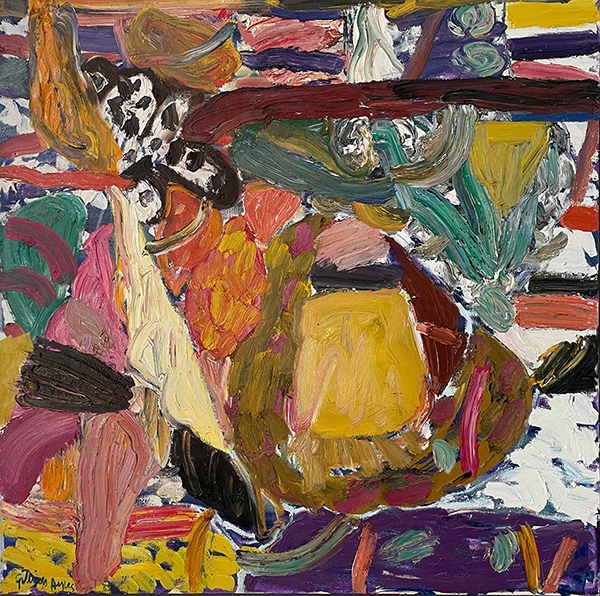
A Scarecrow by Gaylord Chan, Acrylic on canvas, 125 x 125 cm, 1979. Collection of Peter Lau. Courtesy Asia Society Hong Kong Center.
Chan grew up in a modest family as the elder of two children. His father passed away when he was very young, and he lived with his mother and sister on Lion Rock Road in Kowloon City. For a time, he attended a traditional Chinese private school (sishu) that focused on classical Confucian teaching. As soon as he was old enough to work, he joined the British telecoms company Cable & Wireless as a junior operator. Under the company’s training, he not only acquired fluent English but also rose through the ranks to become a certified engineer. One of his most significant achievements was serving as deputy manager for the construction of the Hong Kong section of the Okinawa to Luzon submarine cable in 1977. In 1985, he was made an MBE by Queen Elizabeth II for his contributions to telecoms.
Although Chan had always had an interest in art, he never had the leisure or means to pursue it in his youth. What finally motivated him to learn painting seriously was a mid-life tribulation – he enrolled in HKU’s extramural art classes in 1968 to alleviate a deep depression stemming from his first wife’s battle with throat cancer. He decided to enrol for certificate qualification, which required him to study a robust, three-year syllabus that included practical training as well as art history. The tutors were a star-studded cast that included the Austrian graphic designer Henry Steiner (b.1934); British curator John Warner (1929-2024), who was then also the curator of the City Museum and Art Gallery; and famed local artists such as Wucius Wong (b.1936), sculptor Cheung Yee (1936-2019) and Hon Chi-fun (1922-2019). According to Chan’s recollection, the most demanding classes were taught by the architect Tao Ho (1936-2019), and many eventually dropped out of them: he was one of only three students who managed to graduate in a cohort of 75.
Two years after graduating, Chan held his first major solo exhibition at The Excelsior hotel in 1973, debuting a naive style of painting featuring totemic forms. He coined this style “phylosym”, a term that he created by combining “phylosophical” [sic] and “symbolic.” If this was an emerging artist’s ambition to distinguish himself by coining a new style, he made little mention of it thereafter. He was never one to believe in labels, and “phylosym” seems more a word that he made up to appease a quizzical journalist than a new aesthetic that he wanted to leave in the art history books. As he once said:
“A lot of people confuse visual arts as a cognitive activity. When they see a painting, they ask, ‘What does this picture look like?’ But a painting doesn’t have to ‘look like’ anything, just as how we don’t listen to a piece of music and say it sounds like a cow or a bird. The sensations achieved by a mellifluous cadence make a piece of music. So why do we have to say what a painting looks like? This already means that we are not directly experiencing it.”
Monument for Those Still Alive by Gaylord Chan, Acrylic on canvas, 122 x 122 cm, 1983. Private collection. Courtesy Asia Society Hong Kong Center.
Painting was a medium to express his feelings, and he gravitated towards abstraction because he considered it entirely emotional: “What I understand as ‘abstraction’ is the taking away of mimetic representation. What will remain in a painting after that? I think only feelings.”
Chan was fond of using symbolism to express emotions and convey ideas, and the forms that he relied on often recall indigenous art and ancient artefacts. He was always open about his fascination for Inuit cultural objects, and that because he was studying them so often, they found their way into his paintings subconsciously. The recurring motifs in his paintings, such as tines, circular and elliptical shapes that are often nucleated, and spurred lines are all prominent features in prehistoric Inuit objects. At the same time, he took inspiration from sources as varied as ancient Chinese bronzes, paper cutting, shadow puppetry, traditional Indian textiles, Tarot cards, festive Cantonese flower plaques and trinkets from all over the world. He was invested in understanding how all kinds of form convey meaning, and he assimilated the logic of those that he considered most evocative, which was often the essential geometry that structures our world.
For all the references to folk and indigenous motifs, he painted many more pictures based on his daily observations. He had a habit of using a camera to capture inspiration; unassuming objects, from stationery to vegetables, all became vessels into which he channelled his thoughts and feelings if he saw fit. The art critic Nigel Cameron once likened Chan’s paintings to “fetish objects” because they are often larger-than-life portraits of a single motif. But when these works are considered in context with each other, certain thematic threads begin to surface.
Chan tended to transform mundane objects into unstable, often threatening instruments that betray anxiety about life’s uncertainties. For instance, A Scarecrow (1979) transforms something usually only frightening to birds into a gargantuan creature with thrashing tentacles that threatens to transgress the canvas. The anxiety that often underscores his paintings is unsurprising when we consider how he lived through some of Hong Kong’s most tumultuous, gruelling times. He came of age during the Second World War Japanese occupation of Hong Kong. At a time when locals in the city struggled to survive, he took up the mantle of the family and made dangerous treks over mountains to Yuen Long in the New Territories to source rice with a carrying pole. In the post-war period, he experienced Hong Kong’s rapid modernisation, alongside waves of refugees flooding into the city, rampant corruption and stark labour inequalities. Although he never expressed any social commentary in his paintings, the humble objects that come to life in strange contortions under his brush convey an overwhelming sense that life can grow sinister out of the blue. His lament for the folly of humankind is more subtly expressed in Monument for Those Still Alive (1983), a rare work in his career that directly alludes to warfare and death, after witnessing and surviving over half a century of social upheaval and loss.
Another related and perhaps more personal thematic thread that emerges from Chan’s oeuvre is confrontation with mortality. Growing up, he was an athletic thrill-seeker who loved hiking up Lion Rock mountain, camping in Sai Kung with his friends and swimming for hours on end in open waters, with a small blade strapped to him in case of sharks. Yet he was also afflicted by many ailments, including a case of appendicitis that required surgery without modern anaesthetic. Later in his adult life, he suffered from a series of major health problems, including a stroke that impaired his motor skills in 1998 and lung cancer in 2001 that made it impossible for him to continue painting. His personal struggles with his corporeal “cage” come through in many works that represent the body as fragmented or grotesque. For instance, Hang (1995) depicts some sort of broken alabaster statue missing its head and arms, but subtle shading on the figure gives it a dejected sense of life that is magnified by a seeming pair of leaden dumbbells weighing down on the decrepit body. Still, he was anything but a pessimist. As he proved resilient in every health battle, many of his paintings also resist mortality – Never End (1995) portrays a pair of cheeky buttocks being propelled by hurdling limbs that show no sign of stopping.
3 x 2 by Gaylord Chan, Acrylic on canvas, 92 x 122 cm, 2010. Collection of the artist estate (Chow Suk Fan). Courtesy Asia Society Hong Kong Center.
After Chan retired from permanent duties at Cable & Wireless, he became a full-time artist and founded the Culture Corner Art Academy (CCAA) in 1989 with fellow painter Josephine Chow. Located inside a shopping arcade in Tai Po, CCAA mainly catered to neighbourhood children and teenagers in the urbanising new town. But shortly after opening its doors, Chan also initiated a nine-month weekly acrylic painting course for adults. He was motivated by a simple question: is it possible to devise a single syllabus that can successfully teach students of varying capabilities how to paint? To this end, he recruited an inaugural class of six students with different backgrounds, including some who had no prior experience of painting. His instruction was largely distilled from what he himself was taught on HKU’s certificate course, but he also integrated his own experience and insight over the years to develop a pedagogy that aimed to help students discover their own interests and potential rather than training them in particular skills or styles. He summarised his teaching into a simple rule of thumb: “Fifteen-word truth: front and back, void and solid, light and dark, form, colour, texture” – a grammar of painting that he both preached and practised.
Throughout his career, he was particularly fond of using acrylic paint. The self-taught artist Ha Bik Chuen (1925-2009), a dear friend of Chan, once mentioned the latter’s growing reputation for acrylic:
“[Chan] has been playing with acrylic for over 20 years; word has it that he is now thought of as the ‘king of acrylic’. He is able to manifest the unique characteristics of acrylic in layers that are very thin and nuanced; his impressive technique comes through effortlessly. I’ve seen many who’ve used acrylic for a long time but only treat it as oil paint – they can’t demonstrate its quality. Acrylic can create different transparencies, some translucent, some opaque. He exploits this to vivid extremes.”
Chan was drawn to acrylic paint for its versatile range of viscosities and transparencies, starting when he was studying at HKU. As painting materials were too costly and storage space limited, he would sometimes paint over a work to create a new painting or do over a canvas when he was unhappy with the results. It was likely through recycling canvases that he discovered the charm of layering acrylic.
7 to the Nth Power by Gaylord Chan, Acrylic on canvas, 90.5 x 122 cm, 1995. Collection of the artist estate (Chow Suk Fan). Courtesy Asia Society Hong Kong Center.
As the artist developed his practice, some of his most intriguing works are those that make use of layering to explore the ambiguity of visual perception. 2022 (1992) is his most painstaking such achievement, putting his mastery of acrylic and colour on full display. Commissioned by the Hong Kong Museum of Art, this painting was part of the exhibition Hong Kong 2022, which commemorated the 30th anniversary of City Hall by asking artists to create an artwork that imagined 30 years ahead. Through careful short strokes of translucent colour, he depicts a subtle force swirling towards the centre of the canvas, as if into an intangible future. Compared to his paintings of symbolic glyphs, his abstract canvases exploring pictorial depth feature much more open and atmospheric compositions and a stronger reliance on brushwork. While some paintings use striking contrasts to suggest spatial narratives between different pictorial forms, others forefront the meticulous layering of colour to evoke mysterious expanses. Chan believed that colours could speak on their own, as more than just “adjectives” to forms.
In April of 1998, he suffered a stroke that severely impaired his motor skills. After he was able to return home from the hospital, he took to playing Microsoft Solitaire on a computer as a form of therapy, to retrain his eye-hand coordination. He eventually got so skilled at defeating the program that he grew tired of the game and turned his sights onto another application: Microsoft Paint. After he was diagnosed with cancer in 2001 and lost a quarter of his lungs, he turned to using MS Paint entirely to make art, as he could no longer sustain standing for long periods of time to paint on canvas. Despite its basic functions, MS Paint proved a rigorous medium that challenged him to think about form and colour in a new light. In older versions of the software that he worked with, the undo function could only retract a limited number of changes, and the eraser tool removed both figure and ground indiscriminately, as the same layer. These constraints meant that he not only had to construct a picture carefully but also think through the order in which he drew.
Hang by Gaylord Chan, Acrylic on canvas, 122 x 91 cm, 1995. Collection of the artist estate (Chow Suk Fan). Courtesy Asia Society Hong Kong Center.
MS Paint also encouraged Chan to extend his ideas on the relationship between form and time. Whereas his canvas paintings may have a rustic quality, from paring forms down to the essential, he intentionally created an anachronistic aesthetic in many digital drawings. He often simulated the effect of woodcut prints that recall the German Expressionist work of the early 20th century, which also inspired modern Chinese woodcuts of the 1930s and 40s. But the subjects depicted in these digital “woodcuts” are often still more archaic – an ancient Chinese ding vessel, beasts that evoke the Paleolithic cave paintings of Lascaux, and A tile from Dun Huang (2011). Throughout his career, one of the questions that engrossed him the most was how we are able to tell whether an object is from the present or the past just by looking at it. If his digital woodcuts conflating different eras into one image are his final attempts at tackling this conundrum, the answer is that we are never able to tell for certain. In his heart, he believed:
“A lot of what we now refer to as abstract painting, ancient Chinese splash ink had already done it before. There’s not much point in saying whether a work is abstract or not. What we need to think about is how to convey something very real, an actual feeling, through form, colour and texture – that is what we should do.”
Between this conviction and a lifelong interest in probing the temporality of forms lies Chan’s ambition to create works of art that are timeless. The artist’s legacy shows that art with the power to rouse visceral emotions has the best chance against the tides of time.
Featured image: SR III by Gaylord Chan, Acrylic on canvas, 122 x 184 cm, 1991. Collection of Hong Kong Museum of Art, AC1993.0026. Courtesy Asia Society Hong Kong Center.