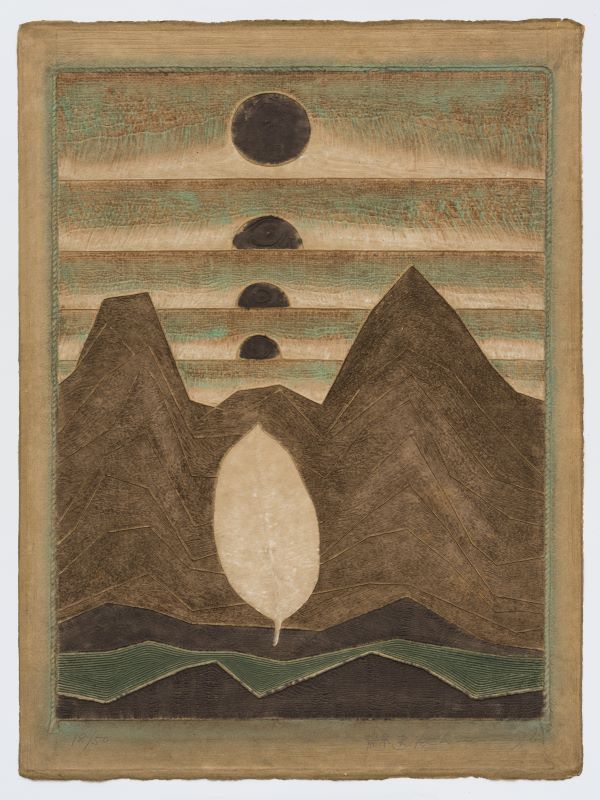
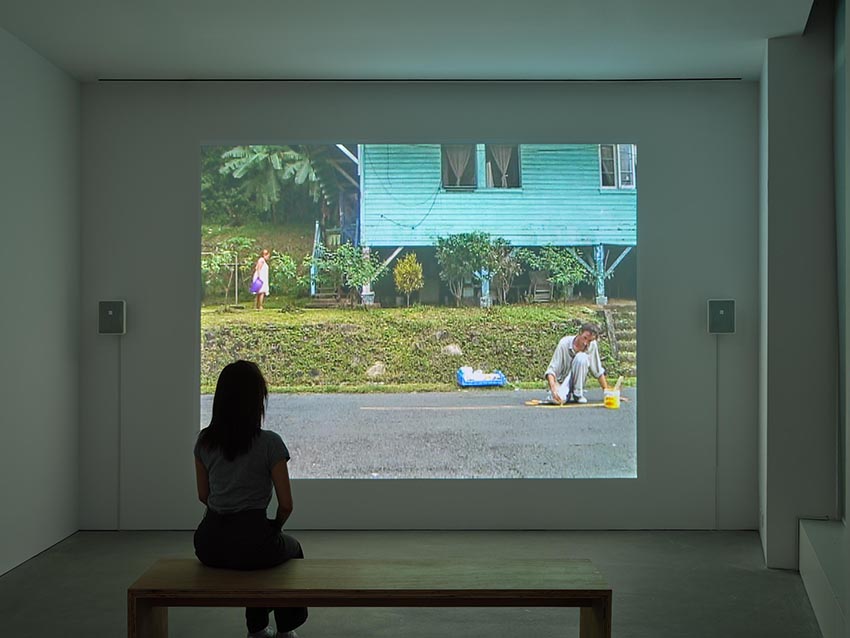
Asia Art Archive (AAA) announces the return of its Annual Fundraiser this October and November, celebrating the organisation’s 25th anniversary. This year’s fundraiser features an auction of over sixty-five works generously donated by artists, galleries, and individuals. The auction presents major pieces by prominent and emerging artists from Asia and beyond, showcasing AAA’s intergenerational and cross-regional reach. Proceeds from the auction will support AAA to continue its mission of preserving contemporary art histories in Asia and providing free public access to resources and education. In partnership with Christie’s Hong Kong, a preview of the artworks opens to the public from 7 to 11 November. The works are available for bidding online at aaa2025auction.com from 27 October, 12nn, to 14 November, 10:30pm.
This year’s auction features work by artists including Au Hoi Lam, Cao Fei, Luis Chan, Huma Bhabha, Ding Yi, Nicole Eisenman, Antony Gormley, Ha Bik Chuen, Ho Tzu Nyen, Heidi Lau, Lee Kit, Hao Liang, Liu Wei, ruangrupa, Vishwa Shroff, Yee I-Lann, Stephen Wong Chun Hei, Xu Bing, Xu Zhen, Samson Young, and more.
Since its founding in 2000, Asia Art Archive has been committed to documenting and sharing histories of contemporary art in Asia. With one of the most valuable and growing collections of over 147,000 records freely available on AAA’s website and in its onsite library, the organisation builds tools and communities to collectively expand knowledge through research, residencies, exhibitions, educational programmes, and publications.
On the occasion of its 25th anniversary, AAA launched a premier archiving facility in July 2025, including a digitisation lab, processing room, and archival storage. This dedicated space for preserving historical records enhances operational capabilities, and serves as a platform to support the archiving needs of local artists and cultural organisations, as well as the professional development of archivists in the field.
Beginning this fall, Asia Art Archive presents its 25th anniversary programme series, Archive for All: Growing with Communities, featuring a year-long exhibition, a publication on Hong Kong art history, residencies, educational resources, and a talk series on archiving. Through Archive for All, AAA aims to bring archives to life and engage local communities in preserving their artistic legacies.
AAA’s 25th Anniversary Fundraiser is supported by Altaya Wines, Christie’s Hong Kong, Chubb, Jebsen, The Peninsula Hong Kong, SALONI, and WTW | Willis, along with media partner ArtReview Asia,media sponsors Art & Market, Ocula, Tatler Hong Kong, The Artling, and The Value, and venue partner, The Henderson.
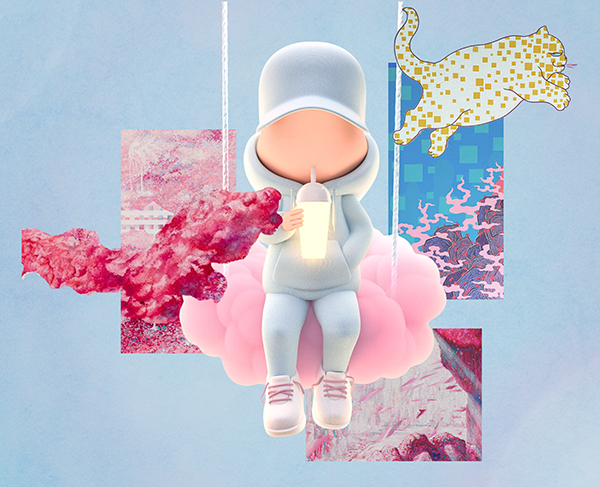
Bringing together three distinct perspectives in contemporary art, this exhibition showcases the work of celebrated French Post-Pop duo Leo & Steph, known for their vibrant character, Kid Cup; Dean Huang, who uses image inversion and mirroring to construct spaces where reality and illusion converge; and Yu-An Liao, who employs distorted, expressive lines to externalize the hidden anxieties and joys of the human heart.
Courtyard of Attachments / M+ / Jun 14 – Oct 12, 2025 / Caroline Ha Thuc /
Courtyard of Attachments, Trevor Yeung’s exhibition at M+, constitutes the Hong Kong iteration of the artist’s presentation for the 2025 Venice Biennale. Distributed across three rooms, one of which is devoted to video documentation, the exhibition has been reconfigured to suit the institutional context of the museum. The original installation featured four site-specific works that incorporated two distinct bodies of water: seawater outdoors and freshwater sourced from the Venice canal indoors.
Central to the project is the notion of relationships explored through absence, mostly articulated through the presentation of 74 uninhabited fish tanks. At M+, this absence is intensified: not only are the fish missing but the water itself has also been removed. The exhibition thus distances visitors even further from the living ecosystems that once animated the installation. Consequently, issues such as water quality, ecological interdependence and human-aquatic relationships are displaced. Instead, questions of care and attachment are replaced by an encounter with their impossibility. The exhibition ultimately stages a dystopian vision of humanity, locked within an isolated, anthropocentric cultural framework.
Installation view of Trevor Yeung:Courtyard of Detachments, 2025 Photo: Dan Leung. Courtesy M+, Hong Kong.
From a curatorial standpoint, the show engages with the complexities and limitations inherent in transposing site-specific installations into a radically different spatial and cultural context. It raises the issue of what remains of the original Venice iteration once it has been relocated to Hong Kong, and conversely, what elements have been altered, damaged or proven impossible to transport – such as the presence of running water from the Venetian canal. Most importantly, it questions how a curatorial narrative and spatial design might be rearticulated in order to accommodate these transformations and to establish meaningful resonance within the new exhibition environment.
Some of the newly constructed narratives appear somewhat tenuous. For instance, the curatorial text accompanying the first installation foregrounds the accumulation of salt deposits and clusters of fungi on the artworks, framing these material by-products as indicators of “survival against the odds” and as an invitation to “imagine alternative modes of existence”. While evocative, the first claim could be applied to any artwork transported from one place to another – and it seems almost comical to think about what it could mean to engage in a so-called alternative mode of existence as fungi.
Whereas the Venice edition evoked the atmosphere of a cultivation centre or industrial facility, the Hong Kong presentation resembles an abandoned scientific laboratory. The first gallery space is immersed in ultraviolet lighting and populated with empty fish tanks, discarded chairs, cabinets, fragments of broken glass and bare desks. At the entrance, a large photograph – Couple in Bubbles (2021) – depicts people in front of a fish shop, holding each other and apparently looking at the fish. It looks like an old souvenir of bygone days when people could buy fish in plastic bags. Highly cinematic, the setting prompts imagination: one might imagine a revolt in which the fish reclaimed their freedom by destroying both their tanks and their human captors. Some works cannot be seen from too close, such as Little Comfy Tornado (2025), previously a complex aquatic system supported by seven filters generating a powerful current. It remains in the dark at M+, out of reach and half broken.
Installation view of Trevor Yeung:Courtyard of Detachments, 2025 Photo: Dan Leung. Courtesy M+, Hong Kong.
The malfunctioning of these systems renders the social allegory of the installation less explicit than in Venice. Without the circulation of water or the bubbling mechanisms that once suggested a stratified, interdependent society, the metaphor of collective functioning collapses. The horizontal reconfiguration of the display further diminishes analogies to social structures. About 20 years ago, duo Map Office exhibited Crab Island (2010), an installation made of 24 aquariums displayed like four towers of social housing units, yet each one was inhabited by real crabs, all living under a purple UV light. Here, it is harder to project the idea of a society, even in ruins, as each piece seems very isolated from the others. The only form of vitality present is that of the audience themselves.
This reflexive dimension is reinforced through Yeung’s use of mirrors. Along the corridor, the wall is covered with distorting mirrors and, within the fish tanks, mirrors also return the viewer’s gaze. In the second room, this motif is developed further with Mx. Tried-My-Best (2025), a work commissioned by M+ consisting of plastic buckets filled with mirrors.
Installation view of Trevor Yeung:Courtyard of Detachments, 2025 Photo: Dan Leung. Courtesy M+, Hong Kong.
Yeung is passionate about fish and has kept them from an early age. A central question guiding his work is whether, when we gaze into a fish tank, we are truly looking at the fish – or merely at ourselves. Which kind of relationships can we build with a pet, especially when it’s confined to a small fish tank? These relationships are inherently asymmetrical: pets exist in conditions of dependence, subject to the authority and care – or neglect and abuse – of their human caretakers. The notion of care, or attachment, can also be questioned. Do we care about the fish we feed themselves or because such care offers us a sense of purpose and self-validation? According to Euromonitor, there were a total of 1.19 million pets in Hong Kong in 2022, with the number of fish expected to increase. What shall we do with these figures and mode of interactions with the living?
The last gallery space presents video documentation that amplifies these questions through testimonial accounts. Exhibition staff from the Venice Biennale describe the daily maintenance tasks required by Yeung’s installations, such as cleaning the tanks to counteract humidity and salt residue. Their reflections suggest that repetitive, utilitarian gestures can foster a form of attachment, even towards an inanimate object. Caring for pets is often an attempt to give purpose to a solitary life. We all remember Tamagotchi, the popular pet simulation game from the 1990s that pushed millions of people into raising and taking care of an egg-shaped device. It revealed clearly how much the idea of pets is a social and cultural construct.
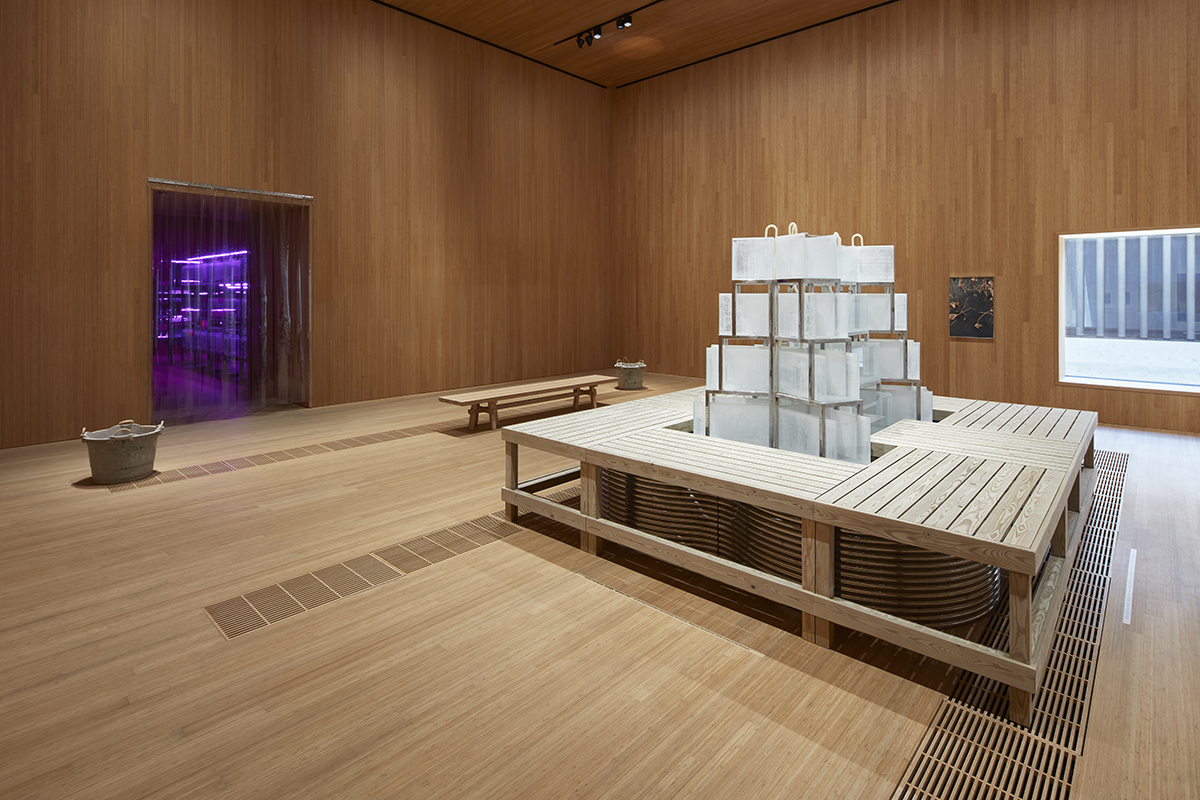
The second room of the exhibition further accentuates this artificiality. With its bright light and empty spaces, it evokes a setting that is at once deserted and absurd. Again, what was shown running in Venice is now out of order and the artworks look like abandoned props. While the exhibition text frames the courtyard as a site for contemplation, the atmosphere it produces is instead one of estrangement and unease. The artworks appear disconnected from one another, resisting a coherent relational structure. At the centre stands a dry fountain, stripped of aesthetic or symbolic vitality. At the back, Gate of Instant Love (2024), once conceived as an entryway, is displayed flat against a wall, stripped of its function and reduced to an inert architectural fragment.
Installation view of Trevor Yeung:Courtyard of Detachments, 2025 Photo: Dan Leung. Courtesy M+, Hong Kong.
Similarly, Rolling Gold Fountain (2024) does not roll any more, since there’s no water to make it do so. The installation was already mysterious in Venice, and here it seems even more strange. The artwork consists of five spheres of a stone resembling citrine, a variety of quartz associated in Chinese culture with prosperity. Whereas such installations typically serve as ornamental displays of prestige in domestic or corporate reception areas, Yeung replaced the expected marble supports with synthetic resin. In their present state, the motionless spheres evoke not vitality but suspension, as though the gallery had been transformed into a waiting room or, more unsettling still, an aquarium designed for human beings.
In his famous novel Axolotl (1956), Argentinian writer Julio Cortázar describes a man so captivated by the amphibians he observes in an aquarium that he ultimately crosses the glass barrier, transforming into one of them. During my own encounter with Yeung’s installation, I found myself drawn to the large windows of the gallery, where birds fluttered among plants growing along the museum’s exterior wall. In contrast to the sterile and reflective interior, the outside world appeared vibrant, animated by non-human life. At least, I thought, Cortázar’s character enjoyed a real encounter with the axolotl. With Courtyard of Attachments, Yeung denies us this possibility. We are directly and constantly sent back within our narrow, anthropocentric vision of the world, alone.
aaajiao, Cao Fei, Chen Chieh-Jen, Chen Zhe, Cheng Xinhao, Ge Yulu, Gong Jian, Guan Xiao, Guo Cheng, He Zike, Phoebe Hui, Jiang Zhi, Kong Chun Hei, Vvzela Kook, Lam Pok Yin, Lawrence Lek, Li Hanwei, Li Shuang, Li Yi-Fan, Lin Ke, Liu Xinyi, Lu Yang, Ma Lijiao, Miao Ying, Shao Chun, Sun Yuan & Peng Yu, Wong Kit Yi, Wong Ping, Xijing Men, Yao Qingmei, Ye Funa, Samson Young, Yu Guo, Zhang Yibei, Payne Zhu Stay Connected: Navigating the Cloud Sep 26, 2025 – Jan 4, 2026
JC Contemporary, Tai Kwun 10 Hollywood Road Central, Hong Kong Tue – Sun, 11am – 7pm
Tai Kwun Contemporary is proud to present Stay Connected: Art and China Since 2008, a panoramic exhibition comprising two chapters and featuring over 70 artists, curated by Dr Pi Li, Head of Art, and Ying Kwok, Senior Curator. The first chapter, Stay Connected: Navigating the Cloud (Sep 26, 2025 to Jan 4, 2026), with more than 35 artists, is installed across three floors of JC Contemporary and in F Hall Gallery at Tai Kwun.
Beginning with Stay Connected: Navigating the Cloud and continuing in Stay Connected: Supplying the Globe (Feb 27 to May 31, 2026), the two chapters are framed through the lenses of digital technology and the manufacturing supply chain, respectively, to portray the diversity of current artistic practices.
Stay Connected: Navigating the Cloud
Navigating the Cloud showcases 35 artists and groups active in China and internationally whose innovative and alternative practices reflect the integration of the internet, social media platforms, and digital technologies into all aspects of daily life.
Since the emergence of the internet, openness has been one of its defining features, enabling users to access a vast array of images, data, and ideas. Yet this promise has been increasingly hampered by rapidly evolving technologies and the systems designed to govern online spaces. In response to the specific conditions of the internet, artists have cultivated their own wild, unruly creativity. Many artists today are exploring ideas of community, solidarity, and mutual support as they seek to reconnect isolated individuals across expansive networks and to explore solutions for society’s many unfolding crises.
More than 50 artworks, including three commissioned works, are presented in eight thematic sections that highlight subjects such as information bubbles, artificial intelligence, communities formed through the internet, and the changing nature of human labour with the use of digital technologies. These sections guide the audience to reflect on how we can overcome boundaries and divisions in order to ‘stay connected’ in a world where the digital and physical realms are already inseparable.
Learning and Engagement Programmes
Over the course of the exhibition, Tai Kwun Contemporary is organising learning and engagementprogrammes such as Teachers’ Morning and Teachers’ Workshops. Held on weekends, GuidedTours: Who’s Next? offer thoughtfully led perspectives on the exhibition by art professionals andguest contributors. Family Day programmes offer tours and activities for participants agedfive and above. The Hi! & Seek corner on 2/F offers a space of dialogue and exploration about theexhibition’s themes.
Contours of Expression / Whitestone Gallery / Hong Kong / Aug 9 – Sep 20, 2025 / Ilaria Maria Sala /
The Hong Kong branch of the Japanese-owned Whitestone Gallery has inaugurated its new Hong Kong space in Wong Chuk Hang with a group show, Contours of Expression. It features four artists: Tsuyoshi Maekawa, a member of the avant-garde Gutai Art Association group, which was active from 1954 to 1972; abstract painter Tetsuo Mizu, who passed away this January, at 80 years of age; Kohei Kyomori, born in 1985; and the Hong Kong and Jingdezhen-based ceramic artist duo Julie & Jesse – Swiss designer Julie Progin and American artist Jesse Mc Lin.
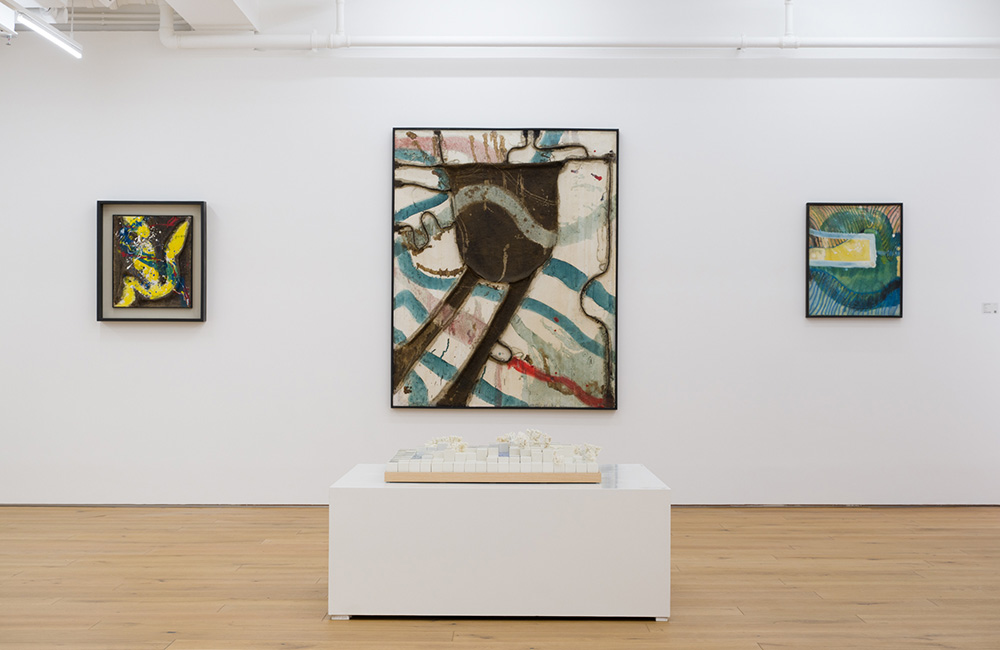
Maekawa’s works date from the early 1960s to 2015 and are all variations of his signature jute/burlap cloth on canvas: using adhesive and paint, he shapes the cloth on the canvas so as to create a three-dimensional element. He adds paint either before shaping the cloth or after, creating abstract works that immediately recall the Gutai approach, with its bright colours and devotion to a process that involved a rather physical approach to art making, going beyond paint and brush. The word gutai itself means “concrete” and is written using the characters for tool and body – when the group was still active, it also engaged in performances, theatre and installations.
Exhibition view of Contours of Expressions at Whitestone Gallery Hong Kong, Aug 9 – Sep 20, 2025. Courtesy Whitestone Gallery.
Work (Nanameni) A-20 (1963), painted on a very pale pink background, weaves sinewy pink, red, blue, azure and brown lines, while a piece of brown jute stretches on the canvas as if it were a primitive container. Untitled 141236 (2014), on the other hand, shows how decades of manipulating the thick burlap cloth has created a deep intimacy between Maekawa’s hands and his favourite technique: the large sack cloth occupies the full size of the canvas. It is fully saturated with glue and has been positioned so as to create large waves and valleys, like the bed of a sharply curving river, made exuberant by splashes of bright yellow, white, blue and red paint. Untitled 160108 (2015) presents the same kind of strong ridges on the canvas, made with burlap and covered in white and blue paint, with just a few splashes of white and red, creating a powerful bridge between painting and sculpture. His later works take a much gentler approach to this same technique, as he used a sewing machine to produce more regular ridges and decorative lines, on which he applied pale blues, greens and purples.
A similar passion for experiment and manual research can be found in a comprehensive selection of Julie & Jesse’s most representative works. The series Anomalous Artefacts (2012) fuses found ceramics shards – pieces of ceramic spoons, horse figurines and teapot handles – using epoxy clay.
The result is a series of fantastical creatures, like a surreal ceramic bestiary, mounted as if they were crawling up the wall in a fairy-tale procession of magical beasts. Since 2022, the artists have been making porcelain bottles using found, broken moulds, which are used and reused, allowing the porcelain slip to fill into the growing mould cracks until the moulds became unusable. The result is ceramic bottles with unexpected forms, like sudden collars or veils that cover parts of the more typical bottle shape. One of these disused plaster moulds is also there at the show, with a thick, wide, blue ribbon around it to keep the various parts together. The Taking Root series (2023) is represented by a number of works in rescued banyan tree, porcelain, glaze and wood that form semi-humanoid bodies turned into planters, to which curvy sticks of polished wood are attached.
Exhibition view of Contours of Expressions at Whitestone Gallery Hong Kong, Aug 9 – Sep 20, 2025. Courtesy Whitestone Gallery.
Mizu’s geometric-abstract works fill the gallery with colour-block canvases that recall nautical flags, or landscapes with a vague Paul Klee echo, but taken to an extreme of abstraction, leaving the blocks of colour to carry all attempts at representation. Kyomori, on the other hand, uses experimentation to mix mineral pigments and UV resins on canvas. A series of works recall decorated Mexican folk calaveras (skulls), like Flowing Skull A-UN col.1 (2023) and S Matsu #1 (2024). On a more traditional Japanese plum blossom painting, resin petals are attached to a black ink tree trunk, rendered in a very calligraphic way.
Through these works, Contours of Expressions inaugurates Whitestone’s new space with highly interesting pieces of a sort not commonly seen in Hong Kong. Through very different aesthetics, the four artists show a keen attention to experimentation, the main thread running through a show that is otherwise somewhat eclectic.
表現的輪廓 白石畫廊 香港 2025年8月9日至9月20日
日本白石畫廊香港空間近日於黃竹坑新址正式揭幕,以群展「表現的輪廓」作為開幕活動。展覽彙聚了四位藝術家的作品,包括前衛藝術團體「具體美術協會」成員前川強,該團體活躍於1954年至1972年間;於今年1月逝世、享年80歲的抽象畫家水島哲雄;1985年出生的京森康平;以及駐香港與景德鎮的陶藝雙人組Julie & Jesse——成員為瑞士設計師Julie Progin與美國藝術家Jesse Mc Lin。
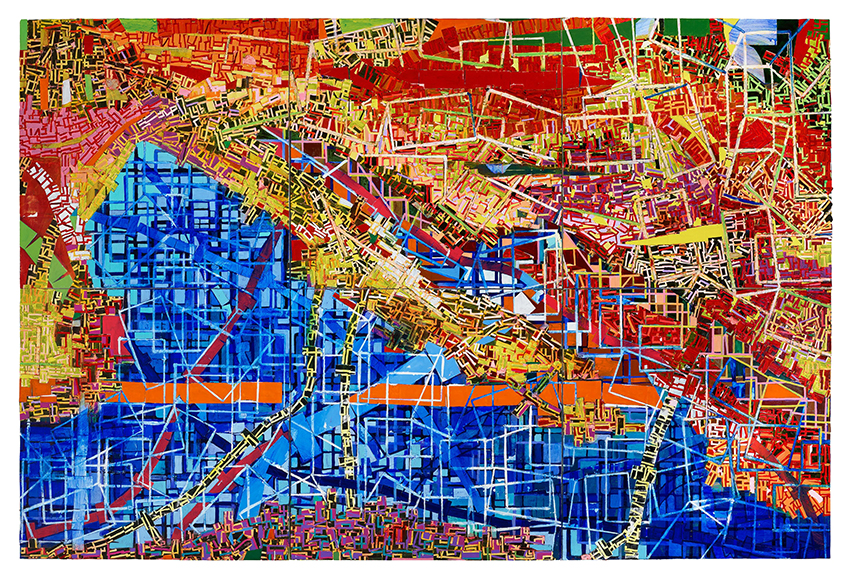
Gagosian is pleased to announce Harbour Fragments, an exhibition of new paintings by Rick Lowe. These works abstract from aerial views of Hong Kong that feature sections of Victoria Harbour, Hong Kong Island, and Kowloon Peninsula, interpreting the dynamic metropolis. On view at the gallery’s location in Hong Kong’s Central district from September 11 through November 1, this is Lowe’s first solo exhibition in Asia.
Taking an exploratory approach to geography and abstraction, Lowe’s practice encompasses both studio work and community-based projects that address urban transformation. His vibrant canvases employ the visual languages of painting, collage, and cartography. These paintings emerge from an improvisational approach derived in part from games of dominoes that Lowe plays with residents worldwide, adapting their intricate patterns and juxtapositions to foreground aspects of urban structures and civic relationships.
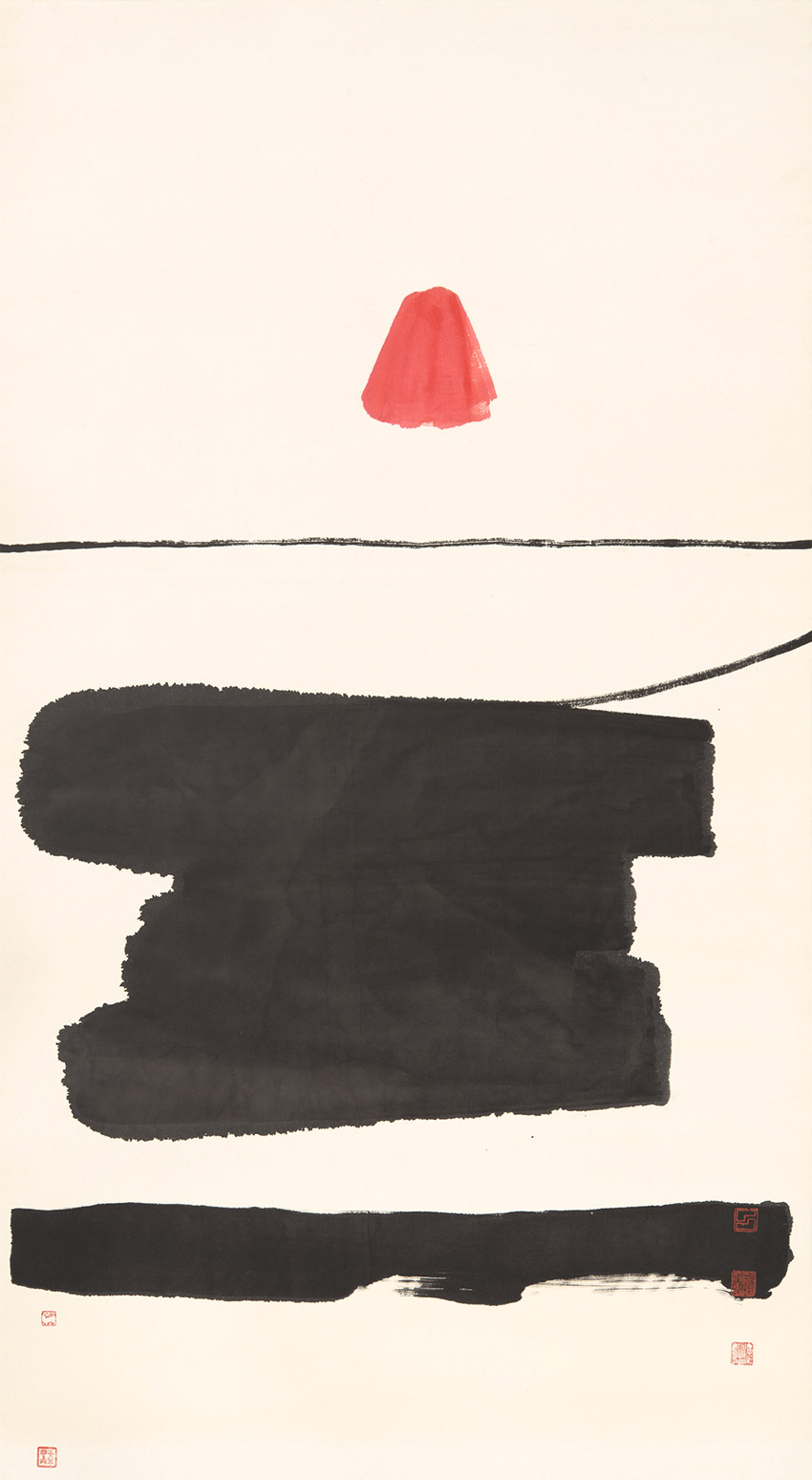
Alisan Fine Arts is proud to present Lui Shou-kwan: Artist Teacher Scholar, commemorating the 50th anniversary of Lui’s passing. This exhibition gathers around two dozen exemplary works across the key decades of the artist’s career from 1951 to 1972. A selection of archive materials on his teachings and writings will also be on display. Together with the publication of a book of the same title, this landmark exhibition aims to re-examine the discursive and wide-ranging influences of Lui through his three distinct, yet interconnected, identities: bold innovator, tireless educator and fierce scholar. Fifty years later, Lui remains one of the most influential artists in Hong Kong’s history, whose groundbreaking approach to art and education continues to inspire generations of artists in the city and beyond.
Born in 1919 to a scholarly family in Guangzhou, Lui grew up immersed in the study of ancient masters. His relocation to Hong Kong at age 28 broadened his artistic horizons, allowing him to blend traditional Chinese influences with Western ideas. This evolution established him as a trailblazer in Chinese art and a founding figure of the New Ink Movement. This exhibition showcases rarely seen works from the Lui family’s private collection, offering examples throughout his artistic career, including landscape paintings of Hong Kong, semi-abstract landscapes, and his abstract Zen paintings.
Fifty years after his untimely death in 1975, his influence on Chinese art continues to expand. Lui championed personal expression and exploration, leaving a lasting impact on the evolution of ink painting. Many of his students became leading figures in the region’s art scene. This exhibition invites viewers to reflect on Lui’s legacy on artistic innovation, cultural placemaking, and lifelong learning.
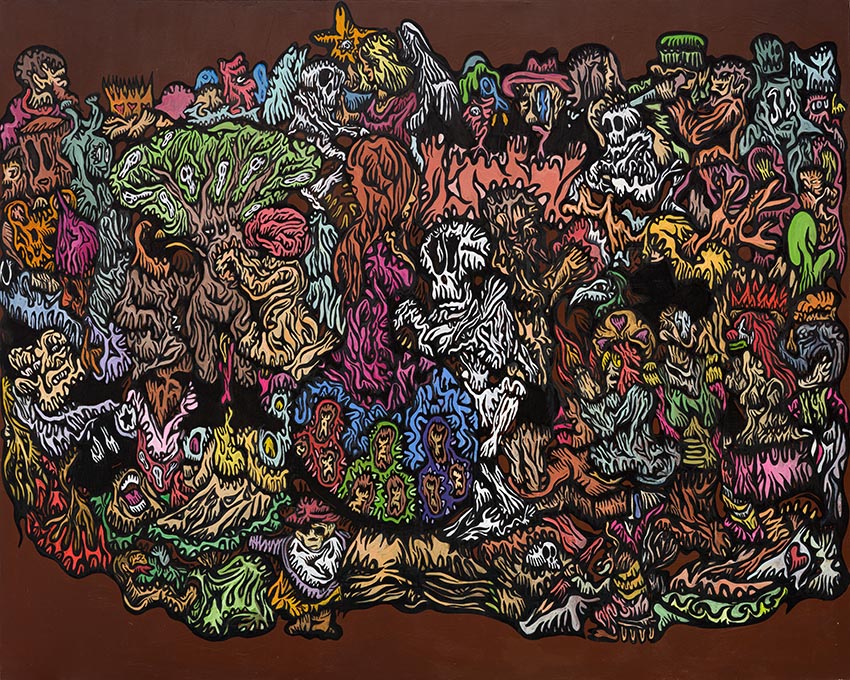
Whitestone Gallery Hong Kong proudly announces the grand opening of its new space in Wong Chuk Hang with the exhibition 50/50, celebrating the 50th anniversary of renowned French artist Fabien Verschaere (1975—). This landmark exhibition showcases a comprehensive selection of works that span his illustrious career, from childhood creations to pivotal pieces displayed in major international exhibitions. The event marks a significant milestone for the artist’s achievements, highlighting a vibrant new start for the gallery.
Verschaere’s philosophy revolves around pushing the boundaries of his artistic practice, creating a dreamlike world that balances humor and depth. His works challenge traditional artistic genres, weaving together complex narratives that invite interpretation.
The exhibition will showcase a diverse selection of Fabien Verschaere’s works, tracing his artistic journey from 1975 to the present. As a graduate of the École nationale supérieure des Beaux-Arts de Paris in 2000, Verschaere quickly gained recognition for his distinctive and prolific creations. Over nearly two decades, his work has traveled globally, featuring in significant exhibitions like La Force de l’Art 02 at the Grand Palais in 2009, and solo shows at the Galerie Traversée in Munich (2012) and the Musée d’Art Moderne de Saint-Etienne Métropole (2014). Selected as ‘French Artist of the Year,’ Verschaere has exhibited in prestigious venues across the UK, Hong Kong, Korea, and France, with works in notable collections from New York to Abu Dhabi and beyond. Each piece in this exhibition reflects his artistic growth, intertwining personal and universal themes. Verschaere’s artistic output is informed by both contemporary influences and historical references, encompassing a wide range of media, including drawings, watercolors, and large-scale murals inspired by underground popular culture and comic strips. His intricate works often incorporate fantastical elements, such as fairies and imps, which he describes as part of a shared visual language.
Known for his highly detailed compositions, he utilises symbols and visual themes derived from various collective traditions, resulting in a distinctive style characterised by decorative and recognisable imagery. Verschaere’s artistic practice intertwines personal narratives with broader existential themes, prompting reflections on identity, emotion, and the human condition. Through his use of watercolors and paintings, he explores concepts of time and space, showcasing vibrant artistic gestures that merge reality with imagination. These creations transform the exhibition environment to theatrical stages, occasionally punctuating the silence with impactful moments, as he views painting a wall as a means of engaging with the space and communicating messages.
The 50/50 exhibition offers a profound exploration of Fabien Verschaere’s artistic landscape, showcasing a unique blend of visual storytelling that invites reflection on personal narratives and shared cultural themes.
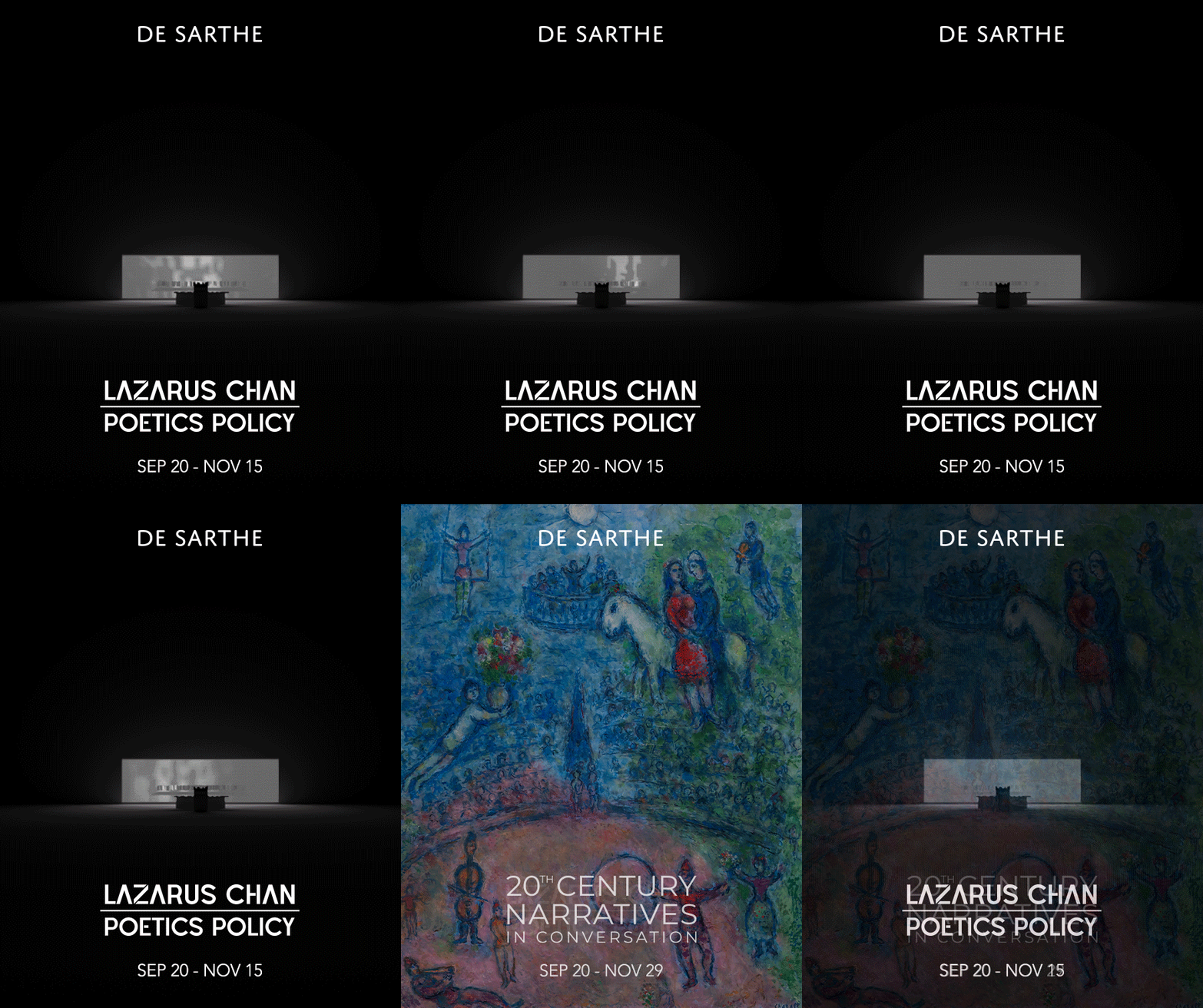
DE SARTHE is pleased to unveil its new and expanded space in the Southside art district, officially opening on September 20th, 2025. Encompassing over 10,000sqft, the gallery’s new home is composed of different exhibition spaces, which will be inaugurated by a solo exhibition by contemporary artist Lazarus Chan, as well as an exhibition of Post-war and Modern works.
The vision for the new space is to showcase the emerging movement of art and technology alongside historically significant artworks to remind of the importance of context in understanding art, whether classic or contemporary. In the same way that master artworks are considered in relation to their era, the gallery maintains that the essence of contemporary art is its relevance to today’s world.
Poetics Policy is the gallery’s first solo exhibition for Hong Kong-based artist Lazarus Chan. Featuring an interconnected body of multimedia and interactive artworks, the immersive exhibition explores the nature of policy-making and the intricate ways in which it manifests in art, machine intelligence, and reality. An imagined simulation of the future, the exhibition is host to a living system built by AI but governed by the artist. Within this space, the essence of art lies not in the generated texts or imagery, but the poetic policies that shape their creation.
Marc Chagall, Chu Teh-Chun, Giorgio de Chirico, Yayoi Kusama, Joan Miró,Henry Moore, Jack Tworkov, Bernar Venet, Zao Wou-Ki 20th Century Narratives – In Conversation Sep 20 – Nov 29, 2025 Opening: Saturday, Sep 20, 3–7pm
20th Century Narratives – In Conversation is a selection of Post-war and Modern artworks, inaugurating the new space with a revitalized vision for public exhibitions of historically significant artworks.
20th Century Narratives – In Conversation brings together paintings and sculptures made in a transcontinental dialogue, featuring influential artists including Marc Chagall, Chu Teh-Chun, Giorgio de Chirico, Yayoi Kusama, Joan Miró, Henry Moore, Jack Tworkov, Bernar Venet, and Zao Wou-Ki.
DE SARTHE 2/F, Block A, Vita Tower 29 Wong Chuk Hang Road Hong Kong +852 2167 8896 Tuesday – Saturday, 11am – 7pm
David Zwirner is pleased to present a group exhibition at the gallery’s Hong Kong location. Border(line) centers on the inescapable thresholds—literal and abstract—that demarcate nations, spaces, and contemporary life, and considers borders as conceptual and psychological states of being.
Bringing together a diverse group of artists from the gallery’s program alongside voices from across Asia, this presentation offers an opportunity for global connection and exchange around the existence and possibilities of such partitions.
The exhibition will feature works by Josef Albers, Francis Alÿs, Chen Wei, Raoul De Keyser, Felix Gonzalez-Torres, Hu Xiaoyuan, James Prapaithong, Prae Pupityastaporn, Wong Ping and Xie Nanxing.
Together, these artists present a multifaceted, cross-generational, and transcultural vision of twenty-first-century life, one that is shaped and reshaped by constantly changing borders, both real and imagined.