Carrie Yamaoka /
Inside Out/Outside In /
Nov 12 – Dec 3, 2025 /
Manshu-in Temple /
42 Takenouchicho, Ichijoji, Sakyo-ku
Kyoto, Japan
Monday – Sunday, 9am – 5pm
Kiang Malingue is pleased to present Inside Out/Outside In, an exhibition by Carrie Yamaoka. Spanning works from the past twenty-five years, this is the artist’s first solo exhibition in Japan, and follows her prestigious 2025 Maria Lassnig Prize.
When approaching a work of Carrie Yamaoka:
Acknowledge the potential of an irreversible intimacy.
Savor your distance to form a holding pattern, as this orbiting could bring you closer to what future proximity might hold.
Recognize your present orientation—physically, mentally, and spiritually—as the inception of your visual recognition and perception.
Consider time’s virtue in the displacement and distance of your encounter. In physics, displacement contains magnitude and direction: walking around the block to return to the starting position yields zero displacement. Yamaoka’s work claims power back from the solitary zero-sum game of life. Walk around that block.
Anticipate the amplitude of your heart to shape the architecture of the self the work offers.
Let the work continue to oscillate in your memory, as it evolves in your absence while you engage, contribute, and transform life through social consciousness and love.
Retrieve it as necessary as a reserve fuel. Sear it with your eyes closed. Retrieve it as necessary as a reserve fuel [1].
Carrie Yamaoka (b. 1957 Glen Cove, USA. Lives and works in New York) is an interdisciplinary artist whose work ranges across painting, drawing, photography, and sculpture. She engages with the topography of surfaces, materiality and process, the tactility of the barely visible and the chain of planned and chance incidents that determine the outcome of the object. Her work addresses the viewer at the intersection between records of chemical action/reaction and the desire to apprehend a picture emerging in fleeting and unstable states of transformation. Her material engagement and rule-breaking strategies embrace accidents and dissolve binaries, such as improvisation/intention, methodology/intuition, and surface/depth. Toggling between visibility and invisibility, overlaying legibility and illegibility, breaking apart and recomposing, Yamaoka’s work is in a constant state of mutation.
Yamaoka considers the viewer’s agency and encounter, in the situated architectural environment and its surrounding conditions such as light, air, and weather, to complete a work, while insisting that an artwork remains mutable. Inside Out/Outside In puts in conversation a range of Yamaoka’s methodology and formal experimentation. Inviting alchemical outcomes through processes of repetition, erasure, and accretion, she cracks open material logic, such as by working on both sides of a surface, its recto and its verso, and the subsequent process of adhering, peeling, and flipping of a work’s strata, often years apart, to create new works.
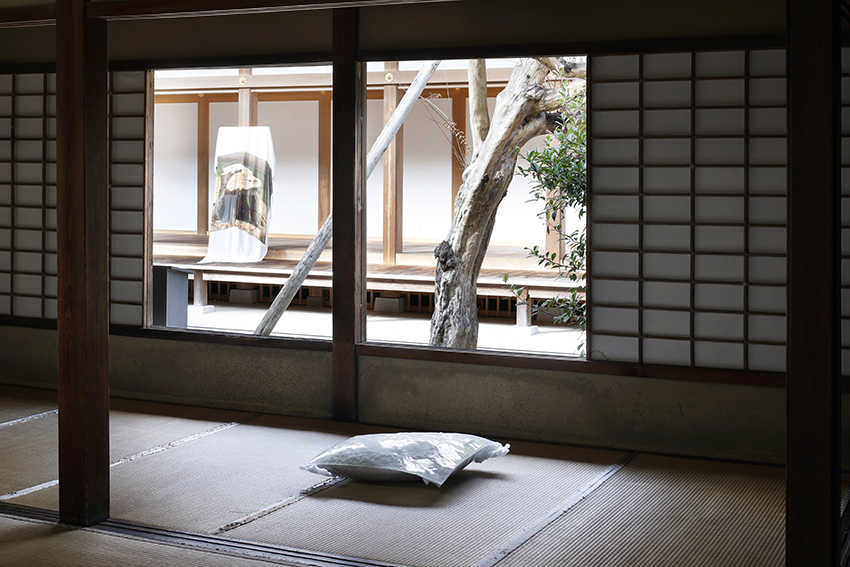
Responding to Manshu-in’s porous spatial boundary between the inside and the outside, Yamaoka guides the viewer by employing the toggling perspectives of looking into and out of, from a distance and close-up. Her works, partially exposed to the elements, catch the intensity of sunlight and shadows at different times of the day, reflect what lies beyond through changing air currents and wind, and coalescing perception with the viewer’s internal rhythm.
Inside Out/Outside In is a significant occasion as Yamaoka’s first solo exhibition in Japan, where she spent her teenage years. The reverse diaspora echoes the ways in which material marks and inhabits dualities: past and present, here and there, outside and inside, always subject to transformation.
[1] Jo-ey Tang, “Epochs become infinite,” in RE: Carrie Yamaoka. (Santa Fe: Radius Books, 2025), 11.
