Agoraphilia /
White Cube Hong Kong /
Jul 10 – Aug 29, 2026 /
A bird-man; one-eyed faces sprouting petal-like rays; life-size mushrooms that function as umbrellas – Shigeo Otake’s surreal paintings feature a curious cast of recurring hybrid characters and motifs.
One in particular, a girl in a red dress, appears in almost all the works on view for Agoraphilia at White Cube Hong Kong. At times she’s peering from a doorway in a corner, placed at the entrance of a market in a public square, in front of a gate or between two tentacled creatures – always poised at a threshold, traversing the invisible porosity between two entities.

19 x 27.3 cm, 21 x 29.3 x 4.5 cm (framed), 2026.
© Shigeo Otake. Photo © White Cube (Kitmin Lee).
With Agoraphilia, Otake creates and explores the possibilities that arise when human and otherworldly realms blur, describing its imagined population as “inhabitants of another world who have somehow slipped into our own, and ordinary people who find themselves in the other world”.
To forge this perspective, the artist needed a figure who represented an ordinary person – the viewer – and conceived the girl in red, whose classic uniform, apparent innocence and curiosity bring to mind the adventurous spirit of children’s-book characters: the French schoolgirl Madeline and Alice of Alice’s Adventures in Wonderland. “She may also be a projection of myself,” Otake says.
The artist is known for putting his own transformative twist on myths and folklore, combining Japanese influences with western, specifically Renaissance techniques to create his paintings.

24.3 x 33.4 cm, 26.3 x 35.5 x 4.5 cm (framed), 2025.
© Shigeo Otake. Photo © White Cube (Kitmin Lee).
At first glance, Otake’s intricately crafted narratives form visuals evocative of storybook illustrations. Numerous influences reveal themselves at once, such as manga and kaiju (the genre of films in which monstrous creatures wreak havoc on metropolises) through his highly stylised figures and the chaos they seem poised to inflict. His complex compositions bring to mind the anarchic frenzy present in Pieter Bruegel the Elder and Hieronymus Bosch’s iconic works, which often depicted large gatherings and life in public spaces. Yet it’s Otake’s niche fascination with fungi and his studies of parasitic life and cordyceps that yield a one-of-a-kind aesthetic – where the perceived social hierarchy of human, animal and vegetal beings collapses.
A self-confessed “insect boy”, Otake has loved insects and enjoyed looking through illustrated books on plants and animals since childhood, as well as science magazines, where he developed a knowledge of cordyceps. However, it was after graduating from university and becoming a painter that he began incorporating fungi as a subject in his work. While staying in a shared mountainside studio on the outskirts of Kyoto, he encountered a large mushroom – over 30cm in diameter – prompting him to research local fungi. He came across a guide featuring the detailed illustrations of Daisuke Shimizu, best known for depicting fantasy landscape art that blends realism and natural scenery with fantastical, supernatural worlds. “I was especially fond of fantasy literature, detective and science fiction,” Otake recalls. “I would like viewers to be surprised by a different expression of a familiar story.”

24.3 x 33.4 cm, 26.3 x 35.5 x 4.5 cm, (framed), 2025.
© Shigeo Otake. Photo © White Cube (Kitmin Lee).
Moments of drama and suspense live in the details of Otake’s vivid visuals, which is especially evident in works such as Phantom Realm Cafe (2026), where long-tongued, fish-like creatures peering from large shrubs in an outdoor cafe seem on the cusp of swallowing diners, waitstaff and their incoming orders in equal measure. In The Magnate (2026), amid what appears to be a potential roadside sale, a surreptitious figure in the corner can be stealing a small pouch hung from one of the wings of Otake’s hybrid bird-man icon.
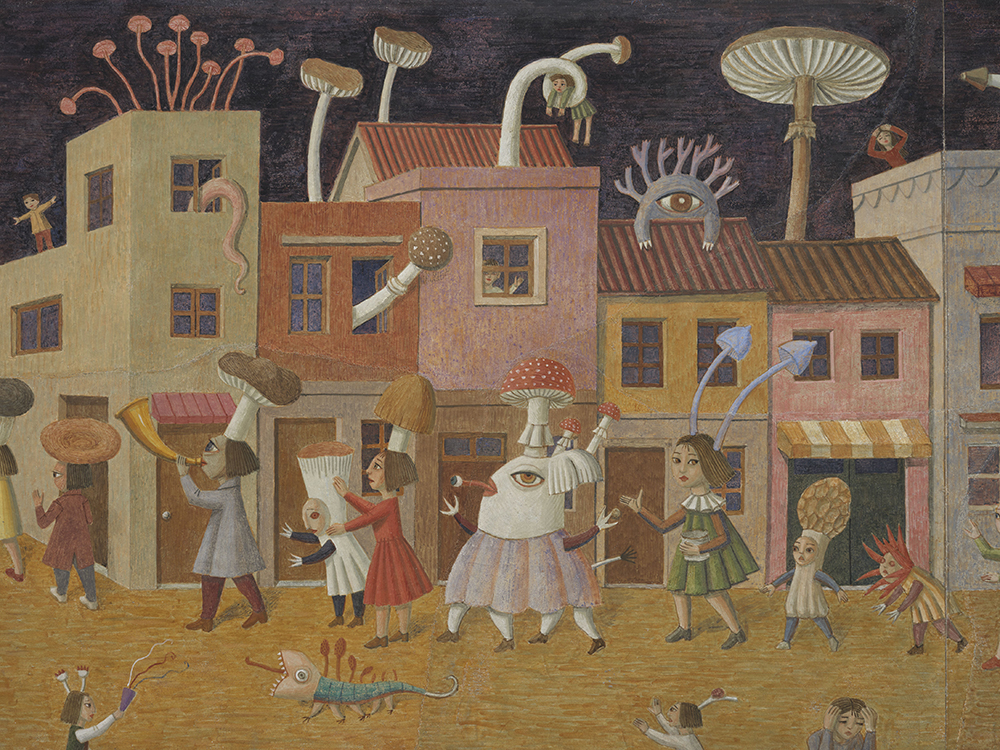
Similar instances punctuate Night Parade of One Hundred Fungi (2026), a two-panel canvas that showcases the artist’s take on Hyakki Yagyō, a nighttime parade of supernatural beings famously depicted by Japanese painter and printmaker Kawanabe Kyōsai, often considered a pioneer of manga. Amid a carnivalesque atmosphere, Otake’s signature creatures – insects, marine life and human-fungal hybrids – lead a procession in front of shops that appear to be closed. All kinds of mushrooms sprout from every surface, from roofs to the tops of various heads.

Overall: 72.7 x 181.8 cm, 2 parts, each: 72.7 x 90.9 x 2 cm, 74.7 x 184 x 4.5 cm (framed), 2026.
© Shigeo Otake. Photo © White Cube (Kitmin Lee).
The level of detail reflects an extremely laborious process. For this work specifically, in addition to using egg tempera, Otake’s preferred material, he employs another technique developed by Italian Renaissance painters: strappo, originally devised for preservation, to detach and maintain frescoes. Otake’s use of strappo includes completing the painting on a wall before applying gauze to the surface; once dry, the gauze is gently peeled away and applied to a wooden board, where the gauze is removed with water and the transposed painting left to dry.
While much of the western aspect of Otake’s artistic training was learned in art school in Japan, it was the six months he spent in Europe during his final year of university that were especially formative.
During this trip, the artist became fascinated with public squares and began using them as the setting for many of his paintings. “I also visited markets frequently, particularly food markets. There would be animal carcasses sold with their heads still attached or things that I could not even imagine how one might eat. There was always something surprising. I also found it fascinating how different the markets were from one country to another.”
Referencing French artist Balthus’s 1933 painting The Street, Otake’s Myco-Market (2026), depicting an open-air market in a public square, reflects his preoccupation with places of gathering and exchange. All manners of transaction and activity – both ordinary and chilling – unravel in this narrative. From the obvious display of various goods being sold to a child pickpocketing a woman’s handbag from underneath a stall in the foreground to the lower halves of two women hanging from windows and a seemingly dead body being hoisted in the air in the back right corner, Otake and the viewer are witness to all, vis-à-vis the girl in red who has a front-and-centre view.
Rather than critiquing the market’s transactional nature, Otake takes a more inquisitive and observational stance. By depicting the circle of exchange, he alludes to questions about the interconnectedness of power, money and everyday life. As such, public spaces where these interactions occur are optimal settings for many of Otake’s compositions.
“What I really want to depict is the kind of drama that arises when strange creatures and ordinary people come into contact with one another,” he says. “The marketplace is a particularly compelling setting for those encounters.” Otake’s desire to capture this interaction is perhaps most aptly realised in An Apparition Seen at the Former Suwayama Zoo (2024), where animals – giraffes, cheetahs and birds – are caged in captivity, while hybrid creatures and humans roam freely, interacting with each other and observing the animals.

24.3 x 33.4 cm, 26.3 x 35.5 x 4.5 cm (framed), 2025.
© Shigeo Otake. Photo © White Cube (Kitmin Lee).
It’s the natural world’s co-dependency that fascinates the artist, forming the foundation of his interest in fungal life – specifically how mushrooms live in relation to other organisms, forging mycorrhizal relationships with plants, decomposing dead wood or parasitising insects. He says that he values the fact that much is still unknown about the natural world. “I think that unknown realm is a precious resource. I feel a real sense of urgency about the possibility that parts of it may disappear through war or environmental destruction before we ever have the chance to know or understand it.”
The foundation of Otake’s work raises a more fundamental question – how do we find a more balanced way of living with nature that quenches humanity’s insatiable compulsion to consume? Perhaps the significance of the girl in the red dress standing at a threshold is to push us from observation to participation in achieving a more sustainable balance.
阿哥拉之愛
香港白立方
2026年7月10日至8月29日
大竹茂夫的超現實畫作裡,反覆出現一群奇異的造物與意象:鳥人、綻放花瓣光芒的單眼面孔、可當雨傘的真人大小蘑菇。
其中一位身穿紅裙的女孩,幾乎在香港白立方「阿哥拉之愛」展覽的每一件作品中出現。她有時會從角落的門後探頭張望,有時會站在公共廣場的市集入口前,有時又會站在大門前,或站在兩隻長滿觸角的生物之間。她總是站在某個界點,穿梭於兩個實體之間無形的孔隙。
大竹茂夫透過「阿哥拉之愛」,創造並探索人類世界與異世界國度模糊時所產生的種種可能。他形容自己想像中的居民,是「不知怎麼溜進我們世界的異界居民,以及發現自己身處另一個世界的普通人」。
為了建立這個角度,藝術家需要一個代表普通人的角色,也就是觀者本身,於是他構思了紅裙女孩。她穿著經典的制服,帶著明顯的天真與好奇,令人聯想到兒童讀物角色那種勇於冒險的精神,像是法國童書中的小女孩瑪德琳,以及《愛麗絲夢遊仙境》中的愛麗絲。大竹茂夫說:「她也可能是我的投射。」
這位藝術家以在神話與民間傳說中加入個人特色而聞名,將日本元素與西方、尤其是文藝復興時期的技法結合,創作出他的畫作。
乍看之下,大竹茂夫精雕細琢的敘事令人聯想到童話書的插畫。作品以他高度風格化的人物,以及隨時準備引發的混亂,同時展現出多重影響,例如漫畫,以及描寫巨大怪物在都市肆虐的「怪獸」電影。他複雜的構圖讓人想起老彼得・布勒哲爾和希耶羅尼米斯・波希標誌性作品中的無政府式狂亂,兩人都經常描繪公共空間的大規模人群聚集與生活。然而,真正造就大竹茂夫獨一無二美學的,是他對真菌的特殊迷戀,以及對寄生之物與蟲草的研究,瓦解人類與動植物之間本應理所當然的社會階序。
大竹茂夫自稱「昆蟲男孩」,自小喜愛昆蟲,也喜歡翻閱動植物圖鑑和各類科學雜誌,在閱讀過程中逐漸認識了蟲草。不過他直到大學畢業成為畫家後,才開始將真菌納入自己的創作。他住在京都郊外一間共用的山邊工作室時,曾偶遇一朵直徑超過30厘米的大蘑菇,自此之後他便開始研究當地的真菌。他找到一本日本攝影師清水大輔的詳細圖鑑,清水大輔以營造融合寫實與自然景觀,以及超自然奇幻世界的幻想風景藝術聞名。大竹茂夫回憶道:「當時我尤其喜歡奇幻文學、推理小說和科幻小說。我希望參觀者能從熟悉的故事中,發現一種截然不同的表達方式。」
大竹茂夫鮮明畫面的細節中蘊藏著戲劇與懸念,這一點在《幻界咖啡館》(2026年)等作品中尤其明顯。戶外咖啡館的大型灌木叢後,幾隻伸出長舌的魚類生物探頭張望,彷彿下一刻就要把食客、侍應和送來的餐點一併吞下。在《大亨》(2026年)中,一幕看似路邊交易的場景裡,角落有個鬼鬼祟祟的身影,正從大竹茂夫筆下鳥人的其中一隻翅膀上偷走小袋子。
類似的情節也穿插於《百菌夜行》(2026年)之中,這幅雙聯畫布作品展現了藝術家對「百鬼夜行」的詮釋。「百鬼夜行」描述超自然生物於夜間遊行,因日本畫家及版畫家河鍋曉齋曾的描繪而馳名,他亦被視為漫畫先驅。大竹茂夫筆下的昆蟲、海洋生物,以及人類與真菌的混種等代表性生物在嘉年華氣氛籠罩下,於一排看似已關門的商店前列隊前行。各類蘑菇從所有表面冒出來,無論是屋頂到人物的頭頂都無處不在。
這種細密程度反映了極其繁複的創作過程。就這件作品而言,除了使用他最偏愛的材料蛋彩畫之外,大竹茂夫還採用了另一種由意大利文藝復興畫家發展出來的技法「揭取法」。這種技法原本是為了保存壁畫而發展,用於將壁畫從原有表面剝離並保存。大竹茂夫採用「揭取法」時,會先在牆面完成畫作,再在表面覆上紗布,乾透後輕輕將紗布剝下,再貼到木板上,最後以水將紗布移除,讓轉移到木板上的畫作自然風乾。
大竹茂夫在日本的藝術學校學習了不少藝術創作的西方元素,然而,大學最後一年在歐洲逗留的六個月,對他影響尤其深遠。
在該次旅程中,藝術家開始迷上公共廣場,並逐漸將其作為許多畫作的場景。他表示:「我也經常去市集,尤其是食品市集,那裡會有連頭保留的動物肉殼出售,或者一些我無法想像可以吃的東西。那些市集總有令人驚訝的東西,我也覺得不同國家市集之間的差異非常有趣。」
大竹茂夫的《菌曜市》(2026年)描繪一個位於公共廣場的露天市集,取材自法國藝術家巴爾蒂斯1933年的畫作《街道》,反映出他對聚集與交流場所的迷戀。在這幅作品的敘事中,各種平凡和恐怖的交易與活動逐一展開。從陳列出售的各種商品,到前景在攤檔底偷女子手袋的孩童,到兩個從窗戶垂下的女子下半身,再到右後方角落一具被舉起的疑似屍體,所有都落入大竹茂夫與觀者的視線,而紅裙女孩正正站在畫面的中央前方,將這一切盡收眼底。
大竹茂夫並非要批判市集以交易為本的本質,而是採取一種更具探究性與觀察性的態度。透過描繪這種交換循環,暗示權力、金錢與日常生活彼此交織的問題。因此,發生這些互動的公共空間便成為了大竹茂夫許多構圖的理想場景。
他指出:「我真正想描繪的,是奇異生物與普通人接觸時所產生的戲劇性。市集正是一個特別引人入勝的相遇場景。」大竹茂夫捕捉這種互動的渴望,或最充分體現於《舊諏訪山動物園所見之幽靈》(2024年)。其中,長頸鹿、獵豹與雀鳥等動物被關在籠裡,而造物與人類則自由遊走,彼此互動,同時觀察籠內的動物。
真正令藝術家著迷的,是自然世界中相互依存的關係,這亦是他對真菌生命感興趣的根基,尤其是蘑菇如何與其他生物共存、與植物建立菌根關係、分解腐木,或寄生於昆蟲體內。他說自己很珍惜自然世界仍有許多未知:「我認為那個未知的領域是種寶貴的資源,我有一種強烈的迫切感,覺得在我們有機會認識和理解它之前,某些部分可能已因戰爭或環境破壞而消失。」
大竹茂夫創作的根基引出一個更根本的問題:我們如何找出一種與自然更平衡的共存方式,同時滿足人類無止境的消費慾望?或許那名身穿紅裙、站在界點上的女孩,正正在推動我們從旁觀走向參與,尋求一種更可持續的平衡。