Pastorale / David Zwirner / Hong Kong / Sep 14 – Oct 28, 2023 /
When Frank Walter was born in Antigua in 1926, the British had freed slaves on the island roughly 90 years before. Yet the wounds of humans owning humans had merely been scabbed over; the aches were persistent. Children and grandchildren of former slaves were part of a system of labour that still rhymed with the treatment of their forebears.
Case in point: 22 years later, Walter was the first black man to become a manager at the Antiguan Sugar Syndicate. He wanted to improve the industry and give his fellow Antiguans fair pay and better working conditions. It was not a smooth path, but Walter did everything he could to make his homeland a better place, including tolerating the bigotry of racial prejudice in England, Scotland and Germany when he sought to learn new ways to farm. It’s easy to imagine that, upon returning to Antigua, Walter’s act of putting that knowledge into practice picked at those wounds.
How do you love the one place you call home when every acre is loaded with agony from the past, the promise of a better future always slightly out of reach?
For Walter, one solution was to create – painting, writing and composing music. He lived alone in the bush, brushing oils onto any scrap surface within reach, like cardboard repurposed from mosquito coil or Polaroid film boxes, as well as sketchpad covers and photographs.
David Zwirner’s presentation of Walter’s paintings, Pastorale, featured more than 90 works by the polymath, many palm-sized or smaller. Walter painted Antigua’s natural landscape like he was writing love letters. He didn’t capture the majesty of green fields or the pristine blues of the sea, but instead shared the feeling of being there, on the hills or by the sea.
In these small scenes, we see the artist depicting himself floating off the coast, the sky tinged red as a hurricane approached. Or we see terracotta roof tiles in the distance, indicating just how far Walter was from the more bustling parts of Antigua. He occasionally took inspiration from Japanese woodblock prints, showing flowers blossoming on branches, leaves draping and transforming as seasons changed, dry to wet to dry again.
These oils don’t leave a strong visual impact. Their mark is more visceral, making the viewer imagine the caress of an ocean breeze or the fragrance of blooming hibiscuses, frangipanis and other wildflowers. A few scenes from European locales are interjected, with grazing sheep and lavender hills in Scotland peppered into the presentation.
Most of the artworks in Pastorale weren’t dated. The paintings are visual snippets of Walter’s observation from different corners of the island he called home. But beneath the brushstrokes was still a creeping discomfort. One work in the presentation was different from the rest: Introducing the New Breed (undated) consists of stencilled text on card stock that spells out the words of its title. When he was in Europe, racial discrimination made him feel alienated, while being at home in Antigua was a little too limiting, so Walter channelled his creativity into painting, poetry, music and other media. Perhaps the “new breed” was himself, or maybe the words referred to a next generation of young men and women who didn’t have to bear the same adversities as him.
Today, Antigua is vastly different from the island that Walter knew. Sugarcane is still cultivated and harvested, but more to produce ethanol than refine sugar. Tourism is now the main industry, with the island describing itself as “sun sea safe” as the Covid-19 pandemic tapered off, the line eventually replaced with the more evocative “the beach is just the beginning”.
But many of the scenes in Walter’s paintings can still be identified. Parts of Bailey Hill, located in the southeastern part of the island where he built his home and studio in the early 1990s, are relatively unchanged. Pastorale was as much an exhibition with pretty landscapes as it was a commentary on what it means to be home, through the lens of a man who never seemed fully satisfied with how far he was able to go.
Featured image: Installation view, Frank Walter : Pastorale, David Zwirner, Hong Kong, September 14—October 28, 2023. Courtesy David Zwirner.
Frank Walter 田園牧歌 卓納畫廊 香港 2023年9月14日至10月28日
Frank Walter在1926年出生於安提瓜,當時英國廢除了當地的奴隸制大約90年。然而人類把其他人類視為財產的創傷才剛剛結痂,傷痛仍在。前奴隸的孩子和孫子工作的處境與他們的長輩仍有不少相同之處。
「田園牧歌」的大部分作品都沒有日期。Walter只是畫下了他在這個他稱之為家的小島上觀察到的各種畫面,但是他的筆觸下卻藏著一種不適感。其中一件作品《Introducing the New Breed 》(《引入新品種》) (未標註創作時間) 尤其不同,Walter在卡片紙上用鏤空的字體拼出作品的標題。當他在歐洲時,種族歧視令他感覺自己格格不入;當他在家鄉安提瓜時又覺得有點受束縛,所以他透過繪畫、詩詞、音樂和其他媒體釋放自己的創造力。也許「新品種」所指的就是他自己,又或許是指不用面對他曾經歷過的困境的下一代年輕人。
Antonio Casadei, Brian Brake, Cheung Yee, Douglas Bland, Arthur Hacker, King of Kowloon (Tsang Tsou Choi), Luis Chan, Antonio Mak Hin-yeung, Yau Leung /
Oct 13, 2023 – Jan 28, 2024 /
Ping Pong Gintonería 129 Second Street L/G Nam Cheong House Sai Ying Pun, Hong Kong +852 9035 6197 Tuesday – Sunday, 6pm – 10pm
Hong Kong’s Forgotten Masters focuses on the critical contributions of departed artists who had a significant influence on Hong Kong’s art scene from the 1960s to 90s, featuring an enriching collection of over 20 paintings and sculptures. Additionally, it will provide a thoughtful compilation of archival material, casting a retrospective lens on an era of Hong Kong’s art history that was more subdued, in contrast to the vibrant, bustling scene of the present day.
Amid Hong Kong’s once dormant art ecology, these largely overlooked artists thrived in a time of minimal cultural infrastructure and scarce patronage. Their struggle took place in a markedly different Hong Kong, devoid of the rich private and public support we see for artists today. Their work bears testament to their resilience in the face of such adversity.
The exhibition features artists, all now deceased, who each had their own personal experiences of life in Hong Kong as creative practitioners. They often balanced a secondary occupation alongside their artistic endeavours.
Various artists / Tomorrow Maybe at Eaton / Hong Kong / Aug 13 – Sept 3, 2023 / Ilaria Maria Sala /
As you enter the exhibition space on the fourth floor of the Eaton Hotel, you are greeted by a small print of an image macro, a digital picture with text superimposed, hanging from the roof, attached with string and clips. It features an image of a manga girl sitting on a messy bed with her legs bent against her chest, provocatively showing the back of her upper thighs, left uncovered by her pink miniskirt – coordinating with her pink baby shoes – her mouth hiding behind a mobile phone. The floor is strewn with all sorts of items: shopping bags and takeaway containers, bits of paper and other undecipherable debris. On top is the sentence that gives the show part of its title: “Welcome >_< take a seat wherever” (not that there is anywhere to sit in this rubbish-piled room). Internet neologisms, and neologisms from internet neologisms – like the cringevibing of the show’s title – add a further layer of fun and stimulation, and a potential feeling of FOMO from being out of the over-productive internet meme loop.
.nomedia-doll (datadollyeschalon.exe) by Miri & Jen. Courtesy the artists and Tomorrow Maybe at Eaton.
This collective show, by and about Gen Z artists and curated by Angela Liu, claims to “take memetic irony as its point of departure”, and while this is plain to see, some of the posters(with pictures of large-eyed manga girls and the superimposed writing “i’m not an artist i’m just a vessel”; “Yes. We are prayer.” by Miri & Jenn, constituting a “hypercitational room of exe file” for the work .nomedia-doll(datadollyeschalon.exe) (2023), are more disquieting than ironic. That description is intentionally confusing, as the stated intention is to peek into a mostly online, occasionally offline universe which is filled with internet citations, images on which memes and only half comprehensible sentences are superimposed (described here as “executable files, or exe files”) and a pervasive soft screen-glow.
Or take Deus ex machina, a massive pink foam installation by Janice Kei, which leaves behind the ironic, humorous approach quite quickly, as the playful intention is absorbed and annihilated by a profusion of objects and references and a sort of everything everywhere feeling, which effectively brings to the forefront the extreme demands on Gen Z’s attention in a world of constant online production, reproduction and uncontrollable expansion of images, trends, memes, viral videos and trends. Works such as Miri & Jenn’s nonsense slogans written in an awkward font over manga-like girl doll faces – huge eyes and shut mouths, in an ever-spreading eroticised Hello Kitty aesthetic – add to the sense of disorientation and déjà vu. Internet trends, at first short-lived, are suddenly proposed again, added back into the Gen Z mix in a rapid and unexpected revival, that only reinforces the sense of overwhelming intensity.
Janice Kei.
From the very first glance, which promises all the multilayered, mixed visuals that await the visitor, we move into a profusion of pink, the main colour of the show. It appears not just in its cutesy, kawaii declination, but also in a more haunting version that pulsates teen confusion and an insomniac exhaustion brought about by a desire to be constantly online. This is exemplified by the representation of various childhood games derived from manga characters or online games that morph into stylised erotic fantasies, portrayed in a series of oil-on-canvas paintings of semi-naked, non-binary characters. These works by E8mkboy are a series of four variations on a theme, depicting a sexually ambiguous, naked figure in various states of S&M bondage. The images are brushed on the canvas at first in a rather realistic style, which fades into a softer semi-abstraction. Memes abound, as do cute images wrapped in the paraphernalia of war and weaponry, such as those in the work by Noura Tafeche, Annihilation Core, Inherited Lore, where a small, play mat-style carpet replete with square pictures of sexy female soldiers from the Israeli army form a series from “Kalashnikitty”, a made-up brand, constituting a short-circuit-inducing representation of military cuteness. These include pictures taken from real Twitter (now X) accounts of Israeli women soldiers that cutify themselves with sweet or sexy facial expressions and a lot of pink, in spite of the rifles they hold in their hands, mixed with Sanrio characters with superimposed writings, like “We Committed tax fraud/Wholesome economy”. On top of the play mat sit a bunch of dakimakuras (large, Japanese-style pillows) with printed images of porn mangas and sweet animals.
VeryVeryVeryVeryVery (Evening Gown and Things) by Ringo Lo
The self-affirmed playfulness, again, shifts in and out of this challenging and stimulating show: it is evident and amusing in works such as VeryVeryVeryVeryVery (Evening Gown and Things) by Ringo Lo, where a wall of text and hypertext has chat-like conversations looping back onto themselves; or in Brandon Bandy and Rachel Jackson’s Political Compass Chair_devirtualized and Platform Artifacts, where formerly functional or semi-functional objects are turned into purely visual products. In Cas Wong’s work Who’s That Girl, we are faced with a “young adult girlie bound in a swamp salon”, like a precog from the film Minority Report, with wings, strange objects in her hand and hair hanging from a helmet: a dark, disquieting composition sitting behind a niche-forming half-wall. A video essay by curator Angela Liu, Adderall Nation Ketamine Please, again reaffirms this dichotomy: a cute, playful life phase entangled in commercialisation and its own exhausted search for meaning, tottering incessantly between laughter and anxiety, arrogance and insecurity, where irony and hypersexualisation seem to act as protective shields against potential pain.
Featured image: E8mkboy. Courtesy the artist and Tomorrow Maybe.
群展 / 逸東酒店Tomorrow Maybe / 2023年8月13日至9月3日 / Ilaria Maria Sala
Alisan Fine Arts is excited to announce two prominent figures in the contemporary art scene: contemporary ink artist Lin Guocheng and Dr. Susan L. Beningson, curator and professor, will engage in a face-to-face conversation at the Central gallery, discussing the topic “Ink in Our Modern Times” on how popular culture, such as ukiyo-e prints, cinema and novels, transforms landscape paintings and their meanings, and on the inspiration Lin draws from ancient totem in his works. This event is as part of the current exhibition Lin Guocheng: A Dance of Landscapes and Civilisation. Notably, Dr. Beningson has travelled from New York to participate in this special event.
Dr. Susan L. Beningson is an independent curator and Professor of Asian Art history at New York University. Her forthcoming exhibition, the retrospective Xu Bing: Word Alchemy, will open at Asia Society Texas (AST) in February 2024. Recent exhibitions include Summoning Memories: Art Beyond Chinese Traditions (AST, 2023) on contemporary ink painting by artists of Chinese descent; We the People: Xu Bing and Sun Xun Respond to the Declaration of Independence (Asia Society Triennial NY, 2021); and One: Xu Bing (2019-2020) and Infinite Blue (2016-2019) at the Brooklyn Museum. From 2013 through 2019 she was a curator of Asian Art at the Brooklyn Museum and reinstalled the permanent Arts of China galleries and co-curated the Arts of Korea galleries. Dr. Beningson was also responsible for the acquisition of more than fifty contemporary works of art for the Brooklyn Museum’s permanent Asian Art collection. She formerly worked at Princeton University Art Museum. Dr. Beningson received her PhD in Chinese art and archaeology from Columbia University focusing on Buddhist cave-temples at Dunhuang and the ancient Silk Roads. Dr. Beningson will also lecture in Ink Asia on October 6, 5pm – 6pm at Hong Kong Convention and Exhibition Centre Hall 3C.
Lin Guocheng: A Dance of Landscapes and Civilisation On view until December 9, 2023
Lin Guocheng is known for his work that integrates Western classical sketches with Chinese ink paintings. Following Lin’s major solo exhibition in Guangdong Museum of Art, our exhibition showcases his two distinct series “Landscape” and “Civilisation” delving deep into the intricate relationship between nature and human civilisation, and offers a fresh perspective on the ever-evolving dynamics of our world. Earlier this year his work was on display at Summoning Memories: Art Beyond Chinese Traditions, Asia Society Texas, USA. He was also invited to create an ink painting for MGM in Macau in 2017.
Alisan is going to exhibit Lin’s works in the Cromwell Place in London, and Ink Asia in Hong Kong during October. Follow us for more updates.
White Cube is pleased to present Julie Curtiss’ first exhibition in Greater China, opening in September. The presentation features painting, sculpture and works on paper, as well as Curtiss’ first film work, a Surrealist narrative incorporating sculptural props made by the artist. The new works feature birds, insects and lush, tropical plants influenced by Curtiss’ new studio location in Florida.
Sparking parallels with art-historical depictions of Eden and Paradise, the motifs serve as fertile ground for the artist’s slyly humorous take on temptation, gender and sexuality.
A new edition, made by traditional Japanese woodblock printing, has been created on the occasion of this show.
Inside the White Cube: New Moroism / White Cube / Hong Kong / May 31 – Sep 9, 2023 /
By Christina Ko /
Blurred lines are very much the theme at White Cube’s summer exhibition, Inside the White Cube: New Moroism. In the literal sense, it refers to the Moroism movement, which emerged in Japan in the 19th century and saw stark outlines replaced by vague or hazy delineations of spatial boundaries. In a more abstract sense, these blurred lines are cultural ones: the four artists contributing to the show are of Asian descent, but no longer live or have never lived in their respective ethnic homelands, and pay homage to their heritage through their work. As such, the painting-dominant show is both romantic and restrained, filled with imagination and longing through an exploration of the concept of home, as embodied in each artist’s practice.
The gallery’s lower floor features three works by London-based Michael Ho, who was raised in a small town in the Netherlands, a so-called third-culture kid whose childhood was and whose practice is dedicated to investigating ideas of belonging. Ho creates mesmerising, hazy backgrounds on his canvases through a unique technique he discovered by accident while working with his late artistic partner Chiyan Ho during the pandemic, when the duo neglected to prime a fabric before painting on it. Flipping the work over, they found their rookie mistake had created textures that they further explored and refined, and that have now become a signature of Ho’s work. Atop these haphazard patterns, he imposes images that draw from East Asian history: With all my might, I hold on (2023) depicts the clenched first of a jade burial suit made for Han dynasty royals; on a long, slim beam-like canvas, he paints a braided queue.
These are juxtaposed with two works by Chris Huen, whose subjects are as personal as Ho’s are public: though the local artist decamped to London two years ago, his wife, children and dogs remain the starring characters on the canvases, their usual background of chaotic indoor apartment scenes replaced by sprawling nature. Huen’s paintings are characterised by the artist’s bold control of white space, offsetting artful brushstrokes placed confidently without prior sketching, from scenes in the artist’s memory and imagination. Though the setting has changed drastically, the tenor of Huen’s work remains constant: an intimate world forged around a single family, with a pleasant sense of “home is where the heart is”.
Up the staircase, we encounter the work of Mexican-Malaysian-American Timothy Lai, a series of small and mid-sized paintings arduously created with layer upon layer of paint, carefully agitated to create scenes that seem everyday, yet awkwardly so – an outstretched finger points to an empty armchair, its owner invisible; a nude male figure curls in a foetal position on the edge of an antique mirror lying on a floor; a shoeless gentleman shuffles near a wall by the looming shadow of a giant bust. Whether in technique, subject matter or composition, Lai’s work holds an intentional tension, each scene seemingly a transitional moment in a larger narrative, but also a poignant snapshot of a moment in flux that can only be defined with greater context. These are thematic explorations consistent with Lai’s investigation of identity, which seek to contrast the personal with collective historical, and the actual with the imagined.
The final artist is Su Yuxin, whose vibrant paint palette is made up of pigments the artist hand-mixes using minerals collected from the earth: volcanic ash, pearl, eggshells, sulphur, tourmaline and more. Her inquiry is into the identity of the earth and its colours, which are manifested finally as paintings – but to take these vibrant landscapes at face value would be to do them a disservice. The Taiwanese artist, who lives in Los Angeles, shows scenes from her home, as well as Indonesia and Hawaii, but the depictions of clouds and other nature scenes aren’t as important as the way in which they were produced. Su studies the politics of colour, light and nature, questioning the order of the world with ideas both simple and complex: why does a canvas have to be square or rectangular? Who named the colours of the world, and what does that system of nomenclature omit? In questioning these most basic building blocks of art, Su throws the whole order of the world into a tailspin.
That these four artists are sharing an exhibition space is not too bewildering – that the space they inhabit is White Cube is perhaps a greater surprise. The gallery best known for giving solo shows to the YBAs – young British artists such as Marc Quinn and Tracey Emin – grew up alongside its superstar stable, and so it’s rare to see emerging names during high season.
Nonetheless, it’s a refreshing combination for the summer, allowing these names and works to be seen in a blue-chip venue, which is in many ways more important than artistic value or curatorial merit. That not one canvas appears out of place is a testament to the quality of the pieces, and it is the viewer’s good fortune to be able to evaluate each artist’s work in this context.
Solo · Exhibition · Twice II: Of Seeing / Sep 12 – Oct 28, 2023 / Opening: Saturday, Sep 9, 4pm – 6.30pm /
Blindspot Gallery 15/F Po Chai Industrial Building 28 Wong Chuk Hang Road Wong Chuk Hang, Hong Kong +852 2517 6238 Tuesday – Saturday, 10.30am – 6.30pm
Solo · Exhibition · Twice II: Of Seeing is the second joint exhibition by Yeung Tong Lung and Sze Yuen since 1995. The exhibition includes Yeung’s recent oil paintings, and Sze’s charcoal works and oil paintings from the past decade to the present. Yeung Tong Lung is known for his large-scale figurative paintings, characterized by vibrant colors, vivid contrasts, and collagesque compositions that connect multiple spaces, different characters, and narratives on the same plane. Sze Yuen’s creations have always adhered to a horizontal scroll format, with most of her works displaying muted color tones, imbued with a deep sense of uncertainty and instability in terms of location, space, time, and subjects. While their artistic styles diverge greatly, their works are connected by the shared experience of Hong Kong – the city they live in, displaying warmth and care for “home” throughout, alongside an acute social awareness.
Solo · Exhibition · Twice II: Of Seeing also reflects the artists’ deep and unhurried contemplation on the act and process of “looking at paintings”, through the making of painting, the display of painting, and the interaction between paintings (and the artists). It may not necessarily reach a destination, but it unfolds as an intimate dialogue between the two.
Images: Tattoo House (detail) by Yeung Tong Lung, Oil on canvas, diptych, 154 x 192.5 cm, 154 x 173.8 cm, 2023. Trip I: Journey(detail) by Sze Yuen, Charcoal on paper, triptych, 17 x 183 x 2.8 cm each, 2021. Courtesy the artists and Blindspot Gallery.
Door to Door / The Shophouse / Hong Kong / Jul 15– Aug 13, 2023 /
Doors open memories. Portals from our past are linked to significant locations or major milestones – the entrance to our childhood home or the gate leading into a campus where we embarked on intellectual explorations, for instance. When we think about important moments that we’ve experienced, those journeys can be traced through doors too, each entryway a marker for consequential junctures in our lives.
For its summer show, Tai Hang’s The Shophouse organised a four-week artist residency and open studio programme that led up to a month-long exhibition, Door to Door. The two artists involved were Hong Kong painter Szelit Cheung and London-based Russian artist Olga Grotova, who created new artworks that drew from The Shophouse’s architectural heritage and, more broadly, the city in which the gallery is situated.
Door || by Szelit Cheung, 59.5 x 42.7cm, 2023. Courtesy the artist and The Shophouse.
In Cheung’s section of the presentation, Door I (all works 2023) showed four rotating panels opening up to let beams of natural light into a muted blue space, the rays dancing between saffron yellow and orange peel. Door II features two archways, with more light flooding into a mossy green space, bathing the viewer in what feels like an abnormally bright, shiny hour. Another rotating panel is set into Door III, this time seemingly with a mirror on its surface, reflecting shades of ochre, mustard and umber.
The architectural interplay continues through Door IV and Door V, with the same two doorways balanced in frame, wide open in the former and cracked in the latter, controlling the brilliance in the viewer’s visual coverage. Door VI is different, in that a glass panel, again rotatable, separates the external light source from the green walls facing the viewer; while Door VII is a close-up of a door barely nudged open, with just enough light pouring in so that our eyes don’t strain.
These pocket universes are a continuation of Cheung’s practice of using architectural elements to tease out tension. The painter places viewers in a dark void, with the only sign of time’s passage present in the way light spills forth from a space beyond our own. The moments captured in Cheung’s work are ones of illumination—not only in the sense that we’re finally able to see the dark space we’re in, but also in realising that there’s something out there, and it’s up to us to walk through the door and enter the unknown.
Grotova’s personal artworks were a foil to Cheung’s seemingly abstract paintings. For her half of Door to Door, she drew from her established practice of using pigments, soil and superimposed images.
Mine and Mother by Olga Grotova, 90.5 x 80cm, 2023. Courtesy the artist and The Shophouse.
Earth tones dominated the works she created during the residency, each a hazy fantasy. Morose titles like Weeping Roots, Ashes and Constellations, A Lake Garden and Stone Tears point at a lingering melancholy. Grotova’s practice often mines her own family’s place in the Soviet Union and, subsequently, the Russian Federation. Gardens are a common reference point, and the artist transported soil from a family garden to Hong Kong to use in the creation of the artworks at The Shophouse.
Whereas Cheung’s oils place viewers in defined moments, there wasn’t the same certainty in Grotova’s photograms and cyanotypes, introducing a much stronger sense of ambiguity in the way her work can be navigated. Both artists responded to their environment during the residency that led up to Door to Door – the architectural elements in Cheung’s canvases were lifted from The Shophouse itself, including its ground floor entrance, stairway, windows and more, while Grotova used materials such as dried flowers sourced locally to cast images onto her photograms, while imbuing a more personal slant to the works.
When art is mounted in a storied space, there’s a risk of the gallery’s character overshadowing the works. But in Door to Door, Cheung and Grotova’s creations worked in tandem with the context of The Shophouse, a pre-war tong lau that has been restored to house exhibitions. Each set of artworks told its own tale, meshing with the art space’s physicality and location, and giving The Shophouse a fresh conceptual extension in the process.
After Door to Door opened in Hong Kong, Cheung and Grotova travelled to London for the second half of the programme – another four-week residency followed by a show that opens at Schoeni Projects in October, living up to the project’s name by completing their journey.
In March 1968, the United States Patent Office received an application filed by one Antonio Casadei of York Road, Kowloon Tong. It was a design for an inflatable sled that could transport goods across ice and snow.
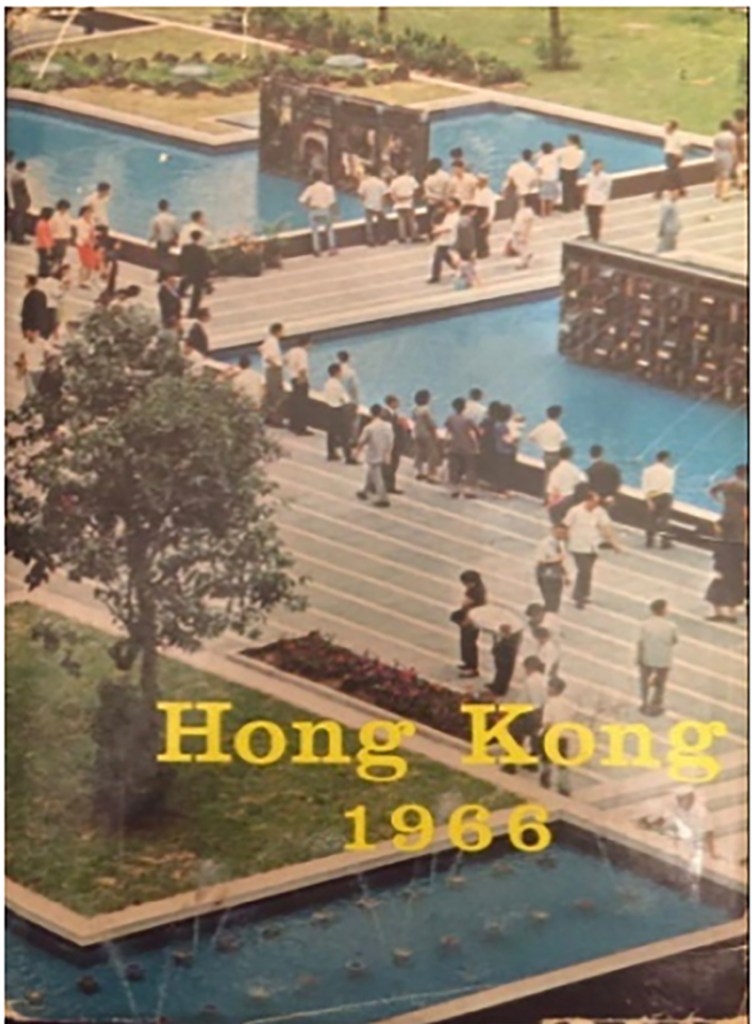
Cover 1966 Hong Kong Report. Courtesy of Hong Kong Design Institute.
The subtropical address wasn’t the only unexpected aspect; Casadei, the hopeful inventor, was an artist in Hong Kong. His work could be seen in hotels and malls, and was already such a public attraction in Statue Square that the British colonial government had put it on the cover of its 1966 annual report.
The sled application was granted in 1970 but expired in 1987. By then, Casadei was living in Spain. After 20 years’ residence, he’d left Hong Kong in 1983, the year he turned 60. When he gave a final interview to the South China Morning Post, the headline read: ‘The artist who’s left his mark on Hongkong’. “In Hongkong, evidence of his talent lies virtually wherever one looks,” wrote the interviewer. “Almost every hotel has something or other of his.”
Design for inflatable sled.
As Casadei moved on, so did the city. These days, unless you know where to look – a restaurant in Causeway Bay, a huge housing estate in Kowloon – his mark on Hong Kong has almost vanished. He liked to carve his name in the Roman style that font designers call Caesar Brute but only a few corners still exist where you can glimpse it. On his Statue Square work, his signature is half-submerged by the fountains, although he’d probably have liked that. He had a creative affinity with water (even when it was frozen). In other places around the city, it has long run dry.
His family came from Forli, in northern Italy, where Antonio was born in 1923. His father, Maceo, was a painter and is still remembered there; one of the town’s small galleries held an exhibition of his work in November 2022. It was jauntily titled Maceo Casadei – Always at Work!.
When Antonio was 11, the family moved to Rome, where Maceo became a photographer for the Istituto Luce, or Light Institute. It had been founded by Italy’s leader Benito Mussolini to supply fascist propaganda. In May 1938, when Adolf Hitler – along with Nazi heavyweights Joachim von Ribbentrop, Rudolf Hess and Joseph Goebbels – visited Mussolini for a week, Maceo photographed the full-on fascist spectacle. (Some of his original photos from those historic seven days were stolen by a collector and only returned to the institute’s archive, which is listed in Unesco’s Memory of the World register, in July 2022.) Later, always at work, he would document World War Two in photographs, paintings and drawings.
Photo of Mussolini and Hitler in Piazza di Santa Croce a Firenze, 1938. Maceo Casedei. Courtesy of archiviole.com.
Antonio, who turned 18, the age of military service, in 1941, took part in the war. Forty years later, in an interview, he made a single vivid reference to witnessing an orphanage being bombed. (“The soldiers just threw the dead children out of the building into the street. I took the little bodies to a nearby hill and buried them.”) So little is known about him – so few people remember him from his two decades in Hong Kong, where he kept a low social profile – that it’s difficult to measure the effects of his war. Perhaps that was its effect.
He had inherited his father’s visual aptitude. In 1943, when he was 20, he won a national photographic prize; and after the war, in the late 1940s, he worked at Cinecittà, the Italian film studios, as a cameraman. Some of his work, including a short black-and-white film of Florence’s wonders called A Portrait Signed by God, is still available online.
He painted, but ceramics were his real artistic love. By the 1950s, he was being commissioned to create large ceramic panels – in villas, in a corporate building, on a ship, in hotels – and he was also teaching art in Rome. There he met his future wife, Frances Wong, a former student of St Mary’s Canossian School in Hong Kong, who was studying art. As a result, he decided to visit Hong Kong in order to study Chinese porcelain.
In September 1962, Casadei – designated “a visiting artist” – held his first Hong Kong exhibition, at City Hall. (Frances Wong would have her own City Hall exhibition the following month.) It was opened by Luis Chan, then chairman of the Chinese Contemporary Artists’ Guild, and now recognised as Hong Kong’s most talented surrealist. Chan described him as “prolific and versatile”.
The South China Morning Post agreed. Its anonymous reviewer liked the oil paintings, the decorated glass and the “striking” sculpture in metal, but their highest praise was reserved for the “rare and beautiful” ceramic creations in which the artist seemed to excel: “He is, indeed, a discovery.”
At the time, the Mandarin Hotel was in the process of being built and its design team were next to discover him. John D’Eathe was deputy estate manager at Hongkong Land, a company that usually built offices but had, a little nervously, decided it might experiment with a hotel.
“There’s no doubt that the initial arts and design inspiration all came from Don Ashton,” remembers D’Eathe from his home in Vancouver. Ashton had been art director on David Lean’s The Bridge on the River Kwai (1957) (he’d constructed the bridge), where he had learned to think in epic fashion. “When he arrived and started talking about design – and budgets – way beyond our parochial aspirations, the entire scene changed,” says D’Eathe. “We started to envisage a hotel wonderland, which then, for its day, was achieved.”
John Howorth and Frank Eckermann of Leigh & Orange, the Hong Kong architectural firm founded in 1874, worked closely with Ashton. Casadei was commissioned to create bas-reliefs for what was called the Lookout Lounge; if you grew tired of looking out, you could always admire his huge beaming sunflowers on the ceiling. In the Clipper Lounge, the tables were traced with Casadei’s golden twirls. He worked from his studio in Kowloon Tong, where he was photographed for an issue of the new hotel’s in-house magazine.
Mandarin Hotel, the Outlook Lounge, early 1960s Courtesy Leigh + Orange Archive.
He also made Chinese shadow puppets for its coffee shop. Now that his own time in the city is only the faintest outline, that seems appropriate; yet even when he was in Hong Kong, people never quite felt they knew him. “I think he would be pleased that I remember his art more clearly than his personality,” says D’Eathe. “He could speak a little English but he was not voluble like everyone else. The other guys were in some bar getting pissed. I do remember the odd coffee with him; he was a cheerful, burly young fellow. But, looking back, he was usually with one of the architects, who maybe spoke for him. So he was just that: an artistic presence hovering anxiously in the background, ensuring his art was appreciated.”
“I’d bump into him sometimes in the Mandarin,” says Brian Tilbrook, who became the Mandarin’s resident artist when it needed backdrops for events and who, now aged 91, still lives on Lamma. “He could be a bit churlish but he was more genial than Don Ashton, who was arrogant and not easy to talk to. I had great respect for Casadei’s work; he was worth his weight as an artist. Those panels he created were very effective.”
The Mandarin opened in 1963. Hongkong Land had another project, which would be unveiled to the public in 1965: a shopping mall in the newly rebuilt Prince’s Building, linked to the Mandarin by Hong Kong’s first pedestrian bridge. (The original Prince’s Building from 1904 had been designed by Leigh & Orange.) Casadei was hired to brighten the interior. He would turn up at meetings with sheaves of artistic possibilities. In honour of the building’s name, he focused on a regal theme – knights, kings, horses – mapping out designs that looked as if a medieval pack of cards were taking part in a chess game.
But he was also a ceramicist with the mind of a modern inventor. He decided to experiment with polyester resins, a type of plastic which is good for laminating surfaces such as cars and boats. After he’d embellished 140 square metres of panelling with his royals – plus their shields and galleons and rampant lions – he coated each panel with Laminac resin to make its surface gleam like ancient bronze. In the lobby hung what he claimed was “the world’s largest polyester chandelier” – seven metres long, two metres wide and five tons in weight. He’d made it from 528 pieces of cylinders, of varying length, so that it resembled a mass of stalactites and it glowed amber, red, white and yellow. “Polyester resin works in ways glass and crystal wouldn’t,” he told the South China Morning Post. “With its transparency, moldability, lustre and strength, it has great potential as a new art vehicle.”
He made that comment in December 1967 (three months before he filed his patent for the inflatable sled – vehicles were clearly on his active mind). By now, he had two children, Mara and Remo, and a stream of commissions. In 1969, his work in the new Hongkong Hotel – now the Marco Polo Hongkong Hotel – was on the cover of The Peninsula hotel’s magazine. (Hongkong and Shanghai Hotels, which owns The Peninsula, had the contract to manage it.) He made nine sculpted murals near the podium pool; he was inspired, he said later, by his underwater swimming.
His work is still around. The iconic Tai Ping Koon restaurant in Causeway Bay opened in 1970, and a Casadei work still dominates one of its walls. The Tai Ping Koon group, which currently has four restaurants in Hong Kong, traces its origins back to Chui Lo-ko, who opened the first one in Guangzhou in 1860. Andrew Chui, his great-great-grandson, says his grandfather commissioned Casadei partly because he was famous and partly because he used to eat at the Wan Chai branch. As Tai Ping Koon is considered one of the world’s first Hong Kong-western restaurants (so-called “soy-sauce cuisine”), this artistic fusion with an Italian seems apt.
Tai Ping Koon Restaurant mural with Andrew Chui’s grandfather, Causeway Bay 1970. Courtesy Andrew Chui.
Apparently, people laughed because it was so expensive – the cost, it was said, of a Wan Chai flat – but Chui insisted. There’s a photo of Casadei at the opening; behind him, the swirling copper on fibreglass glows green and gold. In half a century, it’s darkened considerably and looms over diners but Chui says the customers still love it. If it ever had a title, he says, it’s been lost “like kitchen steam”.
By then, the Casadei family had moved to a remote house in Sai Kung, overlooking Hebe Haven, which had a duck pond, a monkey, some parrots and a fibreglass speedboat that Antonio had built himself to go fishing and diving. He’d also constructed his own shed and kiln where he could experiment with glazes and firing times. The South China Morning Post went to pay a visit one wet day in June 1970 and took a photo of him in flip-flops – not tall but broad-shouldered and square-headed – sandpapering a large fibreglass panel that represented, he said, the world under the sea. He spoke in Italian, translated by his wife.
He certainly needed the space and, perhaps, the isolation. When he was commissioned to create art for the new housing estate at Mei Foo, built from 1968 to 1978 on the old storage facilities of Mobil Oil, one of his works was an eight-metre stainless steel winged horse, Pegasus.
Pegasus at Mei Foo Sun Chuen (circa 1970-1974), Kowloon, Hong Kong. Photo: William Furniss
It was placed in a – now waterless – fountain. Its head rears up to the sky, ignoring its surroundings, still a magnificent beast. Nearby, an aquarium of distinctive fish, each face so cleverly contrived you feel you know its character, swims in the air above a bone-dry fountain.
A vibrant ceramic panel, similar to the Casadei work at Statue Square, sits in the fountain of another courtyard. At Mei Foo, it’s easy to read the chiselled signature: there’s no water lapping at the edges.
Ceramic mural, Mei Foo Sun Chuen, 1970s. Photo: William Furniss
He died in Alicante, on Spain’s Costa Blanca, its white coast, on March 9, 2014. Some of the art from his Spanish years is for sale online; in his 80s, he was still making fish. Always at work, like his father.
In Hong Kong, he has slipped away, like rain off a hillside. On a recent afternoon at Statue Square, a group of schoolchildren sat on a fountain wall, next to his panel. A guide gave them a lecture on the square’s history: Queen Victoria, the Hongkong and Shanghai Bank, the former Supreme Court building. Asked by an onlooker if he knew who’d created the nearby artwork, the guide said no. Then he added, as a helpful afterthought: “Some artist.”
The Shop / David Zwirner / Hong Kong / Mar 20 – May 6 /
Stepping out of the elevator at David Zwirner Hong Kong, you’d be forgiven for thinking you were in the wrong location. What lies before you is an old-fashioned umbrella shop – the kind more commonly seen at street level in Hong Kong. The shop is stuffed to the gills with brollies, Chinese lanterns, manuals, books, a replica of Van Gogh’s The Starry Night. It’s a delight to peruse. All items are for sale.
Installation view. Courtesy David Zwirner Hong Kong.
Is the installation a commentary on the idea of art? An attempt to elevate the umbrella from a banal, everyday object to art by situating it in a different setting? Its creator, Thai artist Rirkrit Tiravanija, has said that Duchamp’s Fountain is his favourite art piece.
Tiravanija is a master at using everyday experiences such as eating and playing to shed light on how the personal is also the political, and how art is a part of the everyday. He is perhaps best known for exhibitions involving food, such as Untitled (Pad Thai), where he served the popular Thai dish to gallery-goers to highlight its autocratic origins – it was invented by then prime minister Plaek Phibunsongkhram in the 1930s as part of a nationalist campaign. At The Shop, Tiravanija turns his gaze to a politically charged object.
The umbrella is a device to protect oneself from the rain or the sun. But in modern-day Hong Kong, an umbrella isn’t just an umbrella. In fact, it stopped being that during the 2014 protests, when it was used as a makeshift shield against tear gas and pepper spray. Here, a machine airs a Cantonese recording of a chapter from Death’s End, the third book in Chinese science-fiction author Liu Cixin’s The Three-Body Problem trilogy. The narrator tells the story of how a spinning umbrella protects a princess from being disappeared by her power-hungry brother.
Installation view. Courtesy David Zwirner Hong Kong.
The theme of disappearance continues in the next space, revealed via a nifty automatic sliding door at the back of the brolly shop, which is austere, stripped of the visual richness and spontaneity that came before. A few robotic vacuum cleaners sweep across the carpeted floor, tracing the Chinese characters for “dark forest”, the title of the second book in the trilogy. The book’s plot revolves around a group of extra-terrestrials trying to eliminate the human race and claim Earth as their own. In Tiravanija’s work, the Chinese characters disappear as viewers walk across the space, then reappear again, in an endless loop.
Downstairs, 3D printers create what look like poorly formed architectural models but are in fact broken umbrellas, their blazing red hue making them looking all the more forlorn. There is also an AR component: as you pan your phone around the gallery, black mutilated umbrellas are suspended in mid-air, one of them so close that it feels like it’s grazing your body. The spinning umbrella that provides protection has transformed into a battered, useless object.
Installation view. Courtesy David Zwirner Hong Kong.
The only way out of the gallery is through the way in. As one re-enters the robo vacuum-filled space and the brolly shop, it almost feels like going back in time. What has disappeared? What has been lost? Has the brolly shop already been relegated to the past?