Solo · Exhibition · Twice II: Of Seeing / Sep 12 – Oct 28, 2023 / Opening: Saturday, Sep 9, 4pm – 6.30pm /
Blindspot Gallery 15/F Po Chai Industrial Building 28 Wong Chuk Hang Road Wong Chuk Hang, Hong Kong +852 2517 6238 Tuesday – Saturday, 10.30am – 6.30pm
Solo · Exhibition · Twice II: Of Seeing is the second joint exhibition by Yeung Tong Lung and Sze Yuen since 1995. The exhibition includes Yeung’s recent oil paintings, and Sze’s charcoal works and oil paintings from the past decade to the present. Yeung Tong Lung is known for his large-scale figurative paintings, characterized by vibrant colors, vivid contrasts, and collagesque compositions that connect multiple spaces, different characters, and narratives on the same plane. Sze Yuen’s creations have always adhered to a horizontal scroll format, with most of her works displaying muted color tones, imbued with a deep sense of uncertainty and instability in terms of location, space, time, and subjects. While their artistic styles diverge greatly, their works are connected by the shared experience of Hong Kong – the city they live in, displaying warmth and care for “home” throughout, alongside an acute social awareness.
Solo · Exhibition · Twice II: Of Seeing also reflects the artists’ deep and unhurried contemplation on the act and process of “looking at paintings”, through the making of painting, the display of painting, and the interaction between paintings (and the artists). It may not necessarily reach a destination, but it unfolds as an intimate dialogue between the two.
Images: Tattoo House (detail) by Yeung Tong Lung, Oil on canvas, diptych, 154 x 192.5 cm, 154 x 173.8 cm, 2023. Trip I: Journey(detail) by Sze Yuen, Charcoal on paper, triptych, 17 x 183 x 2.8 cm each, 2021. Courtesy the artists and Blindspot Gallery.
Door to Door / The Shophouse / Hong Kong / Jul 15– Aug 13, 2023 /
Doors open memories. Portals from our past are linked to significant locations or major milestones – the entrance to our childhood home or the gate leading into a campus where we embarked on intellectual explorations, for instance. When we think about important moments that we’ve experienced, those journeys can be traced through doors too, each entryway a marker for consequential junctures in our lives.
For its summer show, Tai Hang’s The Shophouse organised a four-week artist residency and open studio programme that led up to a month-long exhibition, Door to Door. The two artists involved were Hong Kong painter Szelit Cheung and London-based Russian artist Olga Grotova, who created new artworks that drew from The Shophouse’s architectural heritage and, more broadly, the city in which the gallery is situated.
Door || by Szelit Cheung, 59.5 x 42.7cm, 2023. Courtesy the artist and The Shophouse.
In Cheung’s section of the presentation, Door I (all works 2023) showed four rotating panels opening up to let beams of natural light into a muted blue space, the rays dancing between saffron yellow and orange peel. Door II features two archways, with more light flooding into a mossy green space, bathing the viewer in what feels like an abnormally bright, shiny hour. Another rotating panel is set into Door III, this time seemingly with a mirror on its surface, reflecting shades of ochre, mustard and umber.
The architectural interplay continues through Door IV and Door V, with the same two doorways balanced in frame, wide open in the former and cracked in the latter, controlling the brilliance in the viewer’s visual coverage. Door VI is different, in that a glass panel, again rotatable, separates the external light source from the green walls facing the viewer; while Door VII is a close-up of a door barely nudged open, with just enough light pouring in so that our eyes don’t strain.
These pocket universes are a continuation of Cheung’s practice of using architectural elements to tease out tension. The painter places viewers in a dark void, with the only sign of time’s passage present in the way light spills forth from a space beyond our own. The moments captured in Cheung’s work are ones of illumination—not only in the sense that we’re finally able to see the dark space we’re in, but also in realising that there’s something out there, and it’s up to us to walk through the door and enter the unknown.
Grotova’s personal artworks were a foil to Cheung’s seemingly abstract paintings. For her half of Door to Door, she drew from her established practice of using pigments, soil and superimposed images.
Mine and Mother by Olga Grotova, 90.5 x 80cm, 2023. Courtesy the artist and The Shophouse.
Earth tones dominated the works she created during the residency, each a hazy fantasy. Morose titles like Weeping Roots, Ashes and Constellations, A Lake Garden and Stone Tears point at a lingering melancholy. Grotova’s practice often mines her own family’s place in the Soviet Union and, subsequently, the Russian Federation. Gardens are a common reference point, and the artist transported soil from a family garden to Hong Kong to use in the creation of the artworks at The Shophouse.
Whereas Cheung’s oils place viewers in defined moments, there wasn’t the same certainty in Grotova’s photograms and cyanotypes, introducing a much stronger sense of ambiguity in the way her work can be navigated. Both artists responded to their environment during the residency that led up to Door to Door – the architectural elements in Cheung’s canvases were lifted from The Shophouse itself, including its ground floor entrance, stairway, windows and more, while Grotova used materials such as dried flowers sourced locally to cast images onto her photograms, while imbuing a more personal slant to the works.
When art is mounted in a storied space, there’s a risk of the gallery’s character overshadowing the works. But in Door to Door, Cheung and Grotova’s creations worked in tandem with the context of The Shophouse, a pre-war tong lau that has been restored to house exhibitions. Each set of artworks told its own tale, meshing with the art space’s physicality and location, and giving The Shophouse a fresh conceptual extension in the process.
After Door to Door opened in Hong Kong, Cheung and Grotova travelled to London for the second half of the programme – another four-week residency followed by a show that opens at Schoeni Projects in October, living up to the project’s name by completing their journey.
In March 1968, the United States Patent Office received an application filed by one Antonio Casadei of York Road, Kowloon Tong. It was a design for an inflatable sled that could transport goods across ice and snow.
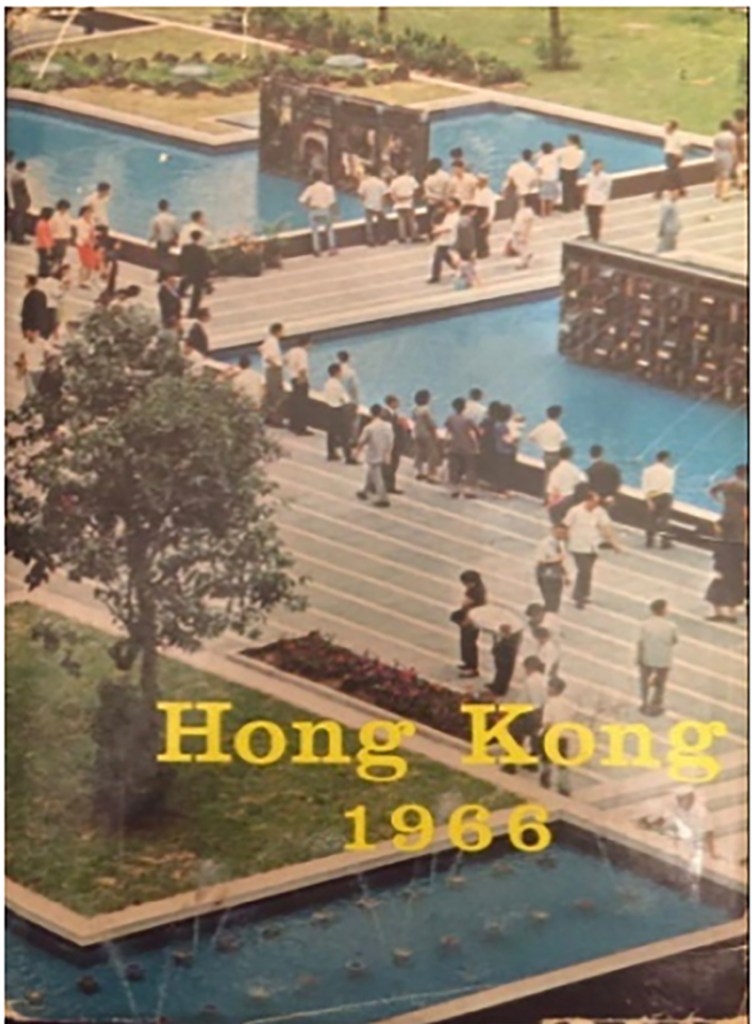
Cover 1966 Hong Kong Report. Courtesy of Hong Kong Design Institute.
The subtropical address wasn’t the only unexpected aspect; Casadei, the hopeful inventor, was an artist in Hong Kong. His work could be seen in hotels and malls, and was already such a public attraction in Statue Square that the British colonial government had put it on the cover of its 1966 annual report.
The sled application was granted in 1970 but expired in 1987. By then, Casadei was living in Spain. After 20 years’ residence, he’d left Hong Kong in 1983, the year he turned 60. When he gave a final interview to the South China Morning Post, the headline read: ‘The artist who’s left his mark on Hongkong’. “In Hongkong, evidence of his talent lies virtually wherever one looks,” wrote the interviewer. “Almost every hotel has something or other of his.”
Design for inflatable sled.
As Casadei moved on, so did the city. These days, unless you know where to look – a restaurant in Causeway Bay, a huge housing estate in Kowloon – his mark on Hong Kong has almost vanished. He liked to carve his name in the Roman style that font designers call Caesar Brute but only a few corners still exist where you can glimpse it. On his Statue Square work, his signature is half-submerged by the fountains, although he’d probably have liked that. He had a creative affinity with water (even when it was frozen). In other places around the city, it has long run dry.
His family came from Forli, in northern Italy, where Antonio was born in 1923. His father, Maceo, was a painter and is still remembered there; one of the town’s small galleries held an exhibition of his work in November 2022. It was jauntily titled Maceo Casadei – Always at Work!.
When Antonio was 11, the family moved to Rome, where Maceo became a photographer for the Istituto Luce, or Light Institute. It had been founded by Italy’s leader Benito Mussolini to supply fascist propaganda. In May 1938, when Adolf Hitler – along with Nazi heavyweights Joachim von Ribbentrop, Rudolf Hess and Joseph Goebbels – visited Mussolini for a week, Maceo photographed the full-on fascist spectacle. (Some of his original photos from those historic seven days were stolen by a collector and only returned to the institute’s archive, which is listed in Unesco’s Memory of the World register, in July 2022.) Later, always at work, he would document World War Two in photographs, paintings and drawings.
Photo of Mussolini and Hitler in Piazza di Santa Croce a Firenze, 1938. Maceo Casedei. Courtesy of archiviole.com.
Antonio, who turned 18, the age of military service, in 1941, took part in the war. Forty years later, in an interview, he made a single vivid reference to witnessing an orphanage being bombed. (“The soldiers just threw the dead children out of the building into the street. I took the little bodies to a nearby hill and buried them.”) So little is known about him – so few people remember him from his two decades in Hong Kong, where he kept a low social profile – that it’s difficult to measure the effects of his war. Perhaps that was its effect.
He had inherited his father’s visual aptitude. In 1943, when he was 20, he won a national photographic prize; and after the war, in the late 1940s, he worked at Cinecittà, the Italian film studios, as a cameraman. Some of his work, including a short black-and-white film of Florence’s wonders called A Portrait Signed by God, is still available online.
He painted, but ceramics were his real artistic love. By the 1950s, he was being commissioned to create large ceramic panels – in villas, in a corporate building, on a ship, in hotels – and he was also teaching art in Rome. There he met his future wife, Frances Wong, a former student of St Mary’s Canossian School in Hong Kong, who was studying art. As a result, he decided to visit Hong Kong in order to study Chinese porcelain.
In September 1962, Casadei – designated “a visiting artist” – held his first Hong Kong exhibition, at City Hall. (Frances Wong would have her own City Hall exhibition the following month.) It was opened by Luis Chan, then chairman of the Chinese Contemporary Artists’ Guild, and now recognised as Hong Kong’s most talented surrealist. Chan described him as “prolific and versatile”.
The South China Morning Post agreed. Its anonymous reviewer liked the oil paintings, the decorated glass and the “striking” sculpture in metal, but their highest praise was reserved for the “rare and beautiful” ceramic creations in which the artist seemed to excel: “He is, indeed, a discovery.”
At the time, the Mandarin Hotel was in the process of being built and its design team were next to discover him. John D’Eathe was deputy estate manager at Hongkong Land, a company that usually built offices but had, a little nervously, decided it might experiment with a hotel.
“There’s no doubt that the initial arts and design inspiration all came from Don Ashton,” remembers D’Eathe from his home in Vancouver. Ashton had been art director on David Lean’s The Bridge on the River Kwai (1957) (he’d constructed the bridge), where he had learned to think in epic fashion. “When he arrived and started talking about design – and budgets – way beyond our parochial aspirations, the entire scene changed,” says D’Eathe. “We started to envisage a hotel wonderland, which then, for its day, was achieved.”
John Howorth and Frank Eckermann of Leigh & Orange, the Hong Kong architectural firm founded in 1874, worked closely with Ashton. Casadei was commissioned to create bas-reliefs for what was called the Lookout Lounge; if you grew tired of looking out, you could always admire his huge beaming sunflowers on the ceiling. In the Clipper Lounge, the tables were traced with Casadei’s golden twirls. He worked from his studio in Kowloon Tong, where he was photographed for an issue of the new hotel’s in-house magazine.
Mandarin Hotel, the Outlook Lounge, early 1960s Courtesy Leigh + Orange Archive.
He also made Chinese shadow puppets for its coffee shop. Now that his own time in the city is only the faintest outline, that seems appropriate; yet even when he was in Hong Kong, people never quite felt they knew him. “I think he would be pleased that I remember his art more clearly than his personality,” says D’Eathe. “He could speak a little English but he was not voluble like everyone else. The other guys were in some bar getting pissed. I do remember the odd coffee with him; he was a cheerful, burly young fellow. But, looking back, he was usually with one of the architects, who maybe spoke for him. So he was just that: an artistic presence hovering anxiously in the background, ensuring his art was appreciated.”
“I’d bump into him sometimes in the Mandarin,” says Brian Tilbrook, who became the Mandarin’s resident artist when it needed backdrops for events and who, now aged 91, still lives on Lamma. “He could be a bit churlish but he was more genial than Don Ashton, who was arrogant and not easy to talk to. I had great respect for Casadei’s work; he was worth his weight as an artist. Those panels he created were very effective.”
The Mandarin opened in 1963. Hongkong Land had another project, which would be unveiled to the public in 1965: a shopping mall in the newly rebuilt Prince’s Building, linked to the Mandarin by Hong Kong’s first pedestrian bridge. (The original Prince’s Building from 1904 had been designed by Leigh & Orange.) Casadei was hired to brighten the interior. He would turn up at meetings with sheaves of artistic possibilities. In honour of the building’s name, he focused on a regal theme – knights, kings, horses – mapping out designs that looked as if a medieval pack of cards were taking part in a chess game.
But he was also a ceramicist with the mind of a modern inventor. He decided to experiment with polyester resins, a type of plastic which is good for laminating surfaces such as cars and boats. After he’d embellished 140 square metres of panelling with his royals – plus their shields and galleons and rampant lions – he coated each panel with Laminac resin to make its surface gleam like ancient bronze. In the lobby hung what he claimed was “the world’s largest polyester chandelier” – seven metres long, two metres wide and five tons in weight. He’d made it from 528 pieces of cylinders, of varying length, so that it resembled a mass of stalactites and it glowed amber, red, white and yellow. “Polyester resin works in ways glass and crystal wouldn’t,” he told the South China Morning Post. “With its transparency, moldability, lustre and strength, it has great potential as a new art vehicle.”
He made that comment in December 1967 (three months before he filed his patent for the inflatable sled – vehicles were clearly on his active mind). By now, he had two children, Mara and Remo, and a stream of commissions. In 1969, his work in the new Hongkong Hotel – now the Marco Polo Hongkong Hotel – was on the cover of The Peninsula hotel’s magazine. (Hongkong and Shanghai Hotels, which owns The Peninsula, had the contract to manage it.) He made nine sculpted murals near the podium pool; he was inspired, he said later, by his underwater swimming.
His work is still around. The iconic Tai Ping Koon restaurant in Causeway Bay opened in 1970, and a Casadei work still dominates one of its walls. The Tai Ping Koon group, which currently has four restaurants in Hong Kong, traces its origins back to Chui Lo-ko, who opened the first one in Guangzhou in 1860. Andrew Chui, his great-great-grandson, says his grandfather commissioned Casadei partly because he was famous and partly because he used to eat at the Wan Chai branch. As Tai Ping Koon is considered one of the world’s first Hong Kong-western restaurants (so-called “soy-sauce cuisine”), this artistic fusion with an Italian seems apt.
Tai Ping Koon Restaurant mural with Andrew Chui’s grandfather, Causeway Bay 1970. Courtesy Andrew Chui.
Apparently, people laughed because it was so expensive – the cost, it was said, of a Wan Chai flat – but Chui insisted. There’s a photo of Casadei at the opening; behind him, the swirling copper on fibreglass glows green and gold. In half a century, it’s darkened considerably and looms over diners but Chui says the customers still love it. If it ever had a title, he says, it’s been lost “like kitchen steam”.
By then, the Casadei family had moved to a remote house in Sai Kung, overlooking Hebe Haven, which had a duck pond, a monkey, some parrots and a fibreglass speedboat that Antonio had built himself to go fishing and diving. He’d also constructed his own shed and kiln where he could experiment with glazes and firing times. The South China Morning Post went to pay a visit one wet day in June 1970 and took a photo of him in flip-flops – not tall but broad-shouldered and square-headed – sandpapering a large fibreglass panel that represented, he said, the world under the sea. He spoke in Italian, translated by his wife.
He certainly needed the space and, perhaps, the isolation. When he was commissioned to create art for the new housing estate at Mei Foo, built from 1968 to 1978 on the old storage facilities of Mobil Oil, one of his works was an eight-metre stainless steel winged horse, Pegasus.
Pegasus at Mei Foo Sun Chuen (circa 1970-1974), Kowloon, Hong Kong. Photo: William Furniss
It was placed in a – now waterless – fountain. Its head rears up to the sky, ignoring its surroundings, still a magnificent beast. Nearby, an aquarium of distinctive fish, each face so cleverly contrived you feel you know its character, swims in the air above a bone-dry fountain.
A vibrant ceramic panel, similar to the Casadei work at Statue Square, sits in the fountain of another courtyard. At Mei Foo, it’s easy to read the chiselled signature: there’s no water lapping at the edges.
Ceramic mural, Mei Foo Sun Chuen, 1970s. Photo: William Furniss
He died in Alicante, on Spain’s Costa Blanca, its white coast, on March 9, 2014. Some of the art from his Spanish years is for sale online; in his 80s, he was still making fish. Always at work, like his father.
In Hong Kong, he has slipped away, like rain off a hillside. On a recent afternoon at Statue Square, a group of schoolchildren sat on a fountain wall, next to his panel. A guide gave them a lecture on the square’s history: Queen Victoria, the Hongkong and Shanghai Bank, the former Supreme Court building. Asked by an onlooker if he knew who’d created the nearby artwork, the guide said no. Then he added, as a helpful afterthought: “Some artist.”
The Shop / David Zwirner / Hong Kong / Mar 20 – May 6 /
Stepping out of the elevator at David Zwirner Hong Kong, you’d be forgiven for thinking you were in the wrong location. What lies before you is an old-fashioned umbrella shop – the kind more commonly seen at street level in Hong Kong. The shop is stuffed to the gills with brollies, Chinese lanterns, manuals, books, a replica of Van Gogh’s The Starry Night. It’s a delight to peruse. All items are for sale.
Installation view. Courtesy David Zwirner Hong Kong.
Is the installation a commentary on the idea of art? An attempt to elevate the umbrella from a banal, everyday object to art by situating it in a different setting? Its creator, Thai artist Rirkrit Tiravanija, has said that Duchamp’s Fountain is his favourite art piece.
Tiravanija is a master at using everyday experiences such as eating and playing to shed light on how the personal is also the political, and how art is a part of the everyday. He is perhaps best known for exhibitions involving food, such as Untitled (Pad Thai), where he served the popular Thai dish to gallery-goers to highlight its autocratic origins – it was invented by then prime minister Plaek Phibunsongkhram in the 1930s as part of a nationalist campaign. At The Shop, Tiravanija turns his gaze to a politically charged object.
The umbrella is a device to protect oneself from the rain or the sun. But in modern-day Hong Kong, an umbrella isn’t just an umbrella. In fact, it stopped being that during the 2014 protests, when it was used as a makeshift shield against tear gas and pepper spray. Here, a machine airs a Cantonese recording of a chapter from Death’s End, the third book in Chinese science-fiction author Liu Cixin’s The Three-Body Problem trilogy. The narrator tells the story of how a spinning umbrella protects a princess from being disappeared by her power-hungry brother.
Installation view. Courtesy David Zwirner Hong Kong.
The theme of disappearance continues in the next space, revealed via a nifty automatic sliding door at the back of the brolly shop, which is austere, stripped of the visual richness and spontaneity that came before. A few robotic vacuum cleaners sweep across the carpeted floor, tracing the Chinese characters for “dark forest”, the title of the second book in the trilogy. The book’s plot revolves around a group of extra-terrestrials trying to eliminate the human race and claim Earth as their own. In Tiravanija’s work, the Chinese characters disappear as viewers walk across the space, then reappear again, in an endless loop.
Downstairs, 3D printers create what look like poorly formed architectural models but are in fact broken umbrellas, their blazing red hue making them looking all the more forlorn. There is also an AR component: as you pan your phone around the gallery, black mutilated umbrellas are suspended in mid-air, one of them so close that it feels like it’s grazing your body. The spinning umbrella that provides protection has transformed into a battered, useless object.
Installation view. Courtesy David Zwirner Hong Kong.
The only way out of the gallery is through the way in. As one re-enters the robo vacuum-filled space and the brolly shop, it almost feels like going back in time. What has disappeared? What has been lost? Has the brolly shop already been relegated to the past?
In 1996, on the eve of Hong Kong handover to China, a bunch of Hong Kong artists founded one of the city’s longest-running independent art spaces in Kennedy Town. Some 27 years later, it has moved to North Point, with the city it is in also facing uncertain times, not least because it has just emerged after three years of pandemic restrictions.
Executive director Billy Tang is looking back to Para Site’s artist-run beginnings, where it was, above all, a platform for artists and ideas to come together. The idea is to have longer exhibitions, where ideas are allowed to gestate over a period of time. This shift in curatorial thinking takes solid form in Para Site’s latest exhibition, signals…, which features three chapters and is curated by Tang and Para Site curator Celia Ho.
While the first chapter, signals…storms and patterns, was about hums beneath the calm, signals…folds and splits, which opened on June 9, explores liminal spaces. The third exhibition, signals…here and there, centres on the idea of dispersal.
Installation view of ‘signals…folds and splits’, Para Site, Hong Kong, 2023. Photo: South Ho.
As the exhibition shifts from one chapter to the next, the works shift, as does the spatial design. Tang says to think of it as “an ensemble of characters that come and go”. Aside from works in the space, signals… also includes newsletters, podcasts and other public engagement programmes.
There is a tendency to see the exhibition opening as the highlight of the event, where art is presented in its “perfect” or completed form, says Ho, but she adds she doesn’t think that’s how “art will have its impact on society”.
For her, impact is only possible with constant engagement between artist, public and curator. What this could mean in practice is expanding the idea of exhibition-making to talks, printed matter, podcasts and other forms of engagement.
signals… is loosely inspired by Signals gallery, an experimental art space in London that ran from 1964 to 1966. Despite its short existence, the gallery was known for its interdisciplinary and generative approach, and particularly its showing of kinetic art.
At signals…, works on display allude to Signals gallery in different ways, some more directly to kinetic art of the 20th century, others using the idea of hums and flows as filters to examine today’s turbulent world: what are the forces governing society, our systems and individuals? It examines the way that small movements can set off a series of effects, Tang says.
In the first chapter, So Wing Po’s Sea Ear Hi-hat (2020) features abalone shells that open and shut, discharging sounds at once melodic and hypnotic, the movement activated by a mechanism. Meanwhile, Printhaus’s Everybody Chips in with their Bit (2019-20) depicts how tiny actions might lead to big impacts. The second chapter features Jaffa Lam’s The past from the ruins (work in progress) (2023), an old football that will move around the gallery during the course of exhibition, evoking the way refugees are often shuttled from one space to another.
Tang is no stranger to disruptions. UK-born and raised, he earned his chops at Beijing’s Magician Art Space and Shanghai’s Rockbund Art Museum before taking up the mantle at Para Site last May. He joined the institution when the city was undergoing a challenging period, negotiating some of the world’s toughest pandemic restrictions while still reeling from the 2019 social movement. The curator notes that every cultural institution is constantly negotiating between what can and cannot be done.
Installation view of ‘signals…storms and patterns’, Para Site, Hong Kong, 2023. Photo: South Ho.
“It’s been difficult, physically, during Covid. [There are] the geopolitical questions as well, and how divided the world is: how do we negotiate and navigate that? These are questions that we cannot solve, but at least we provide a platform to ask them,” he says.
The art space was founded at an ambiguous moment in Hong Kong history, a year before the handover. “There was a fear of the unknown. [The space] has been through many crises faced by the city,” says Tang, who is using this moment to reconnect with artists of different generations, drawing lessons from the past to think about the future.
Ho adds that artists are ideally placed to help navigate what is happening in society. That spirit of finding the alternative is embedded in their DNA. “It could be about challenging the medium, the way of putting things together, our understanding of historical frameworks.”
Despite being a 27-year-old outfit, Para Site, thinks Tang, still takes pride in its “grassroots” identity. “That’s why it is endearing; we aren’t so institutionalised that everything is so polished.”
One of these strategies is to rethink exhibition design. At signals…, wall modules made of wood and bricks can be easily assembled and dismantled, and can lead to different constellations. A collaboration between the Para Site team and architect Joel Austin, these modules are more economical and sustainable, and can easily be adapted for future exhibitions.
Installation view of ‘signals…storms and patterns’, Para Site, Hong Kong, 2023. Photo: South Ho.
For Tang, the next chapter is to think about “creating a structure to embrace openness and experimentalism”. Last month, Para Site launched a new space on the 10th floor of the same building. Half of it is a studio – a “testing ground” for the gestation of new ideas. It launched with Kong Chun Hei’s PS, featuring knocked-out walls, motion sensors and a giant aluminium snake that loops across the space. Some of these will become permanent fixtures of the space, again supporting the idea of letting exhibitions last beyond their official duration.
Tang notes that the smaller space provides a “good parameter” for young curators and artists, as it forces them to be resourceful – “to think of the how, and the why, within a certain scale and budget”.
A shop selling books, catalogues and merchandise takes up the other half of the space.
It’s a way to experiment with a more “diverse relationship to exhibition-making”, but also a way to make Para Site – which has thus far relied on donors and proceeds from its annual fundraising gala – more sustainable.
“There is this image…[of Para site]’s influence, and you come here and realise how small it is,” says Tang. “It speaks a lot about the creativity. The idea of what you can do isn’t restricted to its physical space.”
Featured image: Installation view of ‘signals…storms and patterns’, Para Site, Hong Kong, 2023. Photo: South Ho.
Showcasing the latest works from HART’s artists-in-residence, Postmodern Tales was a multimedia group show featuring eight different artists whose practices are as thought-provoking as they are diverse. From various cultural backgrounds, they are connected via their unique contemporary sensibilities, as well as their willingness to approach art using novel ideas – or to present novel ideas using art. As HART’s second off-site exhibition, curated by HART director Vera Lam, the presentation not only captured what it means to be postmodern, but also served to cement the non-profit organisation’s commitment to nurturing Hong Kong talent.
Visitors were greeted with Body as Lifeguard Tower I (2022), a hanging, life-sized cyanotype fabric work by Michele Chu. Imprinted with silhouettes of her own body, the work is a metaphor for emotional barriers, and aims to break down invisible walls by acknowledging their existence. In Replica of Ruins: Anonymous Road (2023), Natalie Chu Lok Ting invites visitors to step back in time. Her recreation of a pathway in a Chinese garden leads to discovering and uncovering a shared history. Echoing her references to time in a completely different manner, Damian Boylan chooses to stress its impermanence and temporality. Half-Life (2021-2023) is a sound composition of field recordings as an ephemeral accompaniment to a painting made from bismuth – a futuristic-looking metal. The three artists explore the meaning of existence through the human experience – be it relationships, history or expressions alluding to the passage of time.
Left: Half-Life by Damian Boylan, 2021-2023. Right: Replica of Ruins: Anonymous Road by Natalie Chu Log Ting2023. Courtesy the artists and HART.
A crowd pleaser, Vaevae Chan’s Choose Your Weapon… Fight! (2016-21) addresses the world’s obsession with consumerism and the inability to live without technology. A series of brightly coloured iPhone cases that look more like anime-inspired weapons are accompanied by photographs of staged scenarios that expound on the idea of a world where the ludicrous-looking phone cases actually exist. And, taking the modern relationship between artwork and viewer a step further, Wu Jiaru’s untitled_excesstears_mktg_orange_i (2020) invites audiences to take pictures of the artwork with flash for the desired effect. The millennial artists’ works beg the million-dollar question: are we are truly capable of being disconnected from our devices?
Another work that creates stimulating conversations is Merryn Trevethan’s colourful site-responsive installation Frequently Lost (2021-23), which focuses on urban wanderings in Hong Kong amid the pandemic – a metaphor for navigating relationships during uncertain times. Evoking complex emotions about the afterlife, Amy Tong’s hanging paper pillow in You And I, 2053, We Hold Hands Under A Bridge (2023) alludes to a mental state where sleeping, dreaming and dying have become synonymous. Lastly, poet Nicholas Wong plays on the dynamics between imagery and texture in his paper series therefore, this note is not meant to (2023) by creating a whole new language of communication without text.
Frequently Lost by Merryn Trevethan, 2021-23. Courtesy the artist and HART.
Creating art in the same inclusive co-working environment, these HART artists belong to the new generation whose practices evolve and develop alongside each other’s, along with changing socio-cultural currents. With HART’s mission of grooming local talent, the presentation was not only an affirmation of the interconnectivity of these artistic relationships, but more importantly one that places the city of Hong Kong front and centre. It is a collective reflection of the hopes and dreams of this new generation of artistic talent, with the Hong Kong experience at its core.
Featured image: Choose Your Weapon… Fight! by Vaevae Chan, 2016-21.
Featuring more than 50 sculptural, photographic and filmic works by the Australian artist Patricia Piccinini, Tai Kwun Contemporary’s immersive exhibitionHOPE taps into our hopes and fears about the impact of science on humanity. The artist’s hyperrealistic sculptures of human-animal hybrids, both endearing yet grotesque, explore the unexpected consequences of tampering with nature. Visitors will get to explore an engrossing, perplexing, and deeply touching world that is at once fantastical yet one with which we identify naturally and instinctively.
While her work concerns scientific progress and humankind’s destructive power over nature, a resilient optimism shines through. HOPE is Patricia Piccinini’s first solo exhibition in Hong Kong and encompasses all of the gallery spaces of JC Contemporary. Among the largest works in the show is Celestial Field (2021), a vast, immersive installation comprising 4,500 individual flower stems sprouting both upward from the floor and hanging downward from the ceiling, inviting visitors to contemplate on “progress”. Elsewhere, Piccinini responds to the signature spiral staircase of JC Contemporary with a 20-meter-high installation of multicolored wigs spun together and suspended down the void from the ceiling of the top floor.
Much of Patricia Piccinini’s work explores the notion of interdependence: the interdependence between humans and artificial objects—such as shoes, cradles, chairs—and the interdependence between humans and other creatures. The artist is fascinated by what she calls “artificial nature,” where humans are combined with other living creatures either in the imagination or in a laboratory. With humanity on the cusp of being able to design and create new forms of life, these “chimeras” pose fundamental questions about the new horizons that technological advances have opened. For the artist, this prospect triggers both hope and anxiety about the nature of progress. Piccinini imagines how living with such creatures demands the same love, care, and empathy as we are morally compelled to show to the living beings that we share the planet with. Visitors to HOPEwill therefore not only experience the artist’s spectacular vision but will also be invited to delve more deeply into broader questions about progress, science and technology, as well as the ethics of care.
Over the course of the exhibition, Tai Kwun Contemporary will host a wide range of public programming and educational events that dive into the deeper themes raised by Piccinini’s works, including her references to mythology and iconography, as well as broader ethical questions about science, progress, and ethics. These include Patricia Piccinini After Hours, a series of intimate conversations with special guests and speakers who will be discussing topics such as ethics and morality in biotech and genetics, the climate crisis and extinction, and human creations of life. Patricia Piccinini’s Choice meanwhile will screen a series of films as chosen by the artist, including The Rocky Horror Picture Show, Frankenstein, and The Fly. Of particular interest to families with children will be the Family Day events held throughout the run of the exhibition. Finally, HOPE—Patricia Piccinini also includes a special series of guided tours presented in collaboration with art and curatorial researcher Mankit Lai, artist Michelle Lee Ho Wing, artist and curator Eunice Tsang, guest curator and writer Chris Wan Feng, artist Ice Wong Kei Suet, artist and educator Morgan Wong, and architectural designer Human Wu.
HOPE will also present a small number of artist editions and merchandise in the Tai Kwun Contemporary kiosk in the gallery reception area.
Tickets to the exhibition are available on Klook. HK$60 for general tickets and HK$50 for concession tickets (full-time students with ID, people with disabilities, and senior citizens over the age of 60). Tickets will also be available at the JC Contemporary reception: HK$70 (general) and HK$60 (concession). Children under the age of 5 can enjoy free admission. Meanwhile, Tai Kwun will offer limited qualities of buy-one get-one free admission tickets exclusive to TK Fan on a first come, first serve basis.
White Cube Hong Kong is pleased to present New Moroism, a group exhibition which brings together four artists who seek to expand the parameters and ideation of figuration in painting.
Part of an emerging generation of artists whose roots are in Asia, Michael Ho, Chris Huen Sin Kan, Timothy Lai and Su Yu-Xin reflect a new approach and sensibility, responsive to trans-regional shifts and migration. Embracing the concept of ambiguity within their paintings, the artists each explore Moroism, an aesthetic paradigm which is derived from the ‘mōrōtai’ style (mōrō literally translated as ‘vague’ or ‘indistinct’) that emerged in Japan of the late Meiji era (1868–1912), also found as a pictorial intention originating in traditional Chinese painting theory.
Determined by the artists’ shared East Asian heritage, the works in this exhibition are grounded in personal narrative.
Chris Huen Sin Kan’s large-scale oil paintings feature a recurring cast of characters including his wife, son, daughter and dogs. Painted directly from memory, the artist places life’s fleeting moments at the core of his work.
Incorporating a palette of gradated skin tones and elongated, distorted brushstrokes, Timothy Lai examines the ambiguity and tension of his pan-Asian identity and considers the increasingly complex interplay between nationality and race within today’s global society.
Su Yu-Xin’sdynamic landscape paintings are a testament to her meticulous practice. Inspired by the traditional ‘boneless’ method of Chinese brush painting, the artist creates her own hand-made pigments from collected natural materials, which she applies to the surface in layered washesto constructnebulous,multi-perspective horizons.
Employing a similarly rigorous process, Michael Ho adopts a unique painting technique which involves pushing paint from the back of the canvas and superimposing images on the front. A second-generation Chinese immigrant, this method serves as a parallel to Ho’s quest for duality.
Read more on Inside the White Cube: New Moroism at White Cube
For decades, Leung Chi Wo has been exploring the history and historical sites of Hong Kong, mixing archival material with photographs, videos, texts and multimedia installations. While his research-based practice brings forth the contradictions and complexities of historiography, it also injects fantasies, intimacy and emotion into collective narratives. Time, and how to embody its multiple dimensions, is the artist’s main subject, reflected in the title of his new solo exhibition, Past-Future Tense, opening in May 2023 at Blindspot Gallery.
Caroline Ha Thuc: You have recently been to London to look for archives dealing with British plans for the future of Hong Kong after World War Two. What drove you to do so? Leung Chi Wo: I don’t really know why, but I always feel dragged to stories which read unreal but are true, or vice versa. And historical subjects are mostly such: they always claim to be real. They’re sort of far away and so close at the same time. And supposedly, I am part of a colonial history which has been erased and rewritten, and now denied as well. It is a contest and perhaps it is also a self-searching process.
CHT: For a long time, the history of Hong Kong tended to be neglected, but things have changed. Which erasure are you referring to? LCW: Since the 90s, Hong Kong studies have really developed a lot, but there is still plenty of room for historical exploration. However, I’m interested in it not simply because there is not enough work done, and neither can I make many contributions anyway. Rather, it is the subject being just around and so close to me that makes my engagement possible, sometimes even through physical experiences like visiting a site. From there, I can develop personal involvement, memory and projection.
Of course, I am sceptical about the official version of history. We may be more liberal with the premodern part, which feels more remote and less personal. More recent parts, particularly those that may be at variance with our own memory, will prompt more critical perspectives, sometimes emotional and sentimental, though. For example, the official views of the Hong Kong government on the 1967 riots before the handover now have shifted drastically.
CHT: It seems that now you are looking at history from a fresh perspective, choosing to focus on the British side. Why this shift? LCW: I don’t see it as a shift. It’s more of a pragmatic and convenient approach. I wish China and its Hong Kong government would have archives with similar transparency and accessibility. Anyway, I work with what is available to me. I’m not very determined and very often find something interesting totally by chance.
CHT: Archives can be dry and investigations burdensome. After so many years looking into archives, have you developed your own methodology of approaching and working with them? LCW: I find myself exploring, side-tracking and shifting my attention all the time during research. My artwork reflects this trajectory and, sometimes, people complain that it is evading any conclusion. Working with textual material, for me, is no different from dealing with ready-mades—my arbitrary transformation, perhaps, saves me from tedious research.
For my new exhibition at Blindspot Gallery, I have had several conversations with the new in-house curator Jims Lam. He introduced to me the term “seminaut”, coined by Nicolas Bourriaud for those artists who surf between times and signifiers. I didn’t know about that, but somehow I feel it is familiar.
ENEMY BOMBING by Leung Chi Wo, 12 marble sculptures, dimensions variable, each element approx. 30 x 30 x 30cm, 2011. Courtesy the artist.
CHT: You work from different types of archives, images and texts. You especially like scrutinising texts and questioning their consistency. In We must construct as well as destroy (2010-12), for instance, you played with the ambiguities of the word “enemy” used in monuments, and verbal communication has always occupied an important part of your work. LCW: I like to draw an analogy with cooking. You have the ingredients but no less important – actually, the most important for art – is the approach. It is both technical and creative, rational and emotional. I am that kind of cook who prepares his own meals: “enemy bombing” [the work originates in repaired bullet holes in Hong Kong’s Legislative Council Building, which are said to have been created by an unknown enemy] is the egg, and I wanted to transform the egg so it no longer looks like an egg but remains an egg by nature or taste and smell. It becomes “MMONEY BBEING”, “BIG B MONEY MEN,” “BINGO BE MY MEN,” or anything you can turn to. It is a letter arrangement game, down to earth and banal while made of marble. I played on the paradox. It is actually a very formal approach—my artistic articulation can be fed back into the concept; perhaps that is surfing between ideas and realisations too.
CHT: On the other hand, photographic archives led you to develop many series and works about the anonymous people who make history without ever being recognised. Do you treat these sources differently? LCW: I think they are similar. It is a radical thought, but possible. The unknown passer-by in a photo remains unknown for a very long time until one day we recognise we are actually the unknown person in the background in each other’s photos. Once in a while, you hear this kind of true story. And [the fact that people believe something to be true] is a very important element of storytelling. This is why I like to see and employ photos and relics in my work. We all have goodwill to believe and we like to explore anonymity. That keeps the myth rolling and triggers our imagination: this can be me, you or anyone. Keeping the text away – only for a while; those who want to read will read – is just a trick to allow different interpretations.
Frater by Leung Chi Wo, Sewing machine, black & white negative film, 1967 Hong Kong 50-cent coins, low speed-motor and steel frame, 55 x 65 x 146.5cm, 2015. Courtesy the artist and Blindspot Gallery.
CHT: In parallel to your research on archives, you keep looking for old, mundane objects that embody the past, such as the sewing machine that you used for Frater (2015). How do you identify the right ambassadors for your time travel? LCW: So much is by chance. I allow the objects to find me, but I do spend time exploring the interpretations of an object. Of course, there are hints too. In Frater, I had some parameters, such as the 1967 riots and my family story. Sufficient time is also a crucial factor: you can leave an object for some time and see how more research can give it a chance [at being used].
CHT: How much do aesthetics matter in this process? LCW: A lot, as in the surfing experience I mentioned before. But aesthetics are not only about looking good. They are about the judgement that you feel right: something makes you happy after you made that decision.
Shenzhen Mine 1973 by Leung Chi Wo, Video projection, photographs, sound, found objects, electric fan, press button switch, dimensions variable, 2015. Courtesy of the artist.
CHT: More generally, how do you look at objects, beyond the historical narratives they carry? LCW: I work on the narratives with some arguments and ideas. That brings me a whole bunch of materials – text, objects, photos – but it doesn’t guarantee to make any sense. That’s the moment when I must work as an artist. Indeed, sometimes, I get stuck as I find it does not work, even when I try. Then, I have to go back to look for additional materials. In Shenzhen Mine 1973 (2015), a vintage domestic fan blows a magazine cover out of the way of a projector, allowing video to be projected onto a wall when the audience presses the button. In the beginning, it didn’t work. The wind didn’t go in the right direction. A simple act would have been to add a card to channel the wind in the right direction. But I felt: no, it’s so ugly to have this only for this reason. It’s too practical and rough. So I looked for a small book published in the same year [depicted in the piece]. And I was lucky and happy to find a little primary school art textbook that did the work.
A Countess From Hong Kong by Leung Chi Wo, Belilios Public School uniform, cloth hanger, 1967 Hong Kong 50-cent coins, vinyl record This Is My Song by Petula Clark (1967), motor system, 19 x 68 x 134cm (still), 2016. Courtesy the artist and Blindspot Gallery.
CHT: I remember being confused when I saw the installation A Countess from Hong Kong (2016), consisting of a vinyl disc spinning so that a schoolgirl’s uniform that hangs from it is swung from side to side. It linked the theme song of Charlie Chaplin’s last film A Countess from Hong Kong (1967), featuring Sophia Loren, with a student leaving Hong Kong, arguing that both had to escape the city: one for immigration purposes, the other because of her involvement in the 1967 riots. How much do you wish to make these connections visible? LCW: I think I like to build layers of reading and the structure grows along with the search for materials and stories. I was just looking for anything that happened in Hong Kong in 1967 apart from the riots, which were regarded as the main narrative of the time. I wanted to seek parallel worlds between politics and everyday life. And that Chaplin movie popped up. After all, the connection is interpretative, not assigned. I work on things available to me. That schoolgirl is actually the sister of one of the most powerful pro-China political figures in Hong Kong. I just made a pun from the title of the movie and created a piece of sculpture that connects everything by means of physical transformation.
CHT: For that exhibition, Something There and Never There (2018), you did not add any wall label, avoiding a contextual reading of your work. You were also the curator, just like for this new solo show. Is this the best possible way to display your research? LCW: I am not always sure that people really know what I intend to do in my art; most know what I do, though. Besides, I came from a time when a curator was a rare species in Hong Kong. I have to self-curate very often: that’s the reality and spirit of artist-run space—the origin of Para Site. I always say I know how to switch to energy-saving mode when resources are very limited. After all, I’m not a researcher in the conventional sense of the term, and I know the audience will spend less time perceiving my work when the source text is beside them. That said, the text is reincarnated in different materials like wall labels for the Museum of the Lost.
CHT: Overall, would you say that your work aims at generating knowledge, in that case knowledge about the 1967 context of the riots? LCW: I think I am more conscious and hope to raise questions about the available knowledge.
CHT: Sound is important in your practice. In your series This is My Song (2016), the song of the same name by Petula Clark seems to embody a specific period. Is this a way to trigger collective memory? LCW: I always compare sound recording to photography. It brings the absent back to the present. I am unsure if I want to hit on the collective memory, but I like to see it as a piece of time. Actually, I didn’t know this song before I worked on it. I have no memory of it. I think music and vinyl records are very common [ways of measuring time] today.
CHT: These installations are often dynamic, built on repetitive mechanics. It seems that the action is trapped in the past, in never-ending, sometimes violent movement. What are you suggesting with these repetitions? LCW: I think I began to consider the relationship between destruction and construction from the project. We must construct as well as destroy. The notion of violence has gained a place in my artistic agenda. It took a couple of years for me to elaborate on it in the work, and it was Untitled (Love for Sale) (2014) that allowed me to deal with the complexity, both technically and conceptually. In this piece, the audience would press a button to hear but not see a pile of newspaper fall, as their view of it was blocked, and I really enjoyed that. Mechanical repetition, at a certain point, puts you into a state of contemplation. It can feel very creepy, yet sometimes therapeutic too.
CHT: At the same time, by displaying these repetitive actions today, you create a bridge between the past and the present. What is your conception of time? LCW: I used to think it was linear, but now it is getting more circular—things can repeat, return or reincarnate. Maybe it’s an age issue.
CHT: Would you say that we are stuck in this repetitive process? LCW: It looks like history really repeats itself. Most humans don’t learn any lessons, and recent events such as the war in Ukraine have impacted me a lot as they keep rolling in. I am not sure if we are stuck, but the sense of helplessness is unprecedented.
Opening of the Kam Ngan (Gold and Silver) Stock Exchange, March 15, 1971 by Leung Chi Wo, Archival inkjet print, 52 x 82cm, 2021. Courtesy the artist and Blindspot Gallery.
CHT: I am thinking of your ongoing series of photographs of clouds, which also features in your new exhibition. Is it time that you’re looking to capture, as a metaphor for purity?LCW: The Date Series (2017-) are photos taken at the sites of violence. It represents a dilemma. What you see seems nothing but actually it is everything if you consider what is under it.
I began photographing the sky more than 25 years ago. It was a time when I looked at the urban skyline and found myself greatly alienated. I didn’t realise the city had changed so much high up there while I had mostly spent my time with my eyes on the street level. Further development happened when we [Leung and his partner Sara Wong] lived in New York in 1999 and 2000: the famous landmarks didn’t impress me but their negative space did. I started to transform such spaces. Now the world has changed drastically, and maybe only the sky remains the same. It is this sense of purity that creates the dilemma. We hope nothing happens when we look at the sky. It looks beautiful, but I feel sorrow looking around, especially when we are pushed to forget things that happened a few years ago.
CHT: This series is a good example of the issue of contextualising a conceptual work: how much do you say about the story behind it? LCW: This series draws on two extreme aspects: very abstract beautiful images on the one hand, and a random collection of violence in the city on the other hand. The only connection is me physically visiting sites of violence half a century later on the same day, capturing these beautiful skies. For me, it’s a very strong framework, almost self-justifying. What I need to do is to search for violence, match the date and visit the site. It’s like a ritual.
CHT: Are you here influenced by conceptual artists like On Kawara? LCW: I hated his work when I was young; it’s so boring. But I found many years later that it is such an amazing thing to be able to focus on something simple. Obviously, it is also an age issue.
CHT: Are there any artists who deeply influenced your practice? LCW: Not many, but I always think artists from the Arte Povera movement informed my aesthetics.
CHT: Humour is important in your practice. Why? LCW: I always thought that the political cartoon is one of the most powerful art forms. When the most horrible thing happens, the artist can still resort to humour. When the reader really laughs, it’s the saddest moment. It’s the absurdity. It’s almost like an explosion.
Berlin by Leung Chi Wo, Boiler, book, crystal, coin, postcard, stuffed toy, steel frame, 138.5 x 64 x 56cm, 2023. Courtesy the artist and Blindspot Gallery.
CHT: For Past-Future Tense, you have said you want to “project the future in the present past”. What do you mean? LCW: I have been thinking about the past future lately. How did people in the past think about today, which was their future? There are so many what-ifs. It’s fascinating or unbelievable to think: what if my father had empathy with the leftists at the beginning of the riots on the same street where he went to work? My father was born in South America; what if he didn’t return to China? These are all tales now.
This exhibition covers different subject matter, from personal recollection and the history of violence to the coincidences of politics, but all relate to my subjective perception of my immediate surroundings—the city of Hong Kong and its people in the past looking at their future, sometimes passively. I have tried to focus on tangible objects and to exhibit sculptures and collages on the future in the past tense. There are also extended Date Series and My Random Diary. The latter is very much about anxiety: sometimes you try to live your life as normally as possible, but you know it’s no longer the same.
Featured image: Gather The Tears (detail) by Leung Chi Wo, Aluminum alloy, glass, craft knives, book, music stand, 137 x 62 x 62 cm, 2023. Courtesy the artist and Blindspot Gallery.
Caroline Ha Thuc: 你最近曾到倫敦搜集關於第二次世界大戰後英國對香港未來發展規劃的料。是甚麼驅使你這麼做?Leung Chi Wo: 我也不知道自己為什麼會這樣做,但是我常常受到這種看似虛構的真實故事吸引,反之亦然。人們常聲稱歷史故事都是真實的,而歷史距離我們既遠又近。事實上,在那段被抹去及重寫,現在甚至被否定的殖民歷史裡,我自己都是其中的一部分。這不但是一場爭議,亦是我自我探索的過程。
CHT: 你研究各式檔案、影像和文本,尤其喜歡細閱文本和質疑它們的合理性。例如在展覽「我們必須構建以及毀滅」(2010-12年)中,你利用了石碑上「敵軍」一詞的曖昧性,而且語言溝通在你的作品中佔有重要的地位。LCW: 我喜歡用烹飪來作比喻。你有了食材,但同樣重要──甚至可以說更重要的──是做法。烹飪既需要技術又需要創意,需要理性又需要感性。我是那種會為自己做飯的廚師:《敵軍轟炸》(作品源自立法會大廈上已修補的彈孔,彈孔據說是由不知名的敵軍造成)是一顆雞蛋,而我想將雞蛋轉化令其外型不再像雞蛋,但本質上、味道上和氣味上仍是一顆雞蛋。作品可以拼湊成「MMONEY BBEING」 ,「BIG B MONEY MEN」,「BINGO BE MY MEN」,或任何你想要的詞語。這是一個字母排列遊戲,樸實簡單,但作品是用大理石製成。我利用了這種矛盾感。這其實是一個非 常認真的設計──我的藝術表達方式與作品概念互相呼應,這也許亦是思想和實現的展現。
CHT: 聲音在你的作品中非常重要。你的《This is My Song》(2016年)系列中,由Petula Clark 演唱的同名歌曲似乎代表了一段特定的時光。這是不是你引發集體記憶的方法?LCW: 我常常比較錄音和照片。錄音可以把我們不曾參與的過去帶到現在。我不確定自己是否想觸發集體記憶,但是我認為聲音代表了一節時間。其實在創作這系列的作品前我並不認識這首歌,我與它沒有建立過任何回憶。我覺得今時今日,音樂同黑膠唱片都很常見〔於量度時間〕。
CHT: 你的部分裝置是動態的,會重複動作,彷彿代表了被困在過去,不斷重複有時激烈的動作。你想通過這些重複的動作表達甚麼?LCW: 我想我是從這次的項目開始思考破壞和建設的關係。我們在建設的同時也在破壞。暴力在我的藝術計劃中佔有一席位。我花了幾年時間在作品中敘述暴力的概念,直到《Untitled (Love for Sale) 》(2014年)我終於可以在技術和概念上處理暴力這個課題。這件作品讓觀者可以按下按鈕,然後在看不到的情況下聆聽一疊報紙倒下的聲音,他們的視線會被阻擋,我真的很喜歡這件作品的設計。機械性重複在某一刻會把你帶進的冥想的狀態。這感覺有時很詭異,但有時又很治癒。
David Zwirner is pleased to announce an exhibition of new paintings by American artist Katherine Bernhardt (b. 1975) that will take place at the gallery’s location in Hong Kong. The works in this presentation continue to expand Bernhardt’s unique visual lexicon, which culls from an irreverent pop vernacular as well as her own life and the broader culture. With her signature, lively brushwork, and vibrant color palette, the artist here will focus on characters from the Japanese media franchise and global game sensation Pokémon. This will be Bernhardt’s first solo exhibition in Hong Kong and her second with David Zwirner.