Concert Hall, Hong Kong / Cultural Centre / Hong Kong / Jun 29, 2019 / Ernest Wan /
Near the end of this 45th anniversary season of the Hong Kong Philharmonic, audiences were treated to a Finnish programme, performed by Finnish guest artists, that included the local premiere of the acclaimed Clarinet Concerto (2002) by prominent composer Magnus Lindberg.
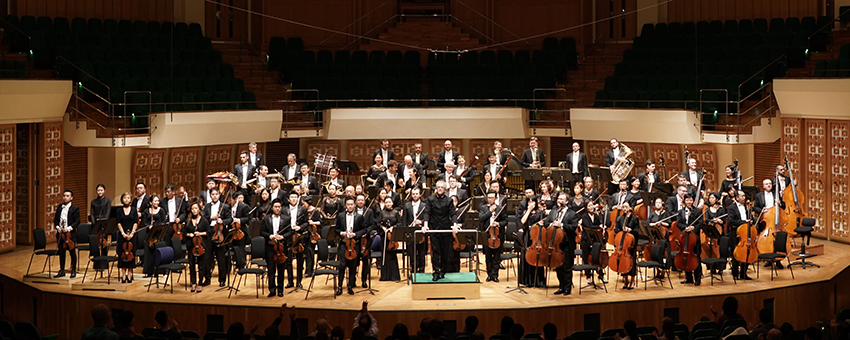
Notwithstanding the characteristically sophisticated musical language, the Concerto is eminently accessible. It begins and ends in unambiguous, life-affirming C major, with a folk-like opening melody that recurs several times like an anchor of stability amid more changeable material. The orchestra, led by Osmo Vänskä, featured a large battery of percussion instruments and produced a diverse range of enchanting colours, with solo clarinetist Kari Kriikku’s many tremolo passages adding much to the often shimmering effect. He had worked closely with the composer on the Concerto and given its first performance, and it was a marvel that he played almost non-stop in this 28-minute work with apparent ease, overcoming one hurdle after another along the way, from seemingly endless series of arpeggios to passages employing advanced techniques such as multiphonics and overtone glissandi.
Kari Kriikku and the Hong Kong Philharmonic Orchestra. Photo by Christine Cheuk. Courtesy the Hong Kong Philharmonic Orchestra.
The authority with which Kriikku performed Lindberg’s Concerto was matched by Vänskä’s command over the Second Symphony (1902) of Jean Sibelius, a pioneer of Finnish musical nationalism. Vänskä has long been one of the world’s foremost Sibelius interpreters, and here, just as in his classic recordings with the Lahti Symphony Orchestra, he brought out the austerity of this music simply by not doing what the score does not expressly ask for — notably, by refraining from effecting supposedly expressive changes of tempo now and then, which many conductors do. As is crucial in Sibelius, textures were clear, climaxes were majestic and the tricky transitions between sections were masterfully handled throughout. It is a shame, however, that in recent years Vänskä’s penchant for extreme dynamics and tempi have apparently turned into a mannerism, so that the passage in the development of the first movement beginning with a steady drumbeat was nearly inaudible, and the movement marked “Tempo andante” started off at a glacial pace. Elsewhere his rendition was wholly convincing, and his imagination and insight were never in doubt.
While the progression from darkness to light in the last three movements of the Symphony has frequently been construed politically, despite Sibelius’s objections, no such interpretative controversy surrounds his best-known work, Finlandia (1900), which was also on the programme: it is a revised version of Suomi Herää (Finland Awakens), one of the pieces he wrote in protest against the process of Russification by which the Russian Empire gradually divested the Grand Duchy of Finland of its autonomous status. Under Vänskä’s baton, the tone poem’s portentous opening was unusually oppressive, its sense of threat unusually palpable. Following the section suggesting national awakening and struggle, the famous hymn tune had a tentative quality to it and sounded more like a glimmer of hope than a promise of eventual liberation — an atmosphere of uncertainty that might well have acquired an extra resonance for Hongkongers this summer.
This June, a photo circulated on social media of a small group Hong Kong-based artists, writers and gallerists standing outside the Congress Center in Basel, Switzerland. Away from Hong Kong for Art Basel and concurrent projects, they showed their support for demonstrators at home with handwritten signs decrying the proposed extradition bill. Nadim Abbas was among them; the artist was in Basel for his solo show Poor Toy at Vitrine (June 11 – August 25), which referenced the horror and banality of domesticity through sculptures including vacuum cleaners and hacked Ikea furniture.
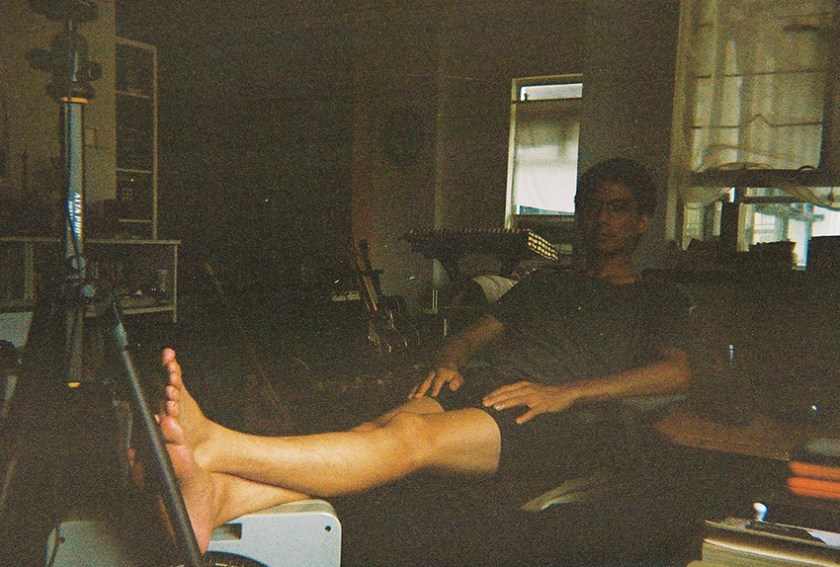
We met in July after he’d returned to Hong Kong. Abbas lives and works in a flat not far from the University of Hong Kong, where he earned his MPhil in 2006. He suggested sitting near his computer where it was brighter; the afternoon sun streamed through the windows onto wall-to-wall bookshelves – fitting for an artist who often references methodically researched science fiction, psychology and philosophy in his work – keyboards, several guitars and a piano with the lid closed. We began by talking about music.
Nadim Abbas, 2019. Courtesy Elliat Albrecht.
Elliat Albrecht: How long have you played the piano? Nadim Abbas: It’s hard to say – you could say I’ve never really played. This is my mum’s piano. I taught myself to play guitar during high school. Then my mum moved house and she couldn’t take this to her new place, so I took it.
EA: I heard you wanted to start a band with Wong Ping. NA: We’ve been talking about it, but it hasn’t happened yet.
EA: Instead he’s started a band with Man, Kwan Sheung Chi and Wong Wai Yin’s six-year-old son. NA: Yes, when I mentioned it, he [Wong Ping] said “We’ve got to get Man involved.” I asked him, “How?” I’ve never met Man properly. I’ve seen him at openings but we’ve never spoken.
EA: I think you’d get on well. He’s also deeply interested in science and makes perfectly scaled drawings of the solar system. Are you in a band now? NA: No, that’s why I wanted to try this thing with Wong Ping. I’ve had ideas for a number of different musical projects. I used to sing in a synth-pop band called A Roller Control. We were okay, but I couldn’t sing very well. If you’re in a pop group, you should at least have a good voice.
EA: Do you ever incorporate your own music into your art? NA: Let’s say that I take cues from the spirit or methodology of music-making and try to apply that to the way I do other things, such as the way I approach space and sculpture.
EA: I’ve heard a few artists extol music above other art forms recently, perhaps due to its capacity for affect. NA: I also feel that music touches people more. For me, the challenge is to take that affect and try to apply it to something that would not in its seemingly natural state move people in that way. It’s almost like trying to achieve the impossible. On the other hand, when I’m making music, I go about it in a much more analytical and methodical way.
EA: You’ve said that you think about a project or an idea for a long time before you make anything. NA: Yes, I’ve been thinking about music all my life and haven’t made much. So maybe that’s a perfect example [laughs]. All my self-initiated music projects, the ones that I dream about, I don’t know if they’ll ever happen. But there’s a sense of urgency when you involve other people: when you’re in a band, you must make decisions, you must turn up to practice and commit.
My work as a visual artist has always been more solitary, at least until recent years. Maybe it’s the influence of the musical process that’s encouraged a concerted effort to collaborate. But after a certain point, there comes a desire to go back and do your own thing.
EA: You’ve also said you tend to look back at your old work and see things that you would change. NA: There’s always an element that’s not fixed, maybe because of the way I work. It begins with a long, somewhat diffuse reflective phase, and then an imminent deadline appears. Have you been sailing? It’s like that. Sailing consists of long periods of complete and utter boredom, punctuated by moments of sublime terror.
But sometimes things get better or more focused when pushed through with such intensity; it lends a sense of spontaneity that you wouldn’t otherwise get with something ultra-planned. To return to music, I’ve always been interested in improvisation; it requires training yourself to be able to do things off the cuff. There may be a predetermined structure, but you can play within that.
EA: Your show Poor Toy in Basel this summer isn’t the first time you’ve shown in a window-like environment. There was also your exhibition Camoufleur in London (2017) and 2016 project at Holy Motors. NA: That setup is something that I’ve always been quite drawn to, because a window suggests separation. Much of my practice deals with the invisible thresholds that exist between the viewer and the art work.
Platsa Twins from the exhibition Poor Toy by Nadim Abbas, Installation view, 2019. Courtesy the artist and Vitrine, Basel.
EA: Do you try to keep the viewer out or let them in? NA: I tend to jump back and forth. The interesting thing for me is walking the tightrope; I’m always trying to balance on a very thin line.
EA: It seems that balance is something that comes up a lot in your work. NA: Yes, maybe. I’m a very indecisive person.
EA: By staying in the middle, you don’t have to choose. Every choice is a veil for a million other choices, and everything in life is made up of a million decisions that we must resolve at every single step. But one must be able to bracket oneself off from this kind of thinking, or else get trapped in paralysing immobility.
EA: “Veil” is an interesting choice of word; instead of every choice rendering another impossible, a veil implies that alternate possibilities still exist but are just concealed. NA: There are some interesting passages in Philip K Dick’s 1965 essay Schizophrenia and the Book of Changes, in which he outlines the pathology of schizophrenia. He describes it as the inability to make a choice from a series of possibilities. His solution to the problem was to turn to the I Ching, the ancient Chinese oracular text. For Dick it was a useful aid to get out of this perpetual schizoid present. He actually used the I Ching to write a few of his books, like The Man in the High Castle.
EA: I can imagine multiple futures, but find it difficult to conceptualise multiple presents. NA: Each present in which we live could conceivably be just one of many. Not necessarily someone else’s, but one simultaneous present. It’s quite terrifying, but a very plausible idea. So much science fiction – well, the kind that I like – uses these ideas. Especially Dick.
EA: Do you ever use similar strategies to help you make choices? NA: I’m inspired by these kinds of literary devices, but again, it’s somewhat like music translated into visual art; when you think about certain forms of literature and try to translate that into something like sculpture, something becomes lost or impossible. There’s this seemingly real aspect of an object that you now hold in your hands, whereas the beauty of literature is its ability to create a world with which to imagine this object.
Installation view of Camofleur at Vitrine Gallery, London, 2017. Courtesy the artist and Vitrine, London.
EA: Do you think that art objects can have literary qualities? NA: Yes, I do, but that depends on how you imagine these things. Of course one role of the artist is to try to get people to imagine. I always use the example of déjà vu, because it’s exactly the type of elusive sensation I’m interested in.
Everyone has their own trigger that leads to that moment. But of course it would be impossible to make or create anything that would automatically trigger such a response.
EA: So you don’t think déjà vu can be provoked at will? NA: No, it can’t. But I try to reverse engineer it somehow and bring that into my work. I’m not trying to trigger it, but rather trying to understand it from a psychological or phenomenological perspective.
EA: Your interest in immobility seems pertinent now in Hong Kong. Maybe there’s a sense of futility here. NA: I have asked myself how my work can be placed in the current situation. In much of what I’ve been doing over the past few years, the entry point has been figures like otaku and hikikomori: people who shun society at large, who escape into a world of their own making. But when the Umbrella Movement kicked off in 2014, an unprecedented sense of community and solidarity emerged. One needed to question the previous assumptions we had about what Hong Kong people are like. So obviously, the context has completely transformed. Whereas previously I could casually talk about my work in terms of social isolation, escapism or breaking away from the status quo, now it is these very same concepts that have undergone mutations in relation to the fractured divisions within society.
M+ Matters: Conversations on Women, Architecture, and the City Organised with the University of Hong Kong Faculty of Architecture November 23, 2019
Miller Theatre, Asia Society Hong Kong Center 9 Justice Drive Admiralty Hong Kong
#MplusMatters
M+ Matters: Conversations on Women, Architecture, and the City is a joint effort between M+ and the University of Hong Kong Faculty of Architecture, which seeks to initiate public conversations in Hong Kong on the under-represented histories and contemporary realities of women in architectural production. The discussions examine the life and work of nine women and their roles in shaping the built environment in Asia, prompting the reappraisal of criteria and methods used to assess architecture.
The series of dialogues brings together historians, editors, and educators to probe issues related to values and approaches in the practices of women architects between the 1950s and the 1980s—as well as the visibility of these practices. Conversations begin with a focus on Minnette de Silva (1918–1998), a pioneering woman architect in Sri Lanka; and Wang Chiu-hwa (born 1925), an architect known for her designs of libraries in Taiwan, who made a generous donation of a large part of her archive to M+. An examination of their work raises questions of how their histories could be constructed. Taking the editorial and curatorial work of Julia Fung and Corrin Chan as a point of departure, a further exchange of views explores the role of women as mediators in architecture. This is followed by discussions of women’s contributions to public service that focus on the work of Anna Kwong and Winnie Ho and. The challenges of women pursuing private practice as individuals and in collaborative partnerships are studied through the work of Joan Leung, Nora Leung and Joanlin Au. Invited interlocutors include the prominent scholars and practitioners Wallace Chang, Thomas Chung, Hsu Li-yu, Tariq Jazeel, Clover Lee, Cole Roskam, Koon Wee, and Marisa Yiu.
The event marks the first collaboration between a museum and a university to address this topic in Asia. It informs both institutions’ collecting and research methodologies, which take into account the non-linear narratives and fluid identities of women architects as part of an expanded and more inclusive effort for the profession.
M+ Matters: Conversations on Women, Architecture, and the City is organised by Eunice Seng (Associate Professor, Faculty of Architecture, University of Hong Kong) and Shirley Surya (Curator, Design and Architecture, M+), with Ina Wu (Research Assistant, University of Hong Kong) and Noel Cheung (Curatorial Assistant, Design and Architecture, M+).
About M+ M+ is a museum dedicated to collecting, exhibiting, and interpreting visual art, design and architecture, moving image, and Hong Kong visual culture of the 20th and 21st centuries. In Hong Kong’s West Kowloon Cultural District, we are building one of the largest museums of modern and contemporary visual culture in the world, with a bold ambition to establish ourselves as one of the world’s leading cultural institutions. Our aim is to create a new kind of museum that reflects our unique time and place, a museum that builds on Hong Kong’s historic balance of the local and the international to define a distinctive and innovative voice for Asia’s 21st century.
About the West Kowloon Cultural District The West Kowloon Cultural District is one of the largest and most ambitious cultural projects in the world. Its vision is to create a vibrant new cultural quarter for Hong Kong on forty hectares of reclaimed land located alongside Victoria Harbour. With a varied mix of theatres, performance spaces, and museums, the West Kowloon Cultural District will produce and host world-class exhibitions, performances, and cultural events, providing 23 hectares of public open space, including a two-kilometre waterfront promenade.
About the University of Hong Kong Faculty of Architecture The Department of Architecture at the University of Hong Kong, founded in 1950, is one of the preeminent institutions for architectural education in Asia and around the world. The department features an internationally recognised design curriculum in architecture, urbanism, and landscape that prepares students for the environmental, social, and aesthetic challenges of contemporary architectural practice. The department offers an accredited Bachelor’s degree programme of Architectural Studies and an accredited Master’s degree programme of Architecture. It also features Postgraduate Research MPhil and PhD degree programmes.
Nov 26 – April 2020 Opening: Tuesday, Nov 26, 6.30pm til late
Combing for Ice and Jade At the end of the 19th century, thanks to the silk trade, numerous women in southern China became financially independent. Many would wear their hair in a long braid to symbolise their autonomy until their wedding. As imperial China began to crumble and instability spread, some women took the initiative of adopting independence permanently, as Comb Sisters. The Comb Up ceremony involved a woman bathing with mulberry leaves as a fellow Sister braided their hair. They took a vow of chastity, declaring themselves free of obligations towards their parents, and would henceforth wear their hair in a long braid and dress in a light-coloured tunic and dark trousers.
Choosing to live a life independent of men was not without its drawbacks. Comb Sisters were not allowed to return home to die in their old age, so many sisterhood homes sprang up where they looked after each other, often considering each other sisters for life.
After the fall of the empire in the early 20th century, the silk trade declined and most of the Comb Sisters found themselves out of work. Many travelled across Southeast Asia to work as nannies and domestic help.
This project is a love letter to my nanny, 87-year-old Mak, who worked for my family for nearly 40 years. Denied opportunities due to her gender, she became the main caregiver to her siblings at the age of eight. In her early 20s, not wanting to be forced into an arranged marriage, she “combed up” and left for Hong Kong.
She would work for only two families for the next 55 years. Over that time, she kept her family alive through the great famine in 1950s, educated her nephews, built houses for them and supported their businesses. Yet through all this, she retained a very simple lifestyle.
Starting from the mere eight photographs Mak had of herself, the multimedia project is an exploration of her extraordinary life, working closely with her over a period of nearly seven years. Her story is slowly revealed through a combination of my own family archive, found photographs from her extended family, new photographs, Chinese ink works and women’s magazines from China spanning six decades.
The work shown here is from part of the project where the artist explores Mak’s impact on the lives of her family back home. The book closely follows Mak’s nephew Quan, who became a successful businessman with her help. Another house that was photographed belonged to Wang, also a nephew, who borrowed money from Mak to start his own cement business but became addicted to gambling and lost all his money. After he failed to pay back loans from loan sharks, they threatened to kill him and his family. They fled their home overnight in the mid-90s and never returned.
The photographs in Combing for Ice and Jade were taken within the house just before it was demolished to make way for the new high-speed railway.
From the Body to the Body Through the Body / de Sarthe Gallery / Hong Kong / Sep 7 – 21 / Vivienne Chow /
Change is the only constant in life – which is why sitting on one of the bean bags inside Wing Po So’s From the Body to the Body Through the Body could induce a warm sensation of strange familiarity and calmness in viewers. The 11-metre-long immersive installation is like a gigantic cocoon, a pit stop where one can hide and seek solace during what could be a painful process of transformation before being reborn into a better version of oneself, like a butterfly emerging from a cocoon or a phoenix rising from the ashes.
From the Body to the Body Through the Body is the title not just of the monumental installation but also of the artist’s first solo exhibition at de Sarthe Gallery. The show is the conclusion of the third edition of its annual artist residency programme deSAR, which was inaugurated with Andrew Luk’s Practice in 2017. Instead of staging haphazard group shows of limited appeal during the summer low season, the gallery opens up its vast space to artists who transform it into an artist studio for two months and produce works there. The artists, particularly those based in Hong Kong, are given the opportunity to create works they normally wouldn’t have the space and resources for. If Hong Kong is determined to be an art hub, more initiatives like this are needed.
Changing States Phase3 by Wing Po So, 170 x 122 cm, 2019. Courtesy the artist and de Sarthe Gallery.
But then, do we still know what Hong Kong is determined to be? It is in the process of transformation or metamorphosis, with the city gripped by the ongoing pro-democracy protests sparked by the controversial extradition bill, which would have allowed suspects to stand trial in mainland China.
The importance of So’s monumental installation is magnified by that context. Hailing from a family of doctors of Chinese medicine, the artist grew up at her father’s pharmacy and is well versed in the language of Chinese herbs and natural resources. From the Body to the Body Through the Body, which is made out of dried corn silk, is a continuation of the artist’s exploration of these resources. Corn is one of the most common ingredients in Chinese medicine, and the dried corn silk was manually combed and arranged during her residency to create an organic cocoon that breathes, smells and allows rays of light to seep through the woven skin.
The installation is accompanied by a series of sculptures made from clay and corncob. They appear to be prehistoric fossils, as the corncob embedded in the clay disintegrates when the piece is heated with fire, leaving traces of what looks like animals or bugs. In Changing States, a new body of work carved from a layer of plaster on board. Fictitious, prehistoric-looking sculptures might suggest a fabricated narrative of the past. But this is not static: the thread will be transformed as it goes through the cocoon. From the Body to the Body Through the Body gives viewers the time and space to contemplate the meaning of transformation. It is a force of nature and necessary at this time, no matter how painful it is.
Crisis of the Ordinary / Starkwhite / Auckland / Aug 21 – Sep 14 / Amy Weng /
Hong Kong-based artist Yuk King Tan’s Crisis of the Ordinary is an exhibition that deftly weaves together symbols of omnipresent political power and contemporary protest culture. Her first show in New Zealand in many years, Crisis of the Ordinary comes at a moment in both New Zealand and Hong Kong society when notions of national identity, civil liberties and colonial legacies have become flashpoints for opposing groups.
On entering the gallery, visitors pass by Eternity Screens, a delicate partition of latticework that signals a subtle transition into a space where meaning forms part of a global economy of exchange. Eternity Screens reveals itself to be comprised of military-grade zip-tie handcuffs, a subtle sleight of hand that sets the tone for the rest of the exhibition, where seductive forms belie social and geopolitical tensions.
Arranged on one wall are an array of brightly banded objects excavated from protest sites in Hong Kong, Korea and New Zealand. Battered water bottles, discarded sunglasses and other ephemera sit on small displayshelves alongside tools of urban protest such as safety helmets, a drone, a snorkel and a megaphone. Each item has been tightly wrapped in brightly saturated thread that pools on the ground, a sort of mummification that both conceals their functions and renders them inert. But Tan’s collecting has less to do with the preservation of relics than the alchemical process of transmutation. She demonstrates how everyday objects, bound in deeply saturated hues reminiscent of countries’ flags, can be transformed into nationalistic icons through grassroots movements and ingenuity.
Installation view of Crisis of the Ordinary at Starkwhite, Auckland, 2019.
The title of the show brings to mind the mundane, the habitual, even the banal, yet Tan’s work suggests how these sites foreground conflict and the struggle for power in disconcerting ways. Bridges, a video work that documents a quiet moment, shows protesters simply milling around. Over the course of 20 minutes, civilians and police officers come and go, umbrellas unfurl, front lines are strategically placed. Private negotiations are transacted. The scene is bustling yet orderly, like a market gearing up for a brisk day’s trade. It’s a far cry from the violent, gritty scenes that have become fixtures of international reportage. Rather, the work presents itself as an interregnum, a moment of calm between two distinct periods of power, if only metaphorically. In this quietude we begin to see emerge an ordinariness where the everyday is profoundly political.
Tan’s work reminds us that the everyday is a space continually acted on by global and capital relations. The ordinary might seem inconsequential but it is embedded with discriminatory practices – racism, sexism, intolerance – that reinforce institutional and authoritarian structures. The crisis that the artist seems to be referring to is not an endpoint but a moment in an ongoing cycle of progress and change.
There’s a faintly optimistic slant to the exhibition, although the artist refrains from stating her position too openly, which is perhaps why it doesn’t entirely connect. New Zealanders might find solace in a show that attempts to draw together the wider Asia-Pacific region through a shared struggle for self-determination, but the cleanly analytical approach keeps the audience at a distance. This is a shame, as there is so much about this show that is worth shouting about.
Dogs watching porn. A cross-dressing hustler. A woman in a yellow rain hat. Out of context, none of these photographs or their subjects might seem particularly extraordinary or groundbreaking to the innocent bystander, but together they make up part of the oeuvre of one of the 20th century’s most influential photographers, Philip-Lorca diCorcia.
The American photographer is the subject of David Zwirner Hong Kong’s latest show, a retrospective that features key pieces from each stage of his career: early, staged photographs set up to resemble reportage; the more glamorous yet highly narrative images he shot for magazines such as W; and excerpts from his acclaimed series Hustlers (1990-92), in which he paid male sex workers their usual session rate for the privilege of photographing them in situations that seem everyday. While many of these images fairly obviously hail from another era, their influence hasn’t dimmed since they were created in the 1980s and 90s.
“A lot of people were very excited, sometimes even emotional [when they heard about this show] – because this is like flipping through a textbook, but it’s the real prints,” says Leo Xu, the gallery’s director. “The community knows him; artists love his work. I’ve met a lot of young people – artists, curators, critics – who grew up with his work, with the MoMA book [the retrospective Philip-Lorca diCorcia (1995)], with the Hustlers book, with a lot of those books in their collection. And it’s a pretty rare and precious occasion to see all the works together under one roof.”
Xu is speaking about others but also himself. The gallerist, curator and writer was also at one point a photographer, and understands the gravity of diCorcia’s work from an artist’s perspective. “In China and Taiwan people are more interested in documentary photography, street photography – playing a lot with decisive moments,” he says.
“When we saw [diCorcia’s] work, it was enlightening. We thought, ‘Oh my God, you can manage lighting like this. You can take a picture that looks almost staged, but which is not.’”
He’s referring to Heads (1999), a series that diCorcia created by setting up innocuous studio lighting on the street, capturing bystanders as they strolled by. The woman in a yellow hat is one of the most iconic examples in this collection, but all of them are dramatically framed and sensuously lit.
Even more impactful on future generations were diCorcia’s staged candids, which he began executing in the 80s, using friends and family members as subjects in seemingly everyday situations.
“He’s one of the very foremost artists who liberated the photography practice,” says Xu. “People had this firm belief that street photography has to be spontaneous, it has to be candid, but then in the late 80s and early 90s, a new generation – like Cindy Sherman, like Jeff Wall – they found a new language, a new path with photography. They wanted to stage, they were deeply inspired by theatre and cinema, but with a lot of theory. I feel [diCorcia] emerged with the capability of merging two camps, the candid shots and the highly conceptual, staged pictures.
Installation view, David Zwirner Hong Kong, 2019. Courtesy the artist and David Zwirner
“So in his early body of work – the pictures he produced, mostly in his house, in the late 80s, and the Hustlers project he staged and photographed in Santa Monica – they’re very human and carry an air of reportage photography, of photojournalism. But at its core, everything is deeply planned and carefully staged, and you can see how he manipulates light, and I feel that had a big impact on a few generations to come. If you look at Jeff Wall, it’s very much about diving deep into art history and translating one picture to another. Cindy Sherman plays a lot with déjà vu, between Hollywood pictures and similar compositions. But [these artists] are not immediately confronting themselves with everyday life. So the whole idea of [fine-art photography] being everyday has so much to do with diCorcia.”
Many of today’s celebrated western photographers openly cite diCorcia as an influence, such as art-world darling Alex Prager, whose crowd scenes are staged to carry an air of the synthetic but also an element of the organic; and who, like diCorcia, dabbles in the world of editorial, crossing back and forth between commercial and fine art, and cross-pollinating as she goes.
From Asia, Xu counts artists such as Chen Wei and Pixy Liao among those who’ve drunk the diCorcia Kool-Aid. “The way [diCorcia] managed those sitters, those styles, it’s so impeccable; it’s too good to be true,” says Xu. “That has been inherited by a lot of young photographers, especially in Asia.”
A Chinese artist who dabbled in sound before experimenting with photography and other media, Chen also stages his set-ups, including his famed series of nightclub scenes showing how China’s youth uses hedonism as a surrogate for dreams unattained – in fact, he asks his actors to strive for fakeness. Liao, on the other hand, is best known for her Experimental Relationship project (2007-), in which she creates portraits showcasing herself and her Japanese boyfriend in situations atypical for heterosexual couples that question the boundaries of relationships – a project whose purpose is not, she says, documentation. Though these photos are a world away in terms of style and substance, they too use the human body as a prop, and also recall the bold subject matter of Hustlers, which was created by diCorcia using the same staged mechanisms in the early 90s.
The David Zwirner show contains a few pieces from his editorials for W, but lacks his commercial work for clients ranging from Fendi and Bottega Veneta to South Korean department store Shinsegae, which would have showcased his other vein of influence, on the fashion world. “He transformed people’s vision in the fashion business, so when the show was announced, I got the most interest, buzz and conversation from people working in fashion and publishing,” says Xu. “At that time people were trying to push forward the photographic vocabulary, like what else can you do if you’re doing a product picture, if you’re doing an Ikea campaign? Remember those amazing photo series that Benneton did for their campaigns and Diesel did once in a while – very human photo campaigns – [diCorcia] was ahead of those alternative pictures; he was the foremost pioneer to experiment with a new methodology.”
DiCorcia’s work also has powerful resonances for Xu himself, dating back to 2009, eight years before he shuttered his own gallery to join David Zwirner as its Hong Kong gallery director. “It was my frist time in New York visiting David Zwirner,” he says. “DiCorcia’s Thousand [a series of 1,000 Polaroids displayed in a single row across the length of the gallery] was being shown. This exhibition didn’t simply change my perspective in terms of style of photography; it changed how I thought about present-day exhibitions and curation.”
Founder and CEO of the M Restaurant Group Michelle Garnaut talks about three of her favourite pieces in her collection.
One of my first pieces of art was Yau Leung’s Dai Pai Dong 1960. It was a present from my brother-in-law in the late 90s. The photograph came with a catalogue of Leung’s works from the 60s and 70s. My brother-in-law got to know Yau Leung while working with [graphic design pioneer] Henry Steiner. Asking my brother-in-law about the piece again for this article, I discovered that the photograph was printed by Leung himself. Dai Pai Dong 1960 is a such classic Hong Kong scene, looking down at a dai pai dong with everybody sitting around tables eating.
Dai Pai Dong by Yau Leung, 28.8 x 24.5 cm, 1964. Courtesy the artist and Michelle Garnaut.
My first encounter with Yeung Tong Lung was when he painted the murals at my former restaurant M at the Fringe, which opened in 1989 at the Fringe Club. Not being able to make a living from his art meant he had to take on commercial work and in this case he recreated Michelangelo nudes. About 10 years later I went to his studio in Kennedy Town to view his enormous canvases and triptychs of local scenes that often show a perspective looking through a window or door, or standing at an elevated position. I instantly fell in love with the moderately sized Restaurant For Sale Or Rent (2003). There is a bored-looking guy at a desk, like a sleazy real-estate agent in a closed-down dai pai dong, blue lino flooring, and stairs leading up to a very typical mezzanine floor – an honest depiction of Hong Kong life.
Restaurant For Sale Or Rent by Yeung Tong Lung, Oil on canvas, 213 x 103 cm. Courtesy the artist and Michelle Garnaut.
I got to know Antonio Mak Hin-yeung when I first came to Hong Kong in 1984. I was working at a restaurant called 97 and when I took over operations a year later, organising monthly exhibitions was part of my job description. I agreed to the part-time curator responsibility on condition that I could show Antonio Mak. Antonio and I became friends and we hung out at the haunted house in Wan Chai where he used to live at the time. After I opened M at the Fringe and made a bit of money, I went to his studio to buy some pieces. I picked a female sculpture which he was reluctant to sell but eventually did. He hardly did females. I got several pieces in the end, mostly for the restaurant; one of my favourites, which is sitting on my desk, is Remanence I & II.
Remanence I & II by Antonio Mak Hin-yeung, Bronze, 16.4 x 18.6 cm, 1993. Courtesy Michelle Garnaut.
What is the future in the past? And what is the past in the future? / Zilberman Gallery / Berlin / Sep 5 – Nov 9 / Angelika Li /
What is the future in the past? And what is the past in the future?, the first solo exhibition in Berlin by Hong Kong multimedia artist Isaac Chong Wai (b.1990), at Zilberman Gallery, features the debut of his new work pietas (2019). In the work, performers Saori Hala and Nobutaka Shomura re-enact four postures based on iconic biblical images, including references from Michelangelo’s Pietà (c.1498-1500) and German artist Käthe Kollwitz’s Mother with her Dead Son (1937), which commemorates the victims of war and tyranny.
Pietas, 2019, performers: Saori Hala, Nobutaka Shomura. Courtesy the artist and Zilberman, Istanbul/Berlin.
The performance prompted contemplation of human vulnerability, violence and humanity. Emotions and empathy were intensified by the long, static postures and dramatic facial expressions of the two performers that froze the room in absolute stillness, creating a collective moment to mourn, meditate and pray. The strategy of the piece recalls Yvon Chabrowski’s video work Afterimage/Protest (2013). But Chong devised a confrontational dichotomy in two of the re-enactments by shifting the gender roles, creating scenes where the dead mourn the living. The piece also referred extensively to recent images of injured civilians and protestors from Hong Kong, echoing Chong’s previous video work Rehearsal of the Futures: Police Training Exercises (2018), which now seems prophetic for the city while at the same time demonstrating how history keeps repeating itself.
As a sequel to The Silent Wall (2014), in which the artist tried to cover the bullet holes on a wall in Sarajevo, Bosnia, in May and June this year he conceived The Silent Wall – Berlin (2019), using his hands to cover the scarred walls of Berlin, as if he were trying to heal these forgotten wounds from wars. These voids that serve as memories were cast into fragile glass sculptures in his installation Missing Space (2019): each piece, mounted with a GPS number giving its location, is covered by a fragile sheet of glass not level with the base. The sculptures provide a powerful sense of instability, as if they could collapse at any second, highlighting the brutality of physical wounds and at the same time the mending and commemoration of them. Each piece encapsulates and preserves human memory and history that might well disappear with the city’s rapid development. These works are not a direct response by the artist to the current political situation in Hong Kong, though they embody subconsciously the many turbulent political situations experienced throughout history.
Missing Space by Isaac Chong Wai, Installation view, 2019. Courtesy the artist and Zilberman, Istanbul/Berlin.
The notions of time, memory and space are central to Chong’s performative practice, in which he appears himself. This exhibition explicitly engages with its German historical context: the artist dates a guy who later writes him a letter about their kiss during a concentration camp visit in I Dated a Guy in Buchenwald (2013); he uses his warm breath to try to blur a window in Neue Wache (2015); he holds a white flag upside down in front of a Nazi bunker in Vienna in Flakturm and the White Flag (2016). His presence prompts the audience to reflect beyond their own physical existence, and instead to contemplate their emotional and ethical existence within human memory and history, often mediated by different forms of violence.
Nadim Abbas, Bettina von Arnim, Chan Wai Kwong, Chen Wei, Cui Jie, Aria Dean, Ho Rui An, Tishan Hsu, Tetsuya Ishida, JODI, Lee Bul, Seiko Mikami, Takehiko Nakafuji, Shinro Ohtake, Yuri Pattison, Sondra Perry, Seth Price, Jon Rafman, Hiroki Tsukuda, Nurrachmat Widyasena, Zheng Mahler
From its outset, cyberpunk depicted radical technological advances—plugged-in consciousness, androids indistinguishable from people—but also worlds divided by unequal access to wealth and resources, where multinational corporations, sovereign states, hackers, and criminal underworld enterprises all manoeuvre for control. Far from having become outdated, cyberpunk’s dystopian scenes—its protagonists, networked and yet isolated, navigating neo-noir city streets illuminated by the glare of commerce—look like an average night on the town in 2019, whether in Hong Kong, Los Angeles, Jakarta or New York. Like so much that was once seen as “cyber” or virtual—as outside of us, a separate and distinct terrain to be explored or conquered—the realms of cyberpunk have begun to seem less like an otherworldly plane, and more of a funhouse mirror of our world, lives, and history. And yet, the more cyberpunk’s futures turn into reflections of our unremarkable, quotidian daily experiences, the more the science fiction being produced now is left in an awkward relationship with the future. Instead of forward-facing narratives, contemporary science fiction has become dominated by crisis modes and fantasies of perpetual disaster.
Inspired by 2019—the year that many iconic cyberpunk futures were set or scheduled to arrive (see Bladerunner, Akira, Running Man, The Island, and more…)—this exhibition, Phantom Plane, Cyberpunk in the Year of the Future, considers the hold that cyberpunk retains on our collective imagination. While the genre’s perspectives have primarily been explored in other genres besides art—such as film and literature, as well as animation and manga, video games, and graphic novels—Phantom Plane explores how its tropes have also bled into art and visual culture, and critically examines its fantasies and system of representation. The exhibition centres around “the meta-city”, as the cyberpunk author William Gibson called the Internet: an urban space just as virtual as it is real. Whether through spectacular panoramas of virtual mega cities, buildings or urban surfaces, or through more affective or psychological depictions of life within, the exhibition questions the ways in which the metropolis of cyberpunk has transformed from a fantastic metaphor for life in the future into an inescapable, looping present.
In some of the works on view, the city—its denizens and attendant digital spaces—linger as ghosts of past futures. Certain artists look at the city’s skyline from afar, whether representing it as spectacular, strange, or utterly ordinary; others get to know the people and machines that populate a metropolis, subverting or questioning stereotypical ways that Asian cities have often appeared in Western and Japanese science fiction narratives: artificial, neon-drenched, latently threatening. Some pieces explore the exploitative labour practices that get overlooked in our desire to imagine virtual space as a seamlessly equal playing field. Other artworks on view trace how intellectual capital flows from country to country, spreading the knotty ramifications of life in the digital age. Still others draw on our fascination with cyberpunk’s fascination with oppositional subcultures, with shantytowns and alleyways, with punk bricoleurs repurposing the electronic waste of mass consumption. For more information