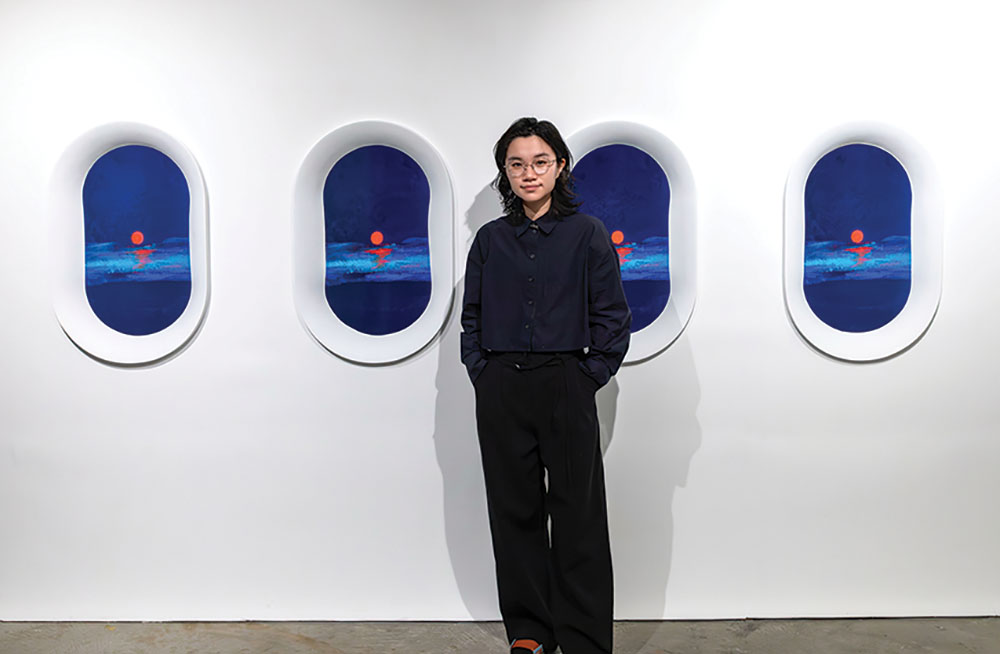
Florence Yuk-ki Lee’s practice interrogates the construction of place, memory and identity through animation, installation and drawing. Rooted in the geographical concept of topophilia, her work examines how affective bonds with specific locations are formed and unsettled amid sociopolitical change. Her recent research extends into Hong Kong’s oral traditions and folklore, using tools such as AI to reimagine collective narratives. Across her practice, Lee questions whether a fixed sense of place can be displaced by a more fluid sense of drift, a condition that speaks to broader questions of belonging, migration and cultural continuity.
Caroline Ha Thuc: Your work seems deeply rooted in the concept of topophilia – the love of place – as defined by geographer Yi-Fu Tuan. I’m curious about your first encounter with this idea. What was it about his philosophy that resonated so strongly with you and became a cornerstone of your artistic practice? Florence Yuk-ki Lee: My first encounter with this idea was through an exhibition at the Hong Kong Arts Centre [2018’s Wan Chai Grammatica: Past, Present, Future Tense, which explored Hong Kong’s cultural and artistic identity through the lens of Wan Chai district]. The concept of a sense of place resonated deeply with me and I realised that much of my work and practice had already centred on expressing the emotional connections people form with places – not only my hometown but also places I have encountered briefly or lived in before.
In many of my animations, there are no characters at all. Instead, landscapes, cityscapes and the emotions and stories embedded within a city become the focus of my exploration and expression. Yi-Fu Tuan’s philosophy helped me better articulate this instinctive direction in my practice and inspired me to further develop my work into what I see as an emotional landscape.

Courtesy the artist.
CHT: Elephant in Castle (2021), in particular, feels like a direct exploration of the Hong Kong cityscape. A rolling ball keeps moving between solid, imposing urban structures, creating a powerful tension between movement and rigidity. Could you elaborate on that dynamic and what it represents in your personal topography of the city? FYKL: The rolling ball symbolises a sense of uncontrollability – an uncertainty of life. It’s like the capsule balls inside a gachapon machine: you never know what you’re going to get. In the same way, you become like one of those balls yourself, never knowing who will pick you. The ball travels through the cityscape, moving between these rigid urban structures and reflecting a feeling of displacement, chance and instability within the city.
The title was inspired by the London Underground station Elephant & Castle. London was where I completed my bachelor’s degree, and the title came from imagining what it would mean for an elephant to live inside a castle. On the surface, it sounds like something beautiful. But if an elephant were really forced to live inside a castle, would it actually be happy?
For me, that image becomes a metaphor for urban life and systems of aspiration. Spaces that appear grand, secure or desirable can also feel restrictive and unnatural for the individual inside them.
CHT: Your work consistently returns to the imagery of childhood – playgrounds, toys and bubbles. What do these symbols represent for you beyond simple nostalgia? FYKL: These images come from personal memories that carry both tenderness and discomfort at the same time. I’m interested in the emotional complexity of childhood – how certain memories can appear playful or innocent on the surface while also containing feelings of vulnerability, loneliness or confusion underneath.
Playgrounds, toys, bubbles and other childlike symbols become a way for me to approach those emotions indirectly. They function almost like emotional containers, holding traces of an inner world that is difficult to articulate directly.
Over time, my relationship with these memories has also changed. In earlier works, I think I was trying to reconstruct or hold onto fragments of the past. But gradually, the process has become less about revisiting childhood itself and more about understanding how these memories continue to shape my emotional landscape and perception of the present.
CHT: Given the significant changes in Hong Kong over the past few years, your own perception of place must have inevitably shifted. How has this evolution in your personal feelings towards Hong Kong been transcribed into your artistic practice? FYKL: In Elephant in Castle, my focus was more closely tied to my emotional connection with Hong Kong during a period of instability and isolation. The work reflected a personal and sentimental response to the city I grew up in – a feeling of navigating unfamiliar emotional conditions within spaces that were once deeply familiar. The cityscape became both a physical environment and a psychological landscape shaped by tension, uncertainty and displacement.
In my more recent project, Double Blue: An Altered Fairy Tale of Hong Kong (2026), that relationship with place has shifted further into a more fragmented and speculative space. Rather than directly responding to the city itself, I became more interested in ideas of searching – searching for happiness, hope or emotional grounding within states of transition and ambiguity.
The narrative in this newer work is darker, more experimental and intentionally open-ended. It was also my first time exploring the idea of collective animation-making, which allowed the project to move beyond my own personal narrative into something more shared and plural.
I think the shift from my earlier works to the recent projects reflects a movement from documenting emotional attachment and loss toward constructing alternative psychological landscapes – spaces that feel suspended between reality and imagination, familiarity and estrangement.
CHT: Tell us more about your current research into fairy tales: is it true that there are no local tales for children? FYKL: When we look into Hong Kong’s cultural history, we find myths and folklore, not traditional fairy tales. Classic European fairy tales exist in idealised settings to teach morals to children. Hong Kong’s oral traditions evolved differently, rooted in survival, community and nature’s realities.
Even the seoi seung yan [boat dwellers] tell stories grounded not in whimsy but in protection and spiritual survival – deities like Tin Hau or legends of the Lo Ting serve as origin stories, not bedtime lessons.
These tales were for the whole community, to ground identity and reflect on history. But as Hong Kong underwent rapid changes, many oral histories were displaced or lost.
That void fascinates me. It opens a speculative space to ask: how can we use our folklore, landscapes and AI collaboration to invent a new fairy tale for Hong Kong today?

Courtesy the artist.
CHT: Could you walk us through your process of working with AI? What drew you to using this technology and what kind of material did it help you unearth? FYKL: AI functioned more as a collaborator and research tool during the scriptwriting process. After gathering material, I worked with writer Jess Lau to further develop the script.
What interested me was AI’s ability to connect different layers of cultural information, local flora and fauna, climate, oral histories, folk tales and Chinese mythology. Based on that research, I asked the AI to generate an original Hong Kong fairy tale, inspired by The Pied Piper of Hamelin but reinterpreted through Hong Kong’s own textures and atmosphere.
For me, the process was less about producing a finished story and more about using AI as a speculative tool, one that could open unexpected narrative possibilities and a relatively objective perspective, not just my own.
CHT: Did you encounter any surprises? FYKL: To be honest, a lot of what the AI generated was generic or boring – so my human collaborator, Jess Lau, did most of the script refinement. But there were a few surreal surprises. For instance, the AI imagined black bats night-touring a cave in Central. That image – wild, nocturnal creatures navigating the heart of ultra-modern Hong Kong – genuinely sparked something for us.
CHT: Why did you choose The Pied Piper of Hamelin? It’s such a dark story. FYKL: For me, it was pure artistic intuition. The moment I encountered the story in this context, I just knew it was the right fit.
Even though it is a dark tale, its underlying emotional atmosphere felt deeply resonant. The image of a collective population being lured away, leaving behind an unexpected emptiness and silence, perfectly mirrors the subtle, melancholic undercurrents and psychological suspension we wanted to explore. Sometimes, a dark archetype is the most honest way to capture a complex emotional landscape.
CHT: In Chapter 2 of the project, you rewrote multiple local tales together with the audience. How did the outcome differ from your version? FYKL: We opened up a collaborative space where multiple alternative fairy tales can emerge at once. Inspired by Chapter 1, the audience and students stepped in to rewrite the narrative and give the story a new ending through a collective animation-making process.
The key difference is one of perspective. My own version is highly solitary, intuitive and close to my personal visual sensibilities and memories of the city. It is a specific psychological landscape.
The collective versions offer a beautiful unpredictability. By inviting the public to construct new endings, the work fractured into fragments of multiple voices. Where my framing leans heavily into a structured state of emotional suspension and open-ended transition, the collaborative versions brought in immediate, diverse traces of the public’s own everyday hopes and vulnerabilities. The outcome wasn’t a single, rigid text but a shared, fluid ecosystem of images – allowing the project to move beyond my own history and become a living reflection of how we collectively navigate Hong Kong today.

Courtesy the artist.
CHT: The tales you’re presenting seem to unfold across two distinct realms: the sea and the sky. Do you have a personal connection to the sea? FYKL: Growing up in Hong Kong, the ocean has always been part of my life. Beyond that, the sea shapes the city’s rhythms – from food and climate to typhoons that suddenly suspend everyday life.
More importantly, the sea became a central element of the project because of the curator, Danson Wong. He comes from a fishing family background, and his family have lived on the sea for generations. He belongs to the last generation of the seoi seung yan before his family eventually relocated onto land. Later, he also moved to Taiwan, which is itself an island.
I think this shared relationship with island geography and the sea created an important emotional foundation for the project. In the work, the sea becomes more than just a physical setting – it also represents movement, transition, memory and a sense of drifting between different states of belonging.
CHT: For the animation installation, you’ve placed the viewer within a space surrounded by buoys and fishing nets. How does the physical installation change or deepen the experience of the animated narrative? FYKL: I wanted the audience to feel physically immersed within the atmosphere of the animation installation, rather than experiencing it as something distant or purely screen-based.
The fishing nets themselves were handmade by Danson Wong’s father. He had not made fishing nets for many years after his family left life at sea. In a way, the nets carry traces of memory, labour and a disappearing relationship with the ocean.
The installation design combines these fishing materials with visual references to playground structures and childhood toys. For example, the bouncing balls trapped within the nets resemble both fishing floats and children’s play objects. I was interested in creating a tension between playfulness and entanglement – something that feels familiar and light on the surface yet also constrained or suspended.
CHT: I have long been intrigued by your series of colourful resin bubbles. They look like preserved specimens, as if a moment of childhood has been trapped inside. Can you talk about the origin of this idea? FYKL: I think that reading is very close to how I feel about the works as well – as if a fragment of childhood has been sealed and suspended in time.
This series developed gradually across several projects. In my first solo exhibition, Broken Heart Pieces Disco Ball (2023), I began by placing bouncing balls inside illuminated gachapon-like machines. The bouncing balls already carried associations of chance, play and emotional unpredictability, which later became recurring motifs in my practice.
Later, in my second solo exhibition, Let It Sprout Beneath My Skin (2024) at Artside Gallery in Seoul, I started dismantling and reinterpreting the bubble-shaped windows commonly found in playground slides. I became fascinated by these translucent surfaces – they function almost like small portals or viewing devices connected to childhood memory.

Courtesy the artist.
CHT: In Where Sight Sinks into Starlit Eyes (2025), the perspective from an aeroplane window makes Hong Kong appear to float, almost unmoored. I felt a similar sensation of drift in your earlier work You built a home in my mind (2023). Is this sense of floating or drifting something you’re intentionally trying to evoke? FYKL: I didn’t intentionally set out to suggest drift or displacement, but I find that interpretation interesting. Looking back, I can see how a sense of floating appears across different works.
Inspired by [Syrian poet] Adonis’s poem Between Your Eyes and Mine (1961), I transformed a line about drowning eyes into a visual narrative on the emotional and mnemonic dimensions of flight. The work is an animated installation modelled after an aeroplane window, [putting viewers in the position of] passengers. Through a first-person view, we ascend through clouds, glide above cityscapes and arrive somewhere unfamiliar. For me, flight becomes a suspended state of contemplation – asking: where are we headed? The eye looking outward also turns inward.
I was interested in the experience of first encountering a place from above, before physically arriving there. Often, our first impression of a city or country happens through the view from an aeroplane window – from the sky, at a distance. For me, the aeroplane window functions almost like an eye: a moving gaze suspended between departure and arrival, memory and anticipation. What we see from above is not just landscape but emotional geography held in suspension.
The animation ends with an endless looping runway – the plane taxiing without fully departing or arriving, a journey that keeps circling between chance, movement and waiting.
CHT: Your animations are created digitally, drawn on a computer. Can you tell me about your entry point into this medium? What are the challenges and, conversely, the freedoms that digital drawing offers you as an artist? FYKL: I first discovered digital animation during college, where the moving image was my area of specialisation. At that time (the late 2000s), digital media was becoming increasingly prominent.
One of the biggest freedoms of digital animation is its flexibility. It allows me to make changes, edits and adjustments much more easily throughout the process, which also reduces the physical workload a lot compared to more traditional animation methods. That fluidity is important for me because my works often evolve intuitively while I’m making them. I’ve always approached animation primarily through movement and imagery rather than through conventional storytelling. For me, animation is almost like a moving painting.
At the same time, I’ve also become increasingly interested in the textures and imperfections of analogue processes. In my recent work Where We Drift Until the Sea Forgets Us (2026), I began exploring hand-drawn animation as part of the process, later combining it with digital editing. I was interested in how analogue marks carry a different sense of intimacy, fragility, materiality and physical presence.
Rather than seeing digital and analogue approaches as opposites, I think I’m interested in the space between them – how digital tools can create fluidity and experimentation, while hand-drawn elements retain traces of touch, memory and human gesture.

CHT: Finally, music and audio play a crucial role in setting the emotional tone of your animations. How do you approach this dimension of your work? FYKL: For Where We Drift Until the Sea Forgets Us, I collaborated with Sky Kung from Lucid Express on the music composition. We wanted the sound to feel almost spiritual and ritualistic – something resembling the atmosphere of a ceremony or procession; for example, Tin Hau temples during ceremonies or festivals. The melody was loosely inspired by the archetype of The Pied Piper of Hamelin and the idea of imagining an altered fairy tale of Hong Kong. In this imagined narrative, the pied piper figure seems to lure or guide all the fish away from the sea, leaving behind a strange emotional emptiness and silence.
Rather than directly narrating the story, the sound functions more like an invisible current moving through the work, carrying feelings of longing, drifting, uncertainty and collective movement. It creates an emotional space that extends beyond the visual imagery itself.
李鈺淇以動畫、裝置與繪畫為創作媒介,探究地方、記憶與身份如何構成。她的作品植根於地理學的「地方感」概念,審視人類在社會政治變遷之中,如何與特定地方建立深厚的情感連繫,以及這些連繫如何被動搖。她近年的研究延伸至香港的口述傳統與民間傳說,並借助人工智能等工具,重新構想集體論述。李氏在創作中質疑,對地方的固有親切感,能否由更流動的漂泊意識所取代,這種狀態亦帶出歸屬感、移居與文化延續等更廣闊的命題。
CHT:你的作品似乎深深植根於地理學家段義孚所界定的「地方感」。你最初如何接觸這一概念?段氏的思想何以能引發共鳴,並逐漸成為你藝術實踐的基石?FYKL:我最初是在香港藝術中心的展覽中接觸到這個概念〔2018 年的「灣仔文法:過去、現在、未來式」;展覽以灣仔區為切入點,探討香港的文化與藝術身份〕。「地方感」令我產生深刻共鳴,也使我意識到,我的作品與創作實踐,其實有一部分早已圍繞人與地方之間形成的情感連繫——不僅關乎我的家鄉,也包括那些我曾短暫到訪或居住的地方。
我的動畫作品中,不少甚至連人物也欠奉。我所探索和表達的,反而以風景、城市景觀,還有潛藏城市的情感與故事為焦點。段義孚的哲學幫助我在創作中更準確地呈現這種直覺,也啟發我進一步把作品發展成我所理解的情感景觀。
CHT:《城堡裡的大象》(2021年)是很好的例子,就像直接解構香港的城市景觀。滾球不斷穿梭於龐然壓迫的都市建築之間,在流動與凝滯之間形成強烈張力。這種動態有哪些涵義?在你的城市地貌中又象徵什麼? FYKL:滾球象徵失控感,代表人生中的無常,就如扭蛋一樣,你永遠不知道會扭出甚麼。同樣地,人也彷彿置身機內,不知道會被誰抽中。滾球穿越城市,遊走於僵化的都市建築之間,反映出都巿生活中流離失所、偶然難料、動盪失衡的感覺。
我在倫敦完成學士學位,倫敦有一個名叫「象堡」(Elephant & Castle)的地鐵站,而作品的命題靈感,正正來自我對大象棲身城堡的想像。乍聽之下,圖景似乎相當美好;然而,若大象被迫困居城堡,它會感到真正的快樂嗎?
依我看來,城堡中的大象就是都市生活與抱負機制的隱喻。那些表面上富麗堂皇、守衛森嚴或令人神往的空間,對置身其中的人而言,也可能令人備受束縛、感到渾身不自在。
遊樂場、玩具與泡泡等童年意象一直貫穿你的創作。除了喚起懷舊之情,這些符號還寄託了甚麼?FYKL:這些意象源於個人記憶,交織著溫柔與不安。我感興趣的,是童年時的複雜情感:某些回憶表面看似充滿玩味或天真,卻每每隱藏著脆弱、孤獨與困惑。
遊樂場、玩具、泡泡,和其他童真的象徵,讓我可以從旁靠近那些情感。這些符號近乎情感的容器,盛載著心內難以直說的痕跡。
久而久之,我與這些記憶的關係亦有所轉變。我在較早期的作品中嘗試重構或挽留往昔碎片。然而漸漸地,創作過程不再只是重訪童年,而是明白童年往事如何塑造情感景觀和感知當下的方式。
CHT:香港近年經歷重大變遷,你對這座城市的感知想必亦隨之轉變。這些個人感受的變化,如何體現於你的藝術實踐之中?FYKL:在《城堡裡的大象》中,我的焦點較貼近在動盪、孤立時,自身與香港的情感連繫。作品是我對這座土生土長城市有感而發的回應:在曾經無比熟悉的空間,探索陌生的情緒處境。城市地貌一方面是實體環境,另一方面是緊張、不確定和流離失所交織而成的心理景觀。
在我較近期的《雙重藍:香港異童話篇章》(2026年)中,這種地方關係已移向更為破碎與推想的空間。我不再直接回應城市本身,而是探討「尋找」的觀念——在過渡與模糊的狀態中尋找快樂、希望,或情感的依靠。
新作品的論述更幽暗、更具實驗性,並刻意不設既定答案。這亦是我首次探索集體動畫創作,讓作品從個人敘事走向更兼收並蓄的多元形態。
我認為,我的早期作品以記錄情感依附與失落為主,然後逐步改變,近期計劃的方向是建構其他心理景觀,創作懸置於現實與想像、熟悉與疏離之間的空間。
CHT: 請分享你目前對童話故事的研究:香港真的沒有本土的兒童故事嗎?FYKL:香港的文化史上可以找到神話與民間傳說,卻鮮有傳統童話。歐洲的古典童話透過理想化的背景向兒童說道德、講教訓。香港的口述傳統的演化非常不同,植根在維生、社群與大自然現實的概念。
就連水上人的故事也並沒有建基於奇想,而是關乎庇佑與精神存續:主角包括天后和其他神祇,也有盧亭的傳說,是族群起源的故事,而不是臨睡前說教訓。
這些故事屬於整個社群,既是身份認同的根基,也是歷史的反思。然而,隨著香港經歷急速變遷,許多口述歷史亦已散佚。
我覺得那種空缺很有意思,是新的推想空間,促使我們自問:如今,我們可以如何運用本土民間傳說與地景,配合人工智能,為香港創造嶄新的童話?
CHT:可否詳述你與人工智能協作的過程?這項技術對你有何吸引力?在它的協助下,你發掘了哪些題材?FYKL:在劇本創作過程中,人工智能所發揮的作用,更近似協作者和研究工具。蒐集素材後,我與編劇劉清華一同開發劇本。
令我感興趣的,是人工智能有能力連結不同文化資訊層次,包括香港原生的動植物、氣候、口述歷史、民間故事和中國神話。我以這些研究為基礎,要求人工智能生成一則原創的香港童話:以《花衣魔笛手》為原型,再以香港的脈絡與氣氛重新詮釋。
對我來說,創作過程的重點不在於製作出完整故事,而是把人工智能視為推想工具,藉此開啟意想不到的敘事可能,並引入相對客觀、不囿於我個人經驗的視角。
CHT:過程中可有遇上甚麼意外或驚喜?FYKL:坦白說,人工智能生成的內容難免籠統甚至沉悶,因此,劇本的細緻修訂主要由我的人類協作者劉清華完成。不過,當中也有過幾次超乎現實的驚喜。例如,人工智能想像黑蝙蝠在中環的洞穴夜遊。畫面中的夜行野生生物在香港的超現代心臟地帶飛翔,的確為我們觸發了靈感。
CHT:為甚麼選擇《花衣魔笛手》般黑暗的故事?FYKL:我覺得那純粹出於藝術直覺。我在這種情景下接觸到故事的一刻,便知道它最為契合。
儘管故事有其陰暗一面,內裡的情感氣氛卻令我深感共鳴。一整批人口被誘拐,徒留無法預計的虛無與寂靜,恰好映照我們希望探索的,微妙而憂鬱的暗流,還有心理懸置。有時候,暗黑的原型反而最能如實捕捉複雜的情感景觀。
CHT:到了計劃第二章,你與觀眾共同改寫了多個本地故事。最終成果與你的版本有何不同?FYKL:我們開闢了新的協作空間,讓多個另類的童話得以同時出現。觀眾與學生在第一章啟發下介入其中,透過集體動畫創作過程將敘事重寫,並為故事帶來全新結局。
主要差異在於視角。我的版本高度孤獨、依循直覺,並緊貼我本身的視覺感性和城市記憶;是一幅特定的心理景觀。
集體創作版本則營造出美麗的不可預測性。透過邀請公眾建構新的結局,作品分解成各式各樣的聲音碎片。我的框架傾向結構化的情感與開放式過渡;協作版本則引入了公眾日常的希望與脆弱,帶來貼身而多樣痕跡。創作成果不再是單一而僵化的文本,而是由影像構成、共有和流動的生態。創作計劃超越了我自己的過去,活生生地呈現人們對現今香港的同感。
CHT:你表達的故事似乎橫跨兩個截然不同的領域:海與天空。你是否對海有特別連繫?FYKL:我在香港長大,海洋素來都是我生活的一部分。除此之外,海也塑造城市的節奏:從食物與氣候,到驟然令日常生活暫停的颱風。
海之所以成為計劃的核心元素,亦與策展人黃銘樂有著莫大關係。他出身漁民家庭,家族世代以海為居,是一家人最終「上岸」之前最後一代的水上人。其後,他亦移居另一個海島:台灣。
我認為,我們與島嶼與海洋之間的共同關係,為計劃奠定了重要的情感基礎。在作品中,海不只是實體背景,同時代表遷移、過渡、回憶,也是象徵不同歸屬狀態的感覺。
CHT:在動畫裝置中,觀眾置身被浮泡與漁網環繞的空間。這一實體裝置如何改變或加深觀看動畫敘事的體驗?FYKL:我希望觀眾能感到實實在在地沉浸於動畫裝置的氛圍中,而不是把它看作遙遠、或純粹存在於螢幕上的影像。
漁網由黃銘樂的父親親手編織。自一家告別水上生活後,黃父已多年未有織網。某程度上,漁網承載著記憶與勞動的痕跡,也見證著逐漸消逝的人海關係。
裝置把捕魚物料,與遊樂場結構和童年玩具的視覺語彙融合。例如,困在網中的彈彈球,既像漁網浮子,也像兒童玩物。我希望在玩味與糾纏之間營造張力,造出表面上的熟悉和輕鬆,其實暗喻著受制和懸置。
CHT:一直以來,你那些色彩斑斕的樹脂泡泡都令我深深著迷。它們貌似標本,彷彿將童年的某一刻封存定格。可否談談這個意念的緣起?FYKL:你的解讀其實非常貼近我對作品的感受——就像把童年片段封存,凝結在時間上的瞬間。
此系列在幾個計劃之後逐步成形。在首個個展「碎心碎片迪斯可球」(2023年)中,我起初把彈彈球放進發光、形似扭蛋機的裝置內。彈彈球本來已令人想到偶然、遊戲和情感的不可預測性,其後亦成為我創作中反覆出現的主題。
其後,在首爾 Artside Gallery 舉行的第二個個展「Let It Sprout Beneath My Skin」(2024年)中,我開始拆解並重新詮釋遊樂場滑梯上常見的泡泡形窗,漸漸被這些半透明表面所吸引——它們儼如微型通道或觀看裝置,連接著童年回憶。
CHT:在《把我的眼睛沉入你的眼睛》(2025年)中,從飛機窗向外望的視角,令香港如同浮起,幾乎失去繫泊。你較早期的作品《心之房》(2023年),也讓我感受到類似的漂泊感。這種浮游或漂泊,是否你刻意喚起的感受?FYKL:我沒有刻意地從漂泊或流離失所出發,但這是很有趣的詮釋。回望過去,我的確看見某種浮游感在不同作品之間反覆出現。
我受到〔敘利亞詩人〕阿多尼斯的詩作《Between Your Eyes and Mine》(1961年)啟發,把關於雙眼沉溺的詩句,轉化為探討飛航旅程中情感與記憶的視覺敘事。動畫裝置作品參照了飛機窗,讓觀眾置身乘客的位置。透過第一身視角,我們穿雲上升,在城市景觀之上飛翔後抵達陌生的地方。對我來說,飛行成為懸置的沉思狀態,提出的問題是:我們正前往何方?外望的眼睛,也向內折返。
我感興趣的,是身體在抵達之前先從高空初遇新地方的經驗。我們對一座城市或一個國家的第一印象,往往來自飛機窗外的景色——從天空遠看。我覺得飛機窗的功能與眼睛非常相似:在出發與抵達、記憶與期待之間流動凝視。我們從高空看見的不只是地景,更是一幅被懸置的情感地圖。
動畫以無盡循環的跑道作結——飛機持續滑行,既未完全出發,也未真正抵達;旅程在偶然、移動與等待之間迴旋不止。
CHT:你在電腦上繪畫,以數碼方式製作動畫。可否談談最初是如何接觸這個媒介?數碼繪畫為藝術家帶來哪些挑戰?反過來說,又為你帶來哪些自由?FYKL:我在大學時期首次接觸數碼動畫,當時專修流動影像。那是2000 年代後期,數碼媒體變得越來越重要。
數碼動畫的靈活性是其中一項最大的自由,讓我在整個創作過程中更輕易地修改、剪輯與調整;大大減輕了傳統動畫製作所需要的體力負擔。這種流動性對我尤為重要,因為作品往往在製作過程中依循直覺演進。一直以來,我主要從動態與影像,而非慣常敘事處理動畫。對我來說,動畫近乎流動的畫作。
與此同時,我對類比創作過程的質感與瑕疵,也越來越感興趣。近期作品《我們漂流,直到海洋遺忘我們》(2026年)中,我開始把手繪動畫融入創作過程,其後再與數碼剪輯結合。我所關注的,是類比筆觸如何承載另一種親密、脆弱、實在與臨場的感覺。
我並不把數碼與類比視為彼此對立的方法;我更感興趣的,是兩者之中的空間——數碼工具如何創造流動性與實驗的可能,而手繪元素又如何保留觸碰、回憶與人手姿態的痕跡。
CHT:最後,在你的動畫作品中,音樂與聲音也在情感基調上扮演著關鍵角色。你如何處理作品中的音樂和聲音層次?FYKL:在《我們漂流,直到海洋遺忘我們》中,我與 Lucid Express 的 Sky Kung 合作譜寫音樂。我們希望聲音近乎靈性和帶有儀式感,令人聯想到慶典或巡遊的氣氛,例如天后廟舉行儀式或節慶時的情景。旋律大致取材自《花衣魔笛手》的原型,以及構想一則香港異童話的意念。在這種想像敘事中,魔笛手彷彿把所有魚從海中引走,留下一片怪異的情感虛無與寂靜。
聲音並不直接講述故事,更像一道遊走於作品中的無形暗流,承載著渴望、漂泊、不明與集體移動,開闢出延伸至視覺影像以外的情感空間。