Angela Su’s work flows from the intersection of science and art, where intricacy meets imagination. With roots in biochemistry and visual arts, her practice is a dance between the tangible and the ethereal, as she weaves delicate lines into intricate drawings, often unsettling and always profound. Her creations—whether on paper, in video or through hair embroidery—speak of bodies in flux, beings in metamorphosis, and the tension between control and chaos.
Su’s art explores the shifting nature of the human body, its transformations, and the interplay of science and fiction. Through her meticulous renderings of invented anatomies, she questions the certainty of the medical gaze, creating speculative worlds where bones become snowflakes, veins twist into vines, and organisms float in space, suspended in the in-between. Her hybrid figures exist in a state of becoming, fragile yet fierce, inviting us into the mystery of the body as it unravels and reforms.
In her hands, the body is a site of resistance, a vessel for transformation and a story waiting to be told. With each line, Su reimagines the universe, drawing us into a world where the boundaries of the possible stretch beyond the limits of flesh and form, offering us a glimpse of something both intimate and infinite.
Jessica Wan: Can you tell us why you decided to undertake your residency in the UK?Angela Su: From April to June this year, I participated in a private artist residency programme in north London, which partly aimed to allow artists to leave their own workshops and take a rest. Because of how busy I have been these few years, I have been constantly stressed, so it was a welcome respite. I first visited London in 2018 at the invitation of the Wellcome Collection, for a two-week residency in the Contagious Cities project that it had commissioned. The last time I was in London was to take part in Frieze London in 2019. I had good experiences both times I was there, so I have been hoping to stay in the city for a longer period.
I had planned to take some taxidermy courses during this residency, but it didn’t happen in the end. I found several places that offered courses when I was visiting in 2018 but, perhaps due to the pandemic, many of them had been cancelled. A friend told me about Get Stuffed, an old place in Islington which has been run by at least three generations. The shop is inconspicuous; its windows and door are behind bars. All visitors have to make an appointment and are only allowed to enter after ringing the doorbell.
As I got through the door, my heart began to race and my eyes widened. Taxidermy mounts of different sizes filled the 300 to 400 sq ft shop space, not in an orderly display like those of a boutique but rather like in a workshop. Through these piles of lifelike animal carcasses was a narrow aisle, with a messy desk at the end of it. I didn’t know if there was a huge workspace hidden at the back, but I imagined there was, and it was a bloody one. Apart from the ordinary mounts of rabbits, white mice and birds, there were also rarer specimens such as bears, lions and kangaroos. The shop owner told me that these carcasses were all donations from zoos and not hunting trophies. Often when an animal died in a zoo, the zookeepers didn’t know what to do, so they asked him to make taxidermy of the body. Other, more common animals were also obtained through humane channels.
The shop owner emphasised that it takes years of training and practice to become a taxidermist. Even if you know how to taxidermy one species, it doesn’t mean you’d know how to do it with another. If a piece is not properly preserved, it might collapse, rot and breed maggots. He was honest enough to tell me that, rather than taking a class on taxidermy, it’d be better to buy books and teach myself, and to practise consistently. I casually asked if I could film his work process, and he answered that his shop had been passed down for generations, the techniques were not shared with outsiders and filming the taxidermy process was not allowed. He also mentioned that many artists, such as Damien Hirst, had collaborated with him. The real human skull used in Hirst’s diamond-encrusted skull [For the Love of God, 2007] was provided by him. After just a 30-minute conversation, I felt that this shop owner was extremely professional and had a true craftsman’s spirit. But at the same time, he had a certain attitude, as if he didn’t want to entertain visitors who were there to satisfy their curiosity, let alone tourists like me. However, after a local friend explained, I learned that years ago, Get Stuffed had been attacked by an animal rights organisation, which is why the shop’s windows were protected by iron bars. No wonder the shop owner was so wary. Is it right to use animal carcasses as art pieces? I don’t really have an answer to that question. I only remember walking down the aisle in the shop, feeling as if time had frozen, as if I were walking between life and death.

JW: In a similar way to how early architectural drawings were heavily influenced by anatomical perspectives and the structural form of the human body, your works often lie at the intersection of different disciplines. How have your studies influenced your work?AS: It might be because I majored in science during university that I have always been interested in research beyond the realm of fine art. I often read books about the history of medicine or the history of technology and think about how to incorporate these discussions into my work. This time in London, I noticed that bookshops often promote books on popular science, which might have something to do with the post-pandemic times, or perhaps it was related to the widespread discussions on [subjects like] artificial intelligence in recent years. So, I took the opportunity to buy many popular science books. I love London because of its long history, including the Enlightenment and the Industrial Revolution. I was incredibly excited to see Charles Babbage’s Difference Engine in the Science Museum. The Viktor Wynd Museum of Curiosities, Fine Art & Natural History in Hackney [in east London] has a certain Victorian Gothic horror feel to it, which also fascinates me.
Whenever I visit a country, I make a point of visiting the local medical museum. I remember when I visited London in 2018, the Hunterian Museum was closed for renovations, so I was fortunate to have the chance to visit this time. I didn’t expect such a small-looking museum to have so many anatomical specimens, neatly arranged in bottles. The way the specimens are presented is different from the Natural History Museum or the Grant Museum of Zoology [both also in London], which retain a 19th-century atmosphere. Typically, historical museums of this kind only use ordinary glass, which reflects light, making it difficult for visitors to clearly view the exhibits. But the Hunterian Museum is different; it uses expensive, non-reflective museum glass, allowing visitors to get closer and view the specimens in high definition. I wanted so much to sit down and sketch right away, but the collection was so vast that I couldn’t possibly finish it all.
The Natural History Museum in London emphasises historicity, but I noticed that the explanatory texts throughout the museum often mention reflections on colonial history. Institutions like this often face historical issues, as many exhibits were acquired through unfair means during the British Empire period, either through trade or plunder. However, they openly acknowledge this history and claim to be working towards better ways to address these issues. Of course, I can’t know for sure whether the museum will truly handle these complex problems, and it’s possible that displaying these explanatory texts is already enough to avoid criticism. On the other hand, precisely because of the need to address decolonisation, artefacts that used to be part of the permanent collection at the Wellcome Collection before the pandemic [that perpetuate racist, sexist or ableist views] have been removed. This is quite disappointing. I’ve heard that these artefacts can now only be displayed sporadically in temporary exhibitions within specific contexts.

Courtesy the artist and Blindspot Gallery.
JW: What was the thinking behind the three hair embroidery pieces you exhibited in the Unravel: The Power and Politics of Textiles in Art exhibition at the Barbican Centre in February? AS: It was a very interesting exhibition, and many of the works were related to freedom of expression. Unfortunately, in February, the Barbican Centre abruptly cancelled a talk titled The Shoah after Gaza, which addressed the massacre of Palestinians in Gaza. In response, a collector called on the artists participating in Unravel to withdraw from the exhibition in protest and to support freedom of speech. I believe six artists eventually responded to this call. One thing to clarify is that the Barbican’s public programming department and its art exhibition department are two separate entities. Personally, I see this incident as a public relations and administrative disaster. The Israeli-Palestinian issue is highly complex, involving nearly a century of history and conflict. Rather than calling on artists to withdraw from the exhibition, it might have been more productive to organise a dialogue or forum on how art and cultural institutions can navigate such challenging and contentious situations.
I think the curatorial team handled the situation well, given the pressure. They placed notices in the gallery spaces vacated by the artists who withdrew, explaining the context to visitors. They respected the artists’ choices and didn’t hide any facts. Malaysian artist Yee I-Lann’s approach was commendable. She didn’t withdraw but made an intervention by displaying books on Gaza’s history in front of her work, inviting the audience to delve deeper into the roots of the Israeli-Palestinian conflict. Indeed, for artists, the dilemma is whether to let the work continue to be shown and keep the conversation about freedom of expression alive, or to withdraw as a form of protest. It’s a difficult decision. Simplifying such a complex issue into a binary opposition by demanding that artists exit or cancel exhibitions seems reductive. After careful consideration, I decided to continue exhibiting my work.
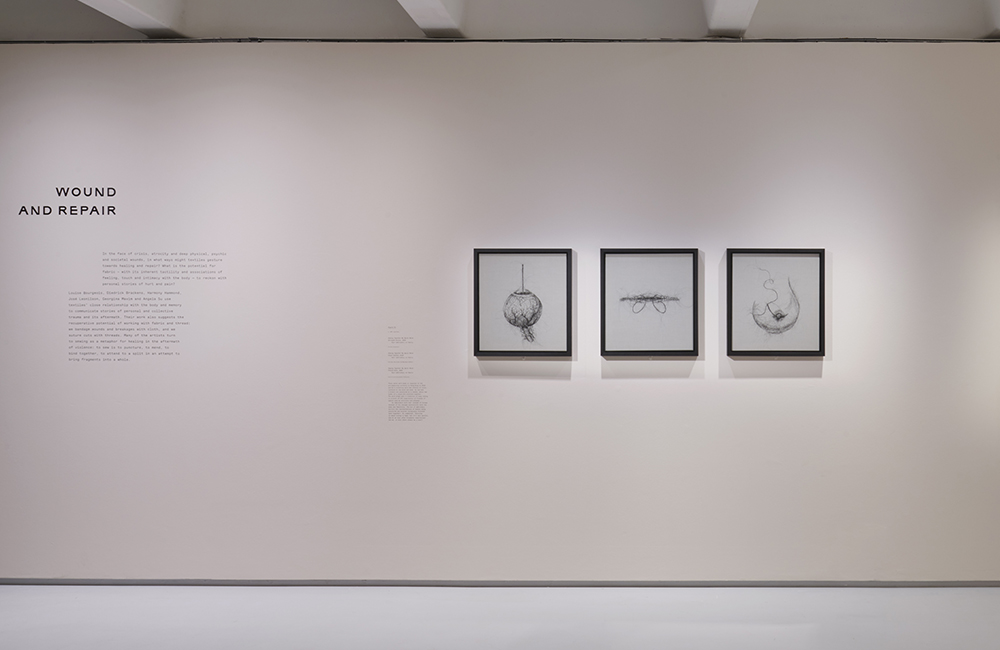
I exhibited three pieces from my Sewing Together My Split Mind: Straight Stitch series. I began this series in 2019, focusing on bodily perception and representation while exploring the trauma and healing caused by social events. The objective of stitching is to heal but the process can be incredibly painful. After trauma, how do we heal? Can we ever fully recover? Or will trauma leave permanent scars? Is it even possible to choose not to heal? The audience is free to find their own answers to these questions.
JW: After this residency, what other subjects do you want to continue exploring? AS: Probably subjects related to technology and artificial intelligence. These are popular topics in recent years but I don’t want to give the impression of jumping on a bandwagon. I’ve always been interested in science fiction and speculative literature, and these elements often appear in my work. My first solo exhibition, in 2008, was about imagining cyborgs, and my 2013 solo show explored the relationship between humans and machines. In 2015, I initiated a science fiction publishing project called Dark Fluid. The book uses science fiction to imagine the future of Hong Kong. The project invited artists, cultural workers and activists involved in social movements to participate in a writing workshop, after which each participant created a short text or visual piece. These works, along with essays and workshop transcripts, were included in the book.
Two months in London felt too short, and there were so many things I wanted to do. One of my regrets was not being able to meet with Hong Kong artists who have relocated there. Indeed, I think the topic of Hongkongers moving to the UK is worth exploring. While this isn’t part of my own research focus, I hope that in future, artists will take this up as a subject for their work.
徐世琪的作品誕生於科學與藝術的交融之中,在精確與想像的邊界上展開一場靜默的對話。她的創作根植於生物化學與視覺藝術的雙重背景,遊走於現實與幻象之間。無論是紙上描繪、影片呈現,還是通過髮絲刺繡,她的作品捕捉了身體不斷變化的輪廓,探索著存在的蛻變,並在控制與混沌之間尋找平衡。
她的藝術實踐探討了人體的流動性和不断轉化的本質,以及科學與虛構的交織。通過細膩描繪虛構的解剖結構,她挑戰了傳統醫學的凝視,開闢出一個充滿想像力的全新世界。在她的視覺語言中,骨骼如雪花般輕盈,靜脈彎曲成藤蔓,生命體懸浮於虛空,游移於現實與幻象的邊緣,呈現出一種既脆弱又堅韌的狀態,隨時準備蛻變,呼應自然的神秘。
在她的創作中,身體不再僅僅是抗爭的場域,而是變革的容器,承載著關於未來的故事。每一條細緻的線條彷彿重塑了整個宇宙,邀請觀者踏入一個超越肉體與形態界限的世界。在這個世界裡,可能性的邊界無限延展,開啟了一片既親密又無垠的境界,讓人流連其中,探尋無盡的未知。
Jessica Wan: 可以談談你當時為什麼決定會去英國做駐留嗎?Angela Su: 今年四月到六月份,我參加了一個位於倫敦北部的私人主導藝術家駐留計劃,計劃部分目的是讓藝術家有可以離開一下自己的工作環境到倫敦休養生息。由於這幾年工作繁忙,身體長期處於繃緊狀態,所以想藉機會勞逸結合。我第一次到倫敦考察旅行應該是2018年,當年獲威爾康博物館(Wellcome Collection)特別委托參與一個名為「疫症都市」的項目,因此被邀駐留兩星期,而最後一次去英國是參與2019年Frieze London。這兩次在倫敦的經驗都很好,所以一直希望可以在這城市逗留一段比較長的時間。
本來打算在這次駐留計劃期間,參加一些動物標本製作(taxidermy)課程,但最後沒有實現。我在2018年做考察的時候,打探了幾個舉辦這類課程的地方,但可能因為疫情的影響,現在很多課程已經停辦。後來朋友介紹我到伊斯靈頓(Islington)區一家已經至少有三代歷史的老店 “Get Stuffed” 。這店毫不起眼,店面門窗都被鐵欄杆圍住,而且拜訪前必須預約,按門鈴後店主才會開門讓你進入。
進去以後,我開始心跳加速,眼睛發亮。這個只有300-400呎左右的店鋪擺滿了大大小小各種動物標本,不是精品店般擺得很精緻整齊的模樣,而是比較像一個工作室的狀態。在這些栩栩如生的動物屍體中間有一條窄窄的通道,通道的末端有一張凌亂的辦公桌。我並不知道辦公桌後的門是否隱藏了一個巨大的工場,但我的腦海裡頓然呈現了一個血腥工場。除了一般的小兔、白老鼠、小鳥的標本外,這裡還有很多稀有的動物,比如熊、獅子和袋鼠。舉店主所講,這些稀有動物的遺體全都是動物園捐出,並非被獵殺的動物。很多時候動物園的動物死了,管理員不知道怎麼處理,就交給他來製作標本。其他較普遍的動物都是從合乎人道的渠道獲得。
店主強調,要成為一個動物標本剝製師需要經過多年的實踐學習。即便你學會了如何製作某一種動物的標本,不代表你懂得製作其他動物的標本。保存不當的話,標本會垮掉、腐爛,還會吸引蟲子。他誠言與其參加一般製作標本的興趣班,不如買書自學,堅持練習。我隨口問他是否可以拍攝他的工作過程,答案是他的店鋪是世代相傳,技術不傳外人,也不准許拍攝製作標本的過程。他還說很多藝術家例如達米恩·赫斯特(Damien Hirst)等等都曾經跟他合作,赫斯特那鑽石骷顱的真人頭骨,就是他提供的。經過短短30分鐘的傾談,我覺得這店主非常專業且具有工匠精神,但同時他很有態度,似乎不想招呼純粹獵奇的訪客,何況是像我這樣的遊客。但經過當地朋友解釋後,得知原來多年前,Get Stuffed 遭受關注動物權益組織襲擊,因此用鐵欄杆保護櫥窗,怪不得店主那麽有戒心。到底是否應該用動物屍體作為藝術品呢?對這問題,我沒有甚麼答案。我只記得走在店內的通道,時間似乎凍結了,就像走在生命和死亡之間。
Jessica Wan: 你剛剛提到解剖學,而早期的建築繪圖深受解剖視角和人體形態結構的影响。那麼,這些研究是怎麼影響到你的創作呢?Angela Su: 可能因為我大學主修科學,所以我一直關注非純藝術領域的研究,經常讀一些關於醫學歷史或者科技歷史的書籍,然後思考如何把這些討論融入我的作品中。這次到倫敦,察覺書店很多時候會推廣科普書籍,這可能是疫情後的現象,也可能與人工智能和量子物理學近年的廣泛討論有關,我於是趁機買了很多科普的書籍。喜愛倫敦,因爲它的歷史久遠,見證了啟蒙運動和工業革命這兩個重要年代。當我在倫敦科學博物館 (Science Museum)裡面看到Charles Babbage 的Difference Engine, 我會感到非常興奮。位於Hackney區的The Viktor Wynd Museum Of Curiosities, Fine Art & Natural History帶有多少維多利亞時代歌德式恐怖,也令我著迷。
我通常到每一個國家,都會特地到當地的醫學博物館。記得2018年到倫敦的時候,亨特博物館(Hunterian Museum)正閉館進行裝修,所以興幸這次有機會可以參觀。沒想到這看起來小小的博物館裡有那麽多一瓶一瓶的生物解剖樣本,而且樣本的呈現方法並不像自然博物館(Natural History Museum)或倫敦動物學博物館 (Grant Zoology Museum)般保持原有19世紀的風格。通常各地這類型歷史悠久的博物館一般只採用普通的玻璃,這種玻璃會反光,觀眾很難清晰地觀賞展品,但亨特博物館不一樣,它用的是不反光的貴價博物館玻璃(museum glass),讓觀眾跟展品的距離拉近,可以「高清」地觀賞展品。我當時很想坐下來速寫,但因為藏品太豐富,根本畫不完。
倫敦的自然史博物館強調歷史性,但我察覺到在館內各處的說明文字或多或少會提及對殖民歷史的反思。像這樣的機構往往有歷史問題,例如許多展品是大英帝國殖民時代通過不公平的手段獲得的,來源於貿易或掠奪。但他們公開承認這段歷史,並表示正在努力尋找更好的方式來處理這些問題。當然,我沒法知道到底博物館是否真的會處理這複雜的問題,有可能這些說明文字的展示已經足夠令博物館避免受到批評。另一邊廂,正正因為要處理去殖的問題,疫情前曾經在威爾康博物館常設展內展出的文物已經被全部收起。這令人頗為失望。據聞這些文物現在只能夠零星地在臨時展覽裡特定的語境下展出。
Jessica Wan: 記得你有三幅髮絲刺繡作品參加了 「Unravel: The Power and Politics of Textiles in Art」 這個展覽。Angela Su: 對,我被邀參與了巴比肯中心(Barbican Centre)在二月份舉辦的展覽「Unravel: The Power and Politics of Textiles in Art」。這是一個很有意思的展覽,其中有很多作品都和言論自由有關。奈何,巴比肯中心在二月份臨時取消了一個關於巴勒斯坦人在加沙被屠殺的講座(The Shoah after Gaza)。某藏家有見及此,立即呼籲參展Unravel的藝術家退出展覽,從而向巴比肯中心抗議及表達對言論自由的支持,好像最後有六位藝術家響應了。要澄清一點,巴比肯中心負責公眾項目的部門與藝術展覽的部門是屬於兩個不同的單位。這次事故,我個人認為是一場公關及行政災難,加上以巴問題複雜,牽涉起碼近一百年的歷史和衝突。與其呼籲藝術家退出展覽,不如舉辦講座對談,探討藝術文化機構怎樣可以處理和面對如此複雜兩不討好的情況。
我覺得策展團隊在這麼多壓力下對這事故處理得很好,他們在場館裡因為藝術家退出而掉空的位置放了告示,向參觀者說明事件的前因後果,他們尊重藝術家的選擇,並沒有隱瞞任何事實。馬來西亞藝術家于一蘭(Yee I-Lann)的處理方法值得一讚,她並沒有退出,但她做了一個intervention, 把一些關於加沙歷史的書籍展示在作品前面,邀請觀眾深入了解以巴衝突的前因後果。其實對藝術家來說,到底應該讓作品繼續展出來持續展覽中關於言論自由的討論,還是以退出作為抗議?這是一個兩難的決定。以要求藝術家退出展覽甚至封殺展覽來表達政治取態,似乎把複雜的問題變成很簡化的二元對立。我自己經過細心思考,決定繼續展出作品。
這次我展出了三幅屬於 《Sewing Together My Split Mind: Straight Stitch》系列的作品。這個系列是從2019年開始創作的,主要關注身體的感知與表象,並探討社會事件所致的創傷與癒合。縫合的目的是治癒,但這個過程非常痛苦。經歷創傷後,我們該如何療癒?我們真的可以痊癒嗎?還是創傷會永遠留下疤痕?可以選擇不療癒嗎?觀眾可以自行決定屬於自己的答案。
Jessica Wan: 這次駐留後,有什麼想要繼續討論的主題嗎?Angela Su: 可能是關於科技、人工智能之類的主題吧。這些都是近年熱門的話題,但我不想給人一個投機的印象。其實我一直對科幻小說及推想文學很有興趣,作品也不時流露科幻或關於科技的元素。我在2008年的第一個個展是關於cyborg賽博格的想像;2013年的個展是關於人類和機械的關係。2015年我發起了一個科幻創作出版計劃叫《暗流體》。《暗流體》這本書以科幻小說為方法,是一個探討關於香港未來想像的思考練習。這計劃邀請藝術文化工作者以及活躍於社會運動的人士共同參與一個寫作工作坊,工作坊後參與者各自創作一部短篇文字或圖像作品,連同論文及工作坊的文字記錄,一併收錄於此書當中。
其後因緣際會,我邀請了住在英國東北部的得獎科幻作家吳志麗,為我威尼斯雙年展香港館的個人作品集撰文。吳志麗年幼時已經從香港搬到英國居住,她腦袋的「轉數」很快而且很感性,也對香港非常關心。曾經一次跟她在香港一家咖啡店聊天數小時,她妙語連珠,我頓然覺得她比藝術家更有藝術氣質。我很想有機會跟她再次合作。可惜這次未能跟她會面。
在倫敦兩個月的時間實在太短,想做的事情真的很多。其中一個遺憾就是未能與移居倫敦的香港藝術家會面。其實我覺得移英港人的議題很值得討論。這不屬於我自己研究的範疇,我希望日後有藝術家可以以此為創作議題。
Jessica Wan: 的確,近年許多香港人移居英國,他們面臨不少挑戰。大多數人選擇搬到英國的二線城市,因為那裡的房租或房價比較便宜,減輕了生活壓力,也讓移民能夠享受更寬敞的空間和悠閒的生活。然而,這些城市與倫敦相比,缺乏多元文化背景,藝術氛圍較弱,且種族歧視問題更加嚴重,移民或難民可能難以融入當地社區。
相比之下,倫敦的情況要好一些,這裡的文化更加多樣化,人們比較包容和理解彼此的差異,而在其他城市,排斥移民的情況可能更為普遍。Artnet記者Vivienne Chow曾在文章中討論過去十年英國藝術產業的資金削減,加上高淨值人士的流失,這些因素都影響了藝術界的發展。除了經濟問題,種族歧視和反移民現象也日益嚴重。幾個月前,英國多個城市發生暴動,伯明翰和利物浦首當其衝,這些生活成本較低的城市,由於移民較多,成為右翼團體的主要攻擊目標。
Angela Su: 對像我一樣的香港人來說,在英國生活的確不容易,除非我非常富有,否則就要放棄很多香港的生活習慣,例如出外飲食、購物和娛樂等等。再者,英國脫歐以來,社會和政治氣氛都變得不穩定,人才和資金流失更為嚴重,很多歐洲投資者也撤資了,新移民能夠找到工作已經很幸運。
移英港人需要面對的問題的確很多。據朋友所說不少家庭因為對移民有不同的期望而發生家暴以致離婚。另外一個問題就是,他們究竟應該積極融入當地社會還是與其他港人為伴?這個問題難以回答。香港是一個單一文化的地方,關於多元文化的議題並不存在,很多港人也沒有文化差異討論的意識,對於其他族裔社群往往視而不見。聽說,有些在香港支持民主的人士,到了英國反而可能會支持保守黨,他們認為英國應該是白人國家,放鬆移民政策只會拖垮英國的經濟。換句話說,他們流露了種族主義意識,這樣的現象很值得我們深思。